Archive for April 25th, 2019

Debate Year in Review 2019

by   |  04.25.19  |  Student Awards

Contributed by: Sheila Ritchie, Director of Forensics & Debate
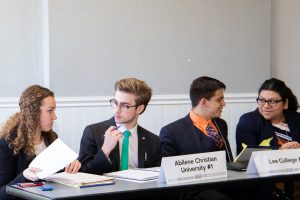
As the year comes to an end, I wanted to update you on the activities of the ACU Speech and Debate Team. Our team has had a phenomenal year of growth and success. They are a young team but they have performed in a way that should make ACU proud.
A few highlights of the year:
  • We attended 10 tournaments throughout Louisiana, Arkansas, Oregon, Texas, and Virginia. The competition included LSU, SMU, Cornell, Rutgers, George Washington, Georgetown, Idaho State, TCU and many others. We earned at least one award at every single tournament we attended.
  • Our Novice Squad ranked 11th out of 92 teams in the Nation for IPDA Debate.
  • We had students who advanced to either Octofinals, Quarterfinals, and Semi-finals in Debate at each tournament.
  • We had two students who advanced to finals in Extemporaneous Speaking in addition to their debate achievements. (Garrett Bonner and Mark Shi)
  • We had three students who won Speaker Awards in addition to their debate achievements. (Shekinah Kahongo, Elizabeth Miller, and Lexi Ritchie)
  • At the National tournament, we had two students, Elizabeth Miller and Noah Pruitt, who advanced to the elimination rounds. Elizabeth reached triple octofinals (out of 115 Novice debaters) and Noah made to quarterfinals before being eliminated. This puts Noah in the top eight Novice IPDA debaters in the nation.
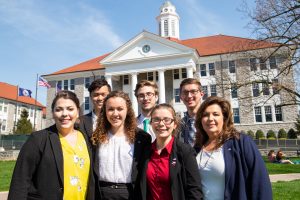
  • We also had two teams invited to the Madison Cup Invitational at James Madison University in Harrisonburg, Virginia. The competition was intense but the team of Garrett Bonner and Elizabeth Miller ranked in the top 8 teams for the tournament and in the end, they won a $500 scholarship.
At the National Tournament, I was also honored to be asked by the Executive Committee of IPDA to join the National Governing Board for the International Public Debate Association. The Governing Board consists of 7 members representing the areas of the nation that support the IPDA style of debate. Most debate coaches are male, so female coaches are the minority. On this committee, I am proud to be the second female member and the representative for the western part of Texas and the southwest part of the United States. The goal for my time on the committee will be to help spread this form of debate westward. We will begin that task by hosting a collegiate IPDA invitational tournament on ACU campus in February 2020 and possibly bid to host the National tournament in 2021.

At this point, the team is resting and getting ready for another great year. We grew from seven students in the fall to nine in the spring. We hope to welcome a few new Freshman to the team in the fall as well.  We will attend some camps and trainings this summer to sharpen our skills and get us ready for another great year.

Thank you for your support and encouragement throughout the past year. As a student debater, I was always told that the ACU Debate Team was the oldest student organization on campus so we needed to honor that legacy. I believe the team this year has done that very well and I hope we are paving a path for many years of excellence in the future. If you have any questions or would like more information about the team, please do not hesitate to contact me.

Thank you again!

Letter to Current Students

by   |  04.25.19  |  Student Awards

Dear Fellow Scholars,

The truth is, I’m not sure that anyone who would venture to pen a letter to the undergraduates of her alma mater and give them “insight” or “advice” about “what I’ve learned about the ‘real world’ since graduation” could ever possibly have a clue what she is actually talking about. The world, and thus human work and human lives, are changing at a rate rapid beyond belief. Our wildest imaginations may not be enough to predict the world of the next 10 or 20 or 50 years, which means you should probably be a touch suspicious about this quasi-life-advice-column I’m writing to you now. Permission to stop reading and go get a Bean cookie or something, it’s the end of the semester and you probably deserve it.

But, if I was going to offer you anything at all in the way of reflections on what’s stuck with me from my time at ACU, suspicion might actually be a good place to start. The world is changing faster than any concrete, “marketable skills” can hope to keep pace with, but what about those skills that require thinking like a human, not a computer? A critical, helpful suspicion is one of these skills you’ve had the opportunity to practice and refine at ACU. Why are these people in power and these people not? Why are these people rich and these people poor? Who decides who gets what? The world may evolve, but it is unlikely that the burning importance of asking these questions will leave us. I worry that there are not nearly enough people asking them.

It’s important to note, however, that one key trait in any good asker-of-hard-questions is that they are willing to turn this suspicion back to face themselves. Another word for this would be one we hear all the time at liberal arts colleges, “humility,” taking seriously the possibility that I might be wrong. At the risk of seeming didactic, I propose to you that this, humility, is actually the central mission of the “college” thing you are up to. Liberal arts colleges are, after all, supposedly “liberating.” And what is it that we need to be liberated from? I don’t know about you, but the thing I need to be liberated from pretty much every day is the easy assumption that I am Right, that the highest Truth is my own experiences, and that the most important thing is the world through my own eyes. This sounds overly dramatic, but it’s more real than it seems. Think about it—I don’t currently hold any beliefs that I think are false, otherwise, I wouldn’t believe them. This makes it incredibly easy for me to write off people who disagree with me, because, from my current view, I already have all the right answers. A suspicious critic without humility cannot hear, cannot emphasize, cannot recognize their own limitations. Only when I can break out of my automatic assumptions can I meaningfully listen, ask critical questions, stand in solidarity, go to work for the sake of justice and the other.

I reiterate. The world is changing faster than we can dream it. The problems of the future are yet unknown, as are their solutions. You are among those lucky enough to spend a few years thinking about the world, what all this means, how we might make it better.  Your best tools just might be the questions you can ask, of yourself first, then of the world as it is, and then of the world as it could yet be. And if you do, you just might figure out how to make things even just a little bit better, and in these small acts, we may just change the world.

Sincerely,

Courtney Tee