
Archive for ‘Faculty Feature’

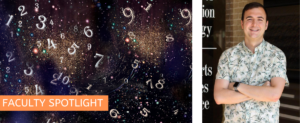
Tatum explores communication mediated through technology
by   |  01.15.20  |  Faculty Feature

1.     When did you first come to ACU?

I started at ACU as a freshman in 2009.

2.     What made you want to come to ACU?

When I was looking for colleges, I wanted somewhere that was relatively small, had lots of ways to get involved, has a Christian atmosphere, and wasn’t too far from home. It also didn’t hurt that I got a full-ride scholarship!

3.     A little bit about your journey at ACU/things you were involved in?

I started off at ACU as a vocal music education major. My whole life, I’ve loved music, so I thought being a music major would be the right path for me. Spoiler alert…. It wasn’t. For me, music was a hobby, not a career. Meanwhile, I had gotten heavily involved as a staff member at Pine Cove Christian Camps where I ended up working every summer of college. That led me to choose Family Studies and Ministry as my new major in hopes of one day working full time at a Christian camp in Texas. While a student at ACU, I was in a Social Club, started an a cappella group, led a Spring Break campaign, and was heavily involved in Sing Song. My involvement with Student Productions eventually led me to get a job working for Tom Craig and choosing to stay at ACU for my M.A. in Communication to continue working with Tom to lead Sing Song and Follies. Fast forward 6 years… Now I’ve taken over Tom’s role as the Director of Student Productions here at ACU.

4.     Where did you get your doctoral degree?

My Ph.D. is from the University of Kentucky. My specialization is Instructional Communication with focus areas in Educational Psychology and Quantitative Methods.

5.     What made you want to pursue a PhD?

Honestly, I never DREAMED I would get a Ph.D…. Much less a Masters. But, serving as a graduate assistant at ACU made me realize that I loved teaching. So, initially, I went on to get my Ph.D. because I wanted to teach. However, I soon realized that I loved research, and my love for both drove me to complete my degree.

6.     Interesting things you are working on right now? Grants received, interesting papers you’re working on, new technologies/methods you are using in the classroom?

I have some exciting research that I’m currently working on. First, I am interested in the effects of response time (i.e., chronemics) in asynchronous, mediated communication. Some of my past research has explored the interpersonal impacts of response time in instructor-student, trainer-trainee, and employer-employee email exchanges. I am currently collecting data for a study that explores the effects of response time on the perceived compatibility of partners in the initial stages of a dating relationship through both text messaging and Instagram direct messaging. Second, I am interested in exploring problems related to communication technology in instructional settings. Given the ubiquitous incorporation of technology into the classroom, my applied research in this area addresses technology-related classroom issues instructors face on an everyday basis. A recent student explored the effectiveness of classroom cell phone policies in university classrooms. In the future, I am working on a study that explores how connecting with students via social media may affect instructors’ credibility, especially for graduate teaching assistants.
Advancing Aging Studies: Interview with Dr. Macaluso

by   |  04.09.19  |  Faculty Feature, Research

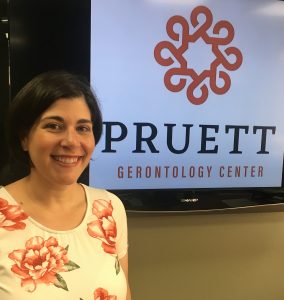
This interview with Dr. Suzie Macaluso, Director of the Pruett Gerontology Center, Associate Professor of Sociology & Gerontology, focuses on her vision for the Pruett Gerontology Center.

What are do you hope to accomplish in your new role as director?

The mission of the PGC is to “prepare today for an aging tomorrow through scholarship, service, and ministry” which means that we have a three-pronged purpose. I hope to expand our scholarship through research presentations at various conferences and publications. I’m working to expand our academic programs by creating a new introductory level course for the undergraduate minor. I’d also like to explore ways that we can expand our graduate level options. I’m also wanting to increase our visibility on campus and in the Abilene community.

How will the new space support your visions and goals?

Having a space that is more easily accessible to our older adult neighbors is an important part of meeting our mission of service. Being located in the Sherrod Building also brings us into closer partnership with the department of Communication & Sociology which will enhance our academic programs and allow for easier research partnerships.

What do you look forward to most about being in the new space?

I’m looking forward to having a space that is open and available for everyone. I want the center to be a service to the community, students, faculty and staff, and community neighbors.

What projects is the center currently working on?

We recently wrapped up the Images of Aging Photo Contest. Several students presented research on Concerns of Aging and how those vary depending on the age of the respondent. They also presented at the ACU Undergraduate Research Festival and at the Pacific Sociological Association. Our big event is the intergenerational study abroad to Germany this summer. Five generations of participants will explore the construction of public memory around the fall of the Berlin Wall.

How does the center support or integrate with sociology?

The center has an academic component in the Aging Studies Minor and the Graduate Certificate in Aging Studies. Gerontology is a multidisciplinary field focused on the biological, social, and psychological aspects of aging. The minor and certificate utilize sociology classes, like Sociology of Aging, to help students understand the social aspects of aging.

What role did you play in creating the new space?

The new space was something that Dr. Pruett and I had talked about. We wanted to better align the center with the Department of Communication and Sociology, and we thought physical proximity would be useful. I chose all of the colors and look of the new space and made sure that the space would fit our needs. The most important part was to have an exterior door that would be accessible for people in wheelchairs or using walkers.


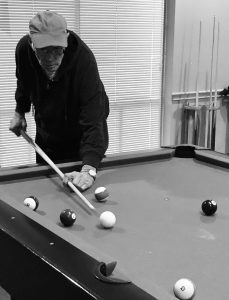
Ageless Billiards by Koby Claborn.

What ways can students be a part of the work you do?

Students can be involved in the study of gerontology by taking classes, but more importantly, they can be involved through research. We have gathered lots of data through surveys at different points in time, and I would love for students to mine that data for projects that they could present at the Undergraduate Research Festival or other regional and national conferences. Students can also be involved in the Images of Aging photo contest which takes place every fall and spring. The student who takes the winning photo receives a cash prize, and then the photos are displayed at the Undergraduate Research Festival.

Are there any other projects or research you are conducting?

I am doing research with two students on the concerns that people have about aging and how that varies along demographic lines. I am also doing research on best teaching practices for gerontology. I have some data on retirement plans of preachers that I’d like to analyze and publish. I also have some ideas for a project with Dr. Heidi Morris around sexuality and older adulthood.