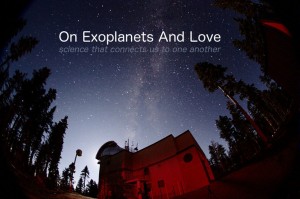
Over the weekend, the radio show On Being broadcast an episode titled “On Exoplanets and Love: Science that Connects Us to One Another.” For the show, the host Krista Tippett interviews Natalie Batalha, a research astronomer at NASA Ames Research Center and a mission scientist with the Kepler Space Telescope. You can listen to the whole interview and read the transcript on the On Being website, and I recommend it. It’s a fascinating conversation about the search for life on other planets.
 At the very least, listen to the first seven minutes. In the first section of the show, Batalha reflects on how she became a scientist. She initially studied business in college; but one day in a introductory physics class, she had an epiphany. Batahla describes what happened when her professor used an everyday example to explain light refraction:
And he’s describing this and he uses this analogy, the rainbow of color on an oil slick, floating on top of water, which, of course, we’ve all seen. It’s something so common to us. And at the same time, he’s writing down all these mathematical equations on the board, and it just struck me at that moment: my gosh, the universe is not a random collection of chaotic events. It can be explained with numbers. It can be explained with math. . . . And at that moment, I think I all of a sudden had this idea that maybe all of the mysteries of the universe are there for us to discover. Maybe there’s no limit to what we could know if the universe is so ordered. And that was very profound to me, so at that point there was no going back. . . . [V]ery quickly I did learn how to think that way, and it changed my brain in exciting ways.
Batahla describes discovering a new way to understand and explore the world. And she claims this new way of thinking changed her brain.
- Based on this short quote, what foundational convictions undergird scientific thinking?
- What do you think she means when she says learning to think this way changed her brain? Does your brain need to change?
- Do you agree that “all the mysteries of the universe are there for us to discover”?
One response to ““It Changed My Brain in Exciting Ways””
Based on the quote I think that validity and mathematical proof are essential to scientific thinking. I think that she means that she kept that door closed in her brain, and might not even have know that it was there. But now, she has the ability to keep that door open and think on a broader and wider scale. She can think in a more infinite way and there are no limits to the universe. There is order, therefore innumerable opportunities for discovery. Personally, I think there is always room for growth in every area. I don’t know if my brain would change like hers and experience the same feelings she would upon her discovery. I do agree with her that the universe is full of mysteries. I don’t think there will ever be a time where on earth we stop discovering things. There are so many things out there for us to discover and we will never stop growing and evolving.