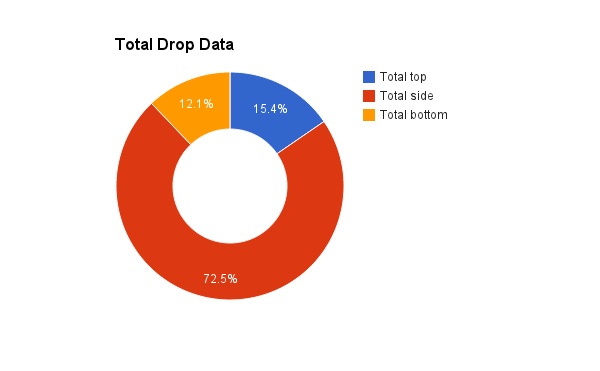
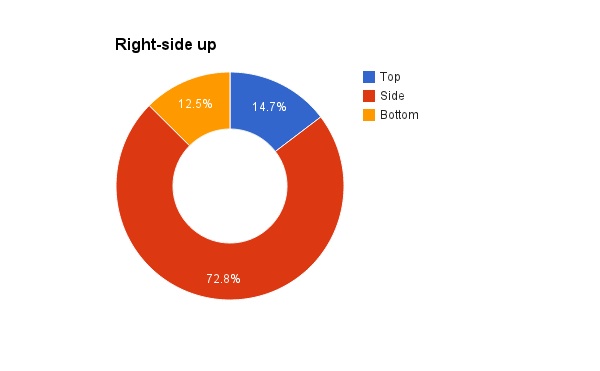
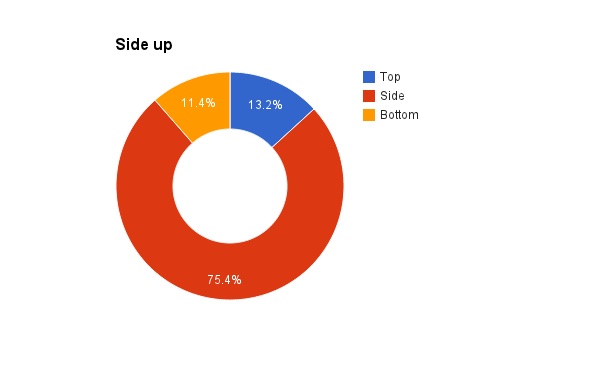
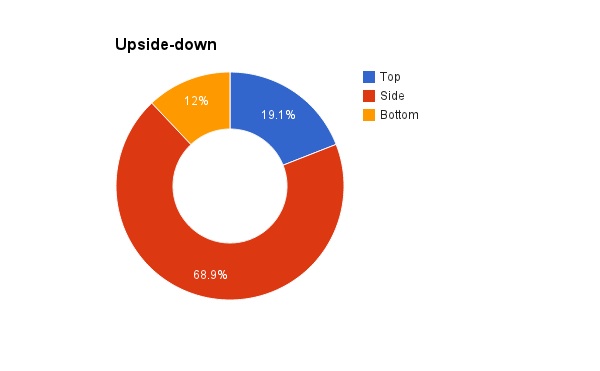
Below, you will see graphs that represent the compiled results from the “Cup Drop Experiment” that several classes conducted on Wednesday. How did the overall results compare with your class’s data? Do you need to revise any explanations?
Dr. Rusty Towell, our Spotlight speaker from Monday, looked over our results and offered the following response:
Clearly the data shows the most probable final orientation for the cup is on its side. The consistence of this result, independent of the initial orientation, suggests that the process of falling and bouncing around on the ground is random enough that the cup’s final resting position is influenced by the structure of the cup and not the initial conditions.Why does the cup land on it’s side? This is a great question and one that the current data may not be sufficient to answer. An obvious and perhaps correct answer would be that there is more surface area on the sides and this causes the cup to land on the side most often. This could be investigated by carefully trimming a cup so that the sides were shorter. Another explanation could be that most of the mass of the cup is in the sides of the cup. One problem with the trimming the sides test is that it would change both the surface area and mass of the sides. To test the effects of mass distribution on the experiment, a small amount of mass could be added to the sides and/or bottom of the cup. Perhaps a small drop of glue could be added to the side or bottom of some cups and then the experiment could be repeated.
3 responses to “Cup Drop Results”
Many hypothesized that when the cup drops it will land on its side. As the results show the cup landing on its side resulted higher then the others. So the hypothesis that was tested came out to be correct.
During our class’s cup experiment we experienced the most lands on the cups side. It didn’t matter which angle or position we dropped the cup from, majority falls landed in its side. Our results seem to match up with the other students results and most of their lands were also on its side. The total amount of lands on the top and bottom of the cup is mostly the same for all our others students results. Maybe we would receive different results if the cups size and or material make up was different. A change in variables could give us different results.
My classes results were the same as the others. The cup almost always landed on its side. If we changed to cups with bigger tops or bottoms than we might get a different result because the weight would be distributed differently.