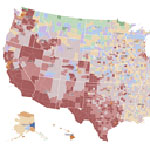
In the spring of 2009, the New York Times ran a series on immigrants and “their impact on American institutions” called Remade in America. Begin by looking carefully at two interactive maps.
In the Immigration Explorer, note the bar across the top of the map will allow you to move quickly through data by decade. Additionally, there are two menus which allow you to look at any single immigrant group either by percent of population or by number of residents. Notice that the data for many nationalities is complete while other groups contain gaps where no data is available. For example, speculate why Vietnam does not have data until 1980 or why data for China disappears from 1910 to 1970. Why might there be a spike in Polish immigration from 1940 to 1950?
Next, open the Immigration and Jobs interactive map in a different window and put these two sources into conversation. For example, you might choose to compare occupations for Chinese and Irish immigrants. Referring back to the population disbursement map, how do these occupations fit uniquely with location? The Immigration and Jobs map clearly identifies Mexico as leading most foreign-born worker categories, but what categories represent the top 10 occupations (hint: start with Find a Country)? Now switch to the Immigration Explorer to identify where Mexican immigrants are concentrated and suggest reasons for these patterns.
The NYT series includes a wealth of other resources. Before posting a question or comment of your own to the Spotlight thread, read one of the series profiles or listen to one of the audio slideshows detailing one part of this complex picture. How do these stories and statistics help illustrate the changing face of the United States or confirm or challenge your worldview?
- A Family Divided profile – a recent college graduate
- Diversity in the Classroom statistics
- Educational Opportunities statistics
(Check the Remade in America series page for other profiles and media.)
Join the Conversation
We welcome comments on this or other related topics on the main Spotlight page.
- Return to Tracy Shilcutt Spotlight page
<< Back to Spotlight
Spotlight Resources