
At the beginning of his Spotlight presentation, Dr. Beck presented several key questions that would emerge throughout his discussion.
These questions were:
- What does “Banality of Evil” refer to?
- What is the source of Eichmann’s and other forms of evil in the world?
- What is magical thinking? Why should we worry about it?
- How does a liberal arts education help combat issues of mindlessness?
http://vimeo.com/48527657/
.
Dr. Beck discussed the “banality of evil,” a term coined by Hannah Arendt in her report of the Nazi war crime trail of Adolf Eichmann. What did Arendt mean when she said that evil was “banal”?
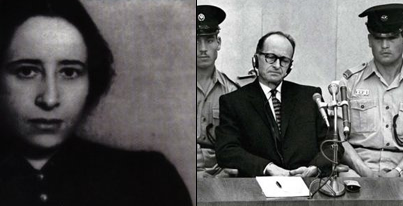
Hannah Arendt Adolf Eichmann
Consider this description from the Internet Encyclopedia of Philosophy:
“[Arendt’s book about the Eichmann trial] controversially uses the phrase “the banality of evil” to characterize Eichmann’s actions as a member of the Nazi regime, in particular his role as chief architect and executioner of Hitler’s genocidal “final solution” (Endlosung) for the “Jewish problem.” Her characterization of these actions, so obscene in their nature and consequences, as “banal” is not meant to position them as workaday. Rather it is meant to contest the prevalent depictions of the Nazi’s inexplicable atrocities as having emanated from a malevolent will to do evil, a delight in murder. As far as Arendt could discern, Eichmann came to his willing involvement with the program of genocide through a failure or absence of the faculties of sound thinking and judgment. From Eichmann’s trial in Jerusalem (where he had been brought after Israeli agents found him in hiding in Argentina), Arendt concluded that far from exhibiting a malevolent hatred of Jews which could have accounted psychologically for his participation in the Holocaust, Eichmann was an utterly innocuous individual. He operated unthinkingly, following orders, efficiently carrying them out, with no consideration of their effects upon those he targeted. The human dimension of these activities were not entertained, so the extermination of the Jews became indistinguishable from any other bureaucratically assigned and discharged responsibility for Eichmann and his cohorts.
Arendt concluded that Eichmann was constitutively incapable of exercising the kind of judgment that would have made his victims’ suffering real or apparent for him. It was not the presence of hatred that enabled Eichmann to perpetrate the genocide, but the absence of the imaginative capacities that would have made the human and moral dimensions of his activities tangible for him. Eichmann failed to exercise his capacity of thinking, of having an internal dialogue with himself, which would have permitted self-awareness of the evil nature of his deeds. This amounted to a failure to use self-reflection as a basis for judgment, the faculty that would have required Eichmann to exercise his imagination so as to contemplate the nature of his deeds from the experiential standpoint of his victims. This connection between the complicity with political evil and the failure of thinking and judgment inspired the last phase of Arendt’s work, which sought to explicate the nature of these faculties and their constitutive role for politically and morally responsible choices.” (Internet Encyclopedia of Philosophy)
Discussion Questions
- How much of the evil in the world, along with our personal contributions, do you think is a product of a failure to think? Of failing to have “an internal dialogue” within ourselves about the moral and social consequences of our actions?
- The description above says that Eichmann failed to display “the imaginative capacities that would have made the human and moral dimensions of his activities tangible for him.” How would a university education–one that emphasized the humanities, arts, and literature–help in creating these “imaginative capabilities”?
Join the Conversation
If you have a question for this week’s speaker or would like to share a conclusion of your own, please post it as a comment below. We welcome off-campus voices to the public Cornerstone dialogue as long as they are respectful and contribute meaningfully to these curricular discussions. See the ACU Blogs Terms of Use or About Cornerstone for more information.
Spotlight Resources


Magical Thinking: the Financial Crisis
Biography
Dr. Richard Beck is a professor of psychology, a researcher in the psychology of religion, and a blogger whose wide-ranging interests include Orthodox Iconography and the Theology of Calvin and Hobbes.
2 responses to “Thinking from Multiple Perspectives”
i really enjoyed this man speaking to us on Wednesday. he put a new view on my perspective. How much can we tolerate before it is enough to hurt someone?
1. I believe that a vast majority of the evil in this world is a consequent result of not thinking. One example of this is C.s. Lewis’ story of the Screwtspe letters. Screwtspe often gives his nephew the advice to not plant ideas, but to simply implant laziness and a sense of unawareness, so that the subject might notnnefessarily think “evil” but will be complacent to go along and not question the slow-changing of his heart.
2. Our university education is vital to our recognition of imaginative possibilities. We are willing to explore the uncomfortable but real consequences of our actions and inactions, and that is the key to understanding our imaginative possibilities.