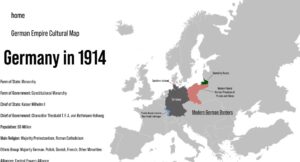
The October Newsletter featured an intricate mapping assignment for Dr. Andrea Di Stefano’s history class “Europe after WWI.” The project was created for his students to inspire creativity and engage course material interaction beyond regurgitating facts. After speaking with Dr. Di Stefano, librarian Laura Baker (‘87) began researching and locating appropriate material; however, after communicating with other library personnel and the professor, it became apparent that there was no one application or system available to create the interactive map as described by him.
Fortunately, the library’s different units joined together in order to create what was needed to support this interesting assignment and utilized their government documents collection to digitize maps originally accompanying the Treaty of Versailles. “The maps are a special boon for history majors who benefit from using primary documents, and require transfer to a format compatible with a tool platform,” says Baker. A digital copy of the map was edited in Photoshop to remove the names of cities and countries and adapted as a template for the class assignment. “Students used this map as a guide to work from in Adobe XD, where they constructed the map as an interactive experience. This project was a great example of collaboration – I’m proud to be a part of the library that facilitates this type of teamwork!” says Erica Pye, Scholarly Communications and Outreach Librarian.
Amos Gutierrez (’19), Learning Technology Specialist and Adobe Ambassador, used Adobe XD to create the framework for interactive maps. This allowed students to then annotate and modify the map, creating an interactive graphic according to Professor Stefano’s instructions. In addition, he provided in-class XD training and one-on-one help sessions for students. Gutierrez explains, “Creativity plays an important role in our lives both professionally and personally. It allows us to think differently, to discover more effective and efficient ways to work and serve others, to invent, and to solve problems. It is not an easy task to engage in the creative process, to try something new, to take risks, and to not fear failure, but it is a worthy task and a needed task.”
Professor Di Stefano is grateful for the library’s contribution in creating a practical and pedagogically sound assignment. He shares, “Thanks to the library partnership, we were able to make something completely new from old resources.”
In our final segment of this feature, we will highlight student interaction with the course material and include a link showcasing Dr. Di Stefano’s class work.