Table 1.1 below summarizes my peer-reviewed intellectual contributions as well as other scholarly contributions during the time after submitting my tenure portfolio (2016-2020), the five-year period immediately preceding my tenure portfolio submission (2011-2016) as well as my prior contributions.
Table 1.1. Jessup publications.
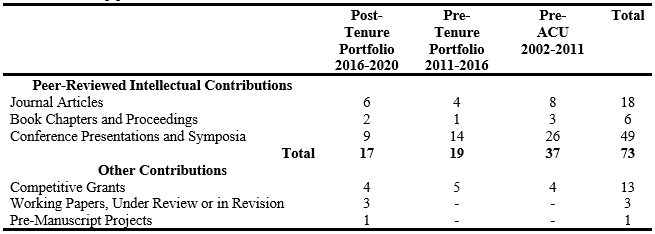 The elements from my overall research that I would like to emphasize are (1) quantity, (2) interdisciplinary focus, and (3) quality.
Quantity
Since receiving tenure and after excluding all non-peer reviewed contributions, I have more than tripled the minimum requirements for scholarship to obtain promotion according to COBA guidelines.
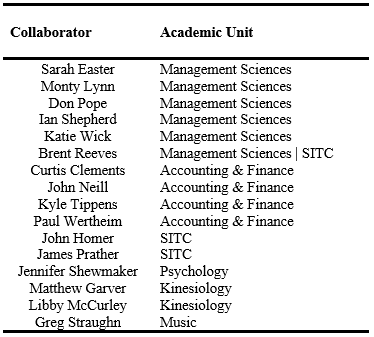
Table 1.2. ACU faculty members with whom I have collaborated since joining ACU faculty.
Interdisciplinary focus
Cognitive science, my primary area of training, is inherently interdisciplinary. This discipline sits at the intersection of a variety of fields, including psychology, artificial intelligence, neuroscience, and economics, among others. Hence, my publications might be expected to reflect this translational emphasis. The interdisciplinary component of my research is reflected in my collaborations at ACU (Table 1.2). In addition to work completed with ACU psychology faculty while a graduate student at ACU, I have also collaborated with ACU faculty in a variety of disciplines since returning to ACU. This interdisciplinary focus can be further observed by the many different subfields in which I have an article published in a top 20 journal (see Table 1.3 below).
Quality
I have primarily targeted higher level journals. There are several ways to measure the quality of a journal, including article impact (aka, impact factor), eigenfactors, the h5 index, and Scimagojr Journal Rank (SJR), the latter being my preferred method due to its ease of access, transparency, and minimal bias. The SJR value is very similar to article impact, where the number of citations a journal receives is divided by the number of articles published (more citations relative to number of articles published indicates a higher impact) but with a twist: a la Google PageRank (the algorithm used by Google for search), the quality of the citing journal matters. Here, a citation from a higher quality journal yields more impact than a citation from a lower quality journal.
Table 1.3. Jessup publications by journal, number of publications within that journal, subfield, h5 index, and subfield rank, according to Google Scholar, and best subfield, SJR value, and subfield rank, according to Scimago. NA indicates that the score or ranking is unavailable for some reason. Either the journal is too new (Advances in Methods and Practices in Psychological Science), it does not publish enough articles annually (Decision, International Journal of Disclosure and Governance), or it is not ranked in the top 20 of its specific subfield (American Journal of Psychology, European Journal of Neuroscience). * Indicates that the journal would be tied for 7th if it were listed in this subfield but is strangely not.
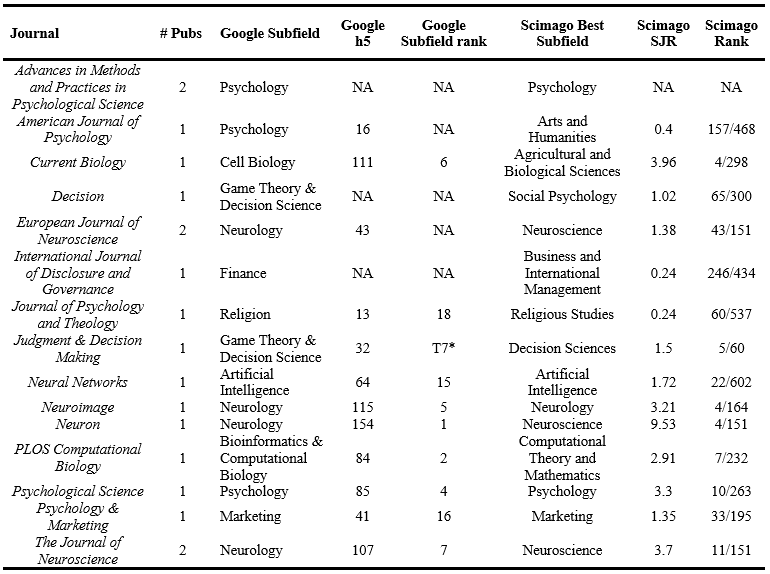
Because disciplines vary it is sometimes helpful to consider the quality of a journal within its specific subfield. Table 1.3 demonstrates the outlets for my journal publications, the number of publications I have at that journal, the subfield, most recent h5 index, and the subfield rank of that journal, all from Google Scholar, as well as the subfield, most recent SJR score, and subfield rank of that journal from Scimago, where available.
As can be clearly observed, many of my publications are in top journals within their subfields, irrespective of the metric considered. I worked on two of the three publications with the lowest SJR values while just getting started as a graduate student at ACU. My two most cited publications, Jessup et al. (2010) and Jessup et al. (2008), have more than 150 citations each. Two of my papers have been cited (here and here) by Nobel Prize winners Al Roth and Vernon Smith, respectively, and a third was cited by Cass Sunstein, co-author with two additional Nobel Prize laureates: Richard Thaler (Nudge) and Daniel Kahneman (Noise).
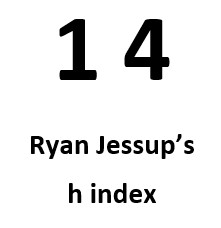
One final comment on quality. In 2014 and 2018, I presented papers at the annual meeting of the Society of Judgment and Decision Making (conference programs from 2014 , 2018). In 2014 I noticed that there were quite a few people presenting from places like Yale, Stanford, and Caltech and very few from places like ACU and our academic peers (i.e., any large masters level university such as Belmont Univeristy, according to the Carnegie Classification data). A quick analysis of the paper presenters (download available here) revealed that there were 126 unique US universities represented. Of those, 118 or 93.7% were classified as very high research university (formerly referred to as Research One), a list that includes schools such as Harvard, University of Chicago, Indiana University, Princeton. Next, 7 or 5.6% were classified as a high research university, e.g., Miami of Ohio and BYU fall in that list. There were no schools from the moderate research university at the doctoral level, a list that includes schools such as Pepperdine and Biola University. There was only one presenter from any other US school – me, from ACU, a large master’s level university. The analysis of the data when I presented in 2018 yielded a virtually identical conclusion. The point is that I am producing research at a level of quality in my field that virtually no one else is producing at a comparable university.