I believe I have grown to be an effective teacher while at ACU. Three different course evaluation methods have been in use during my time at ACU so I have broken them up accordingly. Table 2.1 presents my overall course evaluation means for each course, separated by semester and course, as well as my three highest and lowest rated items, during my first four years. Table 2.2 shows my course evaluation means for the next three years and Table 2.3 shows my course evaluation means for the most recent two years together with my two highest and lowest rated items. An archive containing the entirety of my course evaluations can be downloaded here. I would like to highlight two things: growth and effectiveness.
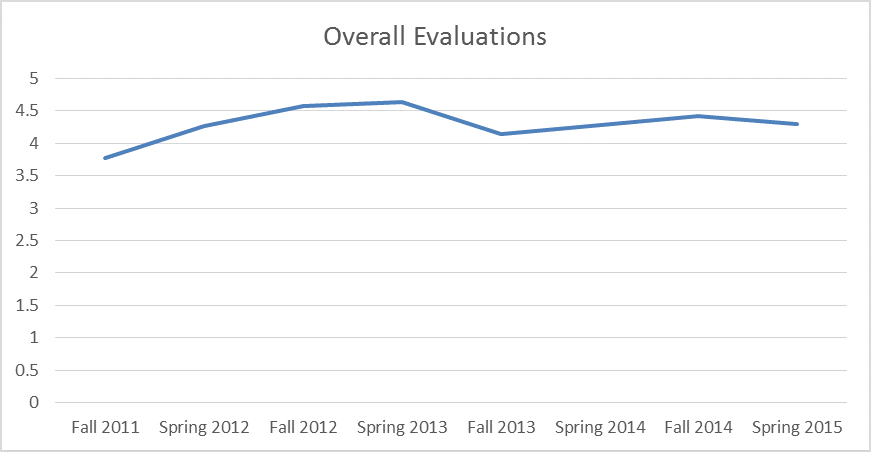
Figure 2.1. Jessup overall course evaluation data by semester using the evaluation method in practice upon my arrival at ACU
Growth
Figure 2.1 presents the weighted average for each semester using the original evaluation method. It demonstrates my steady growth as an educator even as I took on more non-teaching responsibilities. Notwithstanding the dip in Fall 2013 that I believe reflects a change in emphasis (as addressed in my reflections on student feedback), the overall trend is upward. We can actually test whether or not the improvement observed in the last semester was so much higher than the first that the difference could not be attributed to chance. Indeed, the evaluations were significantly higher. I tested this using a paired t-test on the weighted means of the 18 survey items for the first compared to last semesters (t(17) = 5.82, p < .0001). While that is a very simple way to test growth, another way to test it is to see if, overall, there is a positive growth trend for the questions. There was. I tested this by first correlating the ratings from each question for each semester with my years of teaching experience (e.g., 0, .5, and 1 and so on represent my first, second, and third semester, and so on, respectively) and then running a one sample t-test on the resultant correlation coefficients, the result of which was significant (t(17) = 3.00, p < .005, Mean(r) = 0.255, SD(r) = 0.36). This suggests that not only did the overall means improve from the first to the last semester but that my ratings for each individual question improved with time.
Another way we could look at this is to simply observe that my best and worst rated attributes have increased in value (see Table 2.1). A comparison of my lowest rated item from my first semester to the last semester with identical survey data shows that the latter is higher; the same is true when comparing my highest rated items, indicating that I have indeed made progress in what were initially my weakest teaching components and have progressed overall.
Effectiveness
In May 2017, I received the ACU Outstanding Teacher of the Year award. Though the award by itself may be far from a perfect signal (I say more about this award in my reflections on student feedback), when taken together with the course evaluations from recent years (Table 2.3), associated comments, and supporting letters from students, I believe that they together establish my effectiveness as a teacher.