What are the decision and neural computations responsible for individuals choosing poorly? How do contextual and environmental factors influence learning and choice? In seeking to answer these questions, my research uses psychological models of motivation and economic choice, combined with neuroimaging, to distill the computational properties and neural correlates of decision making and learning. The goal of this specialty, decision neuroscience or neuroeconomics, is to extract the neural mechanisms of choice and related processes. Applications of this translational field are quite varied and range from providing better understanding, diagnosis, and treatment of clinical problems (e.g., drug abuse and physical and mental illness) to understanding and predicting consumer behavior in the marketplace.
The core of my research is computational modeling using stochastic and dynamic models of learning and choice, such as reinforcement learning and decision field theory (Busemeyer & Townsend, 1993). Computational modeling enhances research by requiring precision in theory formulation and producing logically valid and constrained predictions.
Improving understanding through computational modeling
My early research entailed extending decision field theory to generate predictions regarding the too much choice effect. The too much choice or choice overload effect refers to the observation that individuals purchase more when presented with fewer options (Iyengar & Lepper, 2000). However, the initial work failed to establish a quantifiable mechanism for the result and ignored the environment. We implemented three possible cognitive explanations for the effect into decision field theory – using various environments – revealing testable predictions regarding its boundary conditions (Jessup, Veinott, Todd, & Busemeyer, 2009). Other modeling efforts involved bridging decision field theory with neurally-inspired models of choice and proposing neural correlates of the theory (Busemeyer, Jessup, Johnson, & Townsend, 2006).
Beyond modeling: Experiential and descriptive choice differences
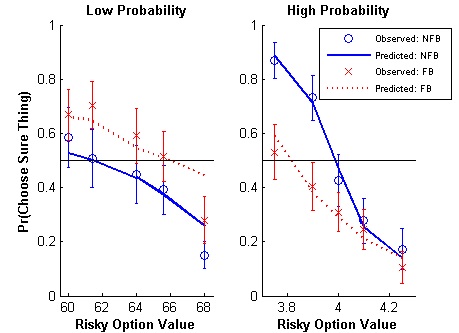
However, the elegance of computational modeling in psychology is unexploited without behavioral experimentation; thus I was eager to advance my training by collecting empirical data. Recent evidence suggests that individuals choose differently when potential outcomes and their associated likelihoods are described relative to when they must be learned about through experience (Barron & Erev, 2003). Thus, an apparently trivial context change produces results that contradict one of the most prominent choice theories in economics and psychology: prospect theory. I hypothesized that feedback is the crucial arbiter between these paradigms, engendering the overweighting of small probabilities observed in descriptive choice and the relative underweighting of small probabilities observed in experiential choice. This was exactly what I found (Jessup, Bishara, & Busemeyer, 2008). Individuals were separated into two groups, feedback or none, and engaged in a repeated-play descriptive choice task, revealing significant between-group differences. Modeling of the choice data enhanced the results (Figure 1.1), as the distribution of the best fits for a key parameter significantly differed between feedback conditions.
Figure 1.1. Aggregate model fits for feedback (red lines) and no feedback groups. These were obtained by fitting the model to the observed individual data (‘X’ for feedback and ‘O’ for no feedback) and averaging the predictions across participants. Choices were between a risky and sure thing option. There were two within subject conditions (high and low), representing the probability of winning the risky option. The vertical axis gives the choice probability for the sure thing and the horizontal axis gives the value of the risky option. The error bars represent the standard error of the mean for the observed choice probabilities.
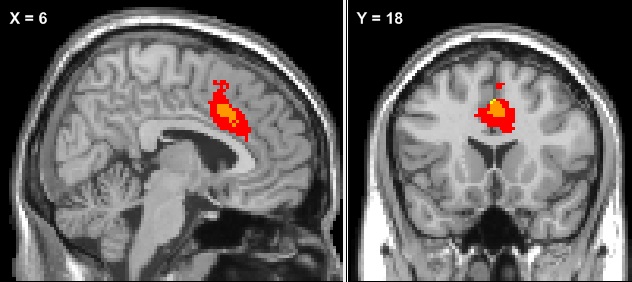
Building on this work, I then desired to ‘draw back the curtains’ to uncover the neural patterns of activation giving rise to these behavioral differences. I hypothesized that neural regions are uniquely recruited – depending on whether feedback is given or not – and the involvement of these regions causes the different behavior between paradigms. This is noteworthy because many researchers conducting neural studies (e.g., fMRI) of choice use the experiential paradigm yet apply and test models that were designed using the descriptive paradigm. I conducted a fMRI study with the same task as above, finding that the posterior cingulate cortex, a region known to be correlated with preference for risk (McCoy & Platt, 2005), showed the same interaction pattern as did preference for the risky choice option in our previous behavioral work. As well, I found that activation in the anterior cingulate cortex (ACC) increased for non-error outcomes when those outcomes were rare (Figure 1.2). ACC activity is generally thought to be recruited after the reception of error feedback, but most tasks finding such an effect have rare errors. When coupled with our rare error condition, this study suggested that ACC activity indicates a surprising event has occurred, i.e., an unsigned prediction error (Jessup, Busemeyer, & Brown, 2010), helping to usher in a more nuanced understanding of the role of ACC in affecting human behavior (Shenhav, Botvinick, & Cohen 2013).
Figure 1.2. ACC significant clusters. Sagittal (left) and coronal views of significant ACC activation for an interaction contrast between the probability (high or low) of an error and the resulting outcome (win or lose) in red, and where this activation overlaps with the more typical ‘rare error rate’ condition (orange).
Fusing the elements: Neural and behavioral examinations informed by modeling
This encounter with neuroimaging motivated me to gain more expertise in decision neuroscience, particularly using a method that would take advantage of my training in modeling: model-based fMRI. This involves fitting to the behavioral data a model and then correlating with the neural data the resultant time-series of data produced by those model fits, giving insight as to how a cognitive process is implemented in the brain and not merely where (O’Doherty, Hampton, & Kim, 2007). To train in this method, I sought out and obtained a post-doctoral fellowship with John O’Doherty.
My first project concerned learning. Previous work has shown that learners have increased neural activity in the striatum when learning, compared to non-learners (Schonberg, Daw, Joel, & O’Doherty, 2007). We wanted to build on that by elucidating the extent to which striatal activity reflects reinforcement learning (RL) on a trial to trial within subject basis. We designed a gambling task meant to encourage participants to vary their choice strategy. Using neuroimaging, we observed that in trials on which participants choose in accordance with RL theory there is a concomitant increase in dorsal striatal activity at the time of choice. This finding suggests that the striatum is involved in implementing choices that are consistent with RL and not simply stronger prediction error signals (Jessup & O’Doherty, 2011). This work was featured in the Fall 2011 issue of the Caltech E&S article “From Dendrites to Decisions” (I am mentioned on p. 10 of the pdf which is p. 20 of the issue) as well as on multiple LA area tv newscasts, including channel 4’s KNBC (see Video 1.1) and channel 9’s CBS-LA (transcript here). My second project involved an exploration of how different neural regions respond to different components of rewarding and punishing outcomes. Our results have helped neuroscientists better understand the complicated pattern of neural responses to rewarding and punishing outcomes, clarifying an often confusing literature (Jessup & O’Doherty, 2014).
Video 1.1. KNBC on-air mention of our research. Video may not work on iOS devices.
Ongoing research activities: Diversity today
My ongoing research has been characterized by an increase in diversity of topics. Much of this newly found diversity is a product of my collaborations with ACU faculty who do not necessarily share my research interests. However, I have also continued working on research in decision neuroscience and psychology.
Continuing research streams
Many of my collaborations with faculty beyond ACU continue my existing research stream within a variety of projects, particularly in decision neuroscience. For example, my work with Elizabeth Tricomi at Rutgers University examined the dynamics of neural activity in the striatum, a portion of the basal ganglia responsible for the integration of reinforcement learning, reward cognition, and motor function (Dobryakova, Jessup, & Tricomi, 2017). My collaboration with Richard Piech at Anglia Ruskin University in Cambridge, UK combines my mathematical modeling expertise with clinical psychology and neuroscience, as we find that administering acetylcholine to individuals before they engage in a risky choice task results in significantly altered subjective probability weighting of events (Gidi, Jessup, & Piech, in preparation).
I have also continued my research concentration in the psychology of economic and consumer choice. Funded by a 2012 ACU Cullen grant and 2012 ACU Undergraduate Research grant, one project explored factors that contribute to the likelihood of an individual selecting a stochastically dominated option and represented a behavioral follow up to Jessup & O’Doherty (2011), conducted in collaboration with former undergraduate Lily Assaad and new ACU assistant (now associate) professor Katie Wick. Here, we found that the presence of sunk costs made an individual more likely to select a stochastically dominated option (Jessup, Assaad, & Wick, 2018). This marked my first time to publish with an undergraduate student in a peer reviewed journal.
Also, funded by a 2013 ACU Pursuit grant, was an empirical follow up to my earlier work on the too much choice effect (Jessup et al., 2009) conducted in collaboration with former undergraduate Levi Ritchie and ACU computer science associate professor John Homer. In this work we empirically tested the predictions made by decision field theory and found that time pressure increased the effect (also known as choice overload), consistent with our theory. In addition to the novel findings, these results also indicate the value of linking empiricism with theory-driven approaches. This paper was presented at a regional psychology conference, a national decision making conference, and recently became my second publication at a peer reviewed journal with an undergraduate student at ACU (Jessup, Ritchie, & Homer, 2020).
My work with Jerome Busemeyer at Indiana University was funded by a 2014 ACU Pursuit grant and conducted in collaboration with former ACU undergraduate Allison Phillips and John Homer. In it we introduce and test a new model which combines reinforcement learning with decision field theory in an effort to bridge two major decision making paradigms: (1) decisions from experience and (2) decisions from description. Our model has excellently predicted the behavioral results, results which are difficult for competing models to predict. This work has been presented at a regional psychology conference, a national decision making conference, and we intend to submit it to a peer reviewed journal (Jessup, Phillips, Dimperio, Homer, & Busemeyer, in preparation).
New research areas
In addition to continuing my existing research streams, my variety of ACU collaborations have also stimulated work in multiple unique research areas. For example, I provided statistical assistance for Matt Garver in his research involving physical activity in the elderly as well as Ian Shepherd and Brent Reeves’ work in mobile learning. Also, I worked with Jennifer Shewmaker on research funded by a 2013 Pursuit grant to understand whether playing with gendered Legos (i.e., the Lego Friends line which is marketed towards girls) engenders gender stereotype threat, research that also enlisted the help of multiple former ACU undergraduates, including Levi Ritchie and Caitlyn Spain. Monty Lynn, Sarah Easter, Greg Straughn, and I used both qualitative and quantitative methods to analyze the messages regarding work in Christian hymns. Each of these projects have been presented at multiple conferences.
Figure 1.3. 2015 JP Final Rankings. End of regular season rankings for the Jessup Pope (JP) College Football Ranking system during the 2015 regular season. Our system predicted that Alabama was the best team in the nation and would defeat Clemson in the national championship game by 5.7 points. Alabama won by 5 points.
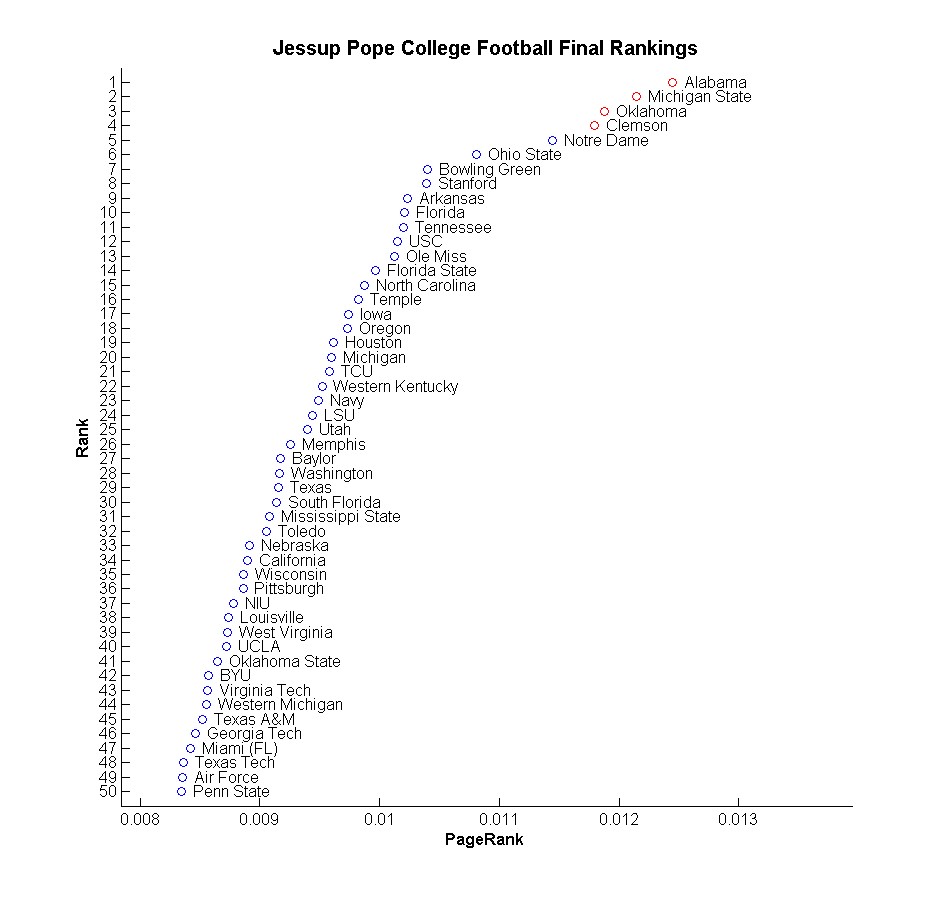
I have also begun exploring the use of Google’s PageRank algorithm (Page & Brin, 1998) for research purposes. What first began as an attempt to rank intramural soccer teams at ACU before the playoffs has developed into a full-fledged research project involving Don Pope in which we try to determine the best team in college football before the bowl games. We presented this work at the 2015 Christian Scholars Conference held at ACU and made posts on the ACU COBA blog on our weekly predictions during the 2015 and 2016 college football seasons. (Figure 1.3 shows our rankings at the end of the 2015 regular season).
This work spawned two additional projects: another with Don Pope on management quality analysis which he largely carried out himself (though he still included me on the presentation and in the proceedings) as well as one with several ACU faculty in the accounting & finance department wherein we use the algorithm to generate an estimate for the quality of institutions’ board of directors. This work has been presented at multiple conferences and was published in a peer reviewed journal (Clements, Jessup, Neill, & Wertheim, 2018).
Given the similarity in our research interests, Katie Wick and I have collaborated on multiple projects together beyond those already mentioned. Together with Kyle Tippens and then undergraduate now UTA graduate student Emily Studer, we sought to determine whether there was bias against small schools in judging conference abstracts. Interestingly, we found a peer bias (bias for peer institutions) rather than the hypothesized prestige bias (bias for prestigious universities). We also conducted a two-part study as part of a multi-site registered replication. Though our role was small – take a look at the number of authors on each of the two articles here and here – the overall result showed that neither effect from these very famous studies replicated, denoting a potential weakness in the priming literature. Lastly, together with John Homer, Katie and I have begun an interdisciplinary and multi-year project. A few years ago, one of us had a friend who had been unfaithful in marriage. While pondering this, Katie and I began to see the similarity between marital relationships and one of the most famous experimental techniques within economics: the prisoner’s dilemma from game theory. Surprisingly, no one had previously paired married partners in the prisoner’s dilemma. So, we did it with the goal of observing how individuals treat their spouses differently – if at all – and whether an individual’s behavior towards their spouse could predict their or their partner’s marital satisfaction. Using a Bayesian variable derived from a individual’s probability of cooperation, we found that one’s marital satisfaction is predicted by their behavior in the game. Although we are collecting more data on this project, the earlier work involved three former undergraduate students – Barrett Corey, Kaleigh Borge, and May 2020 graduate Luke Stevens – and one graduate student, Emily Rodriguez. The first two undergraduate students have now completed master’s degrees in analytics and Luke is enrolled for the same degree at UT Austin. Each of these projects with Katie have been presented at a regional psychology conference and the two replication studies were published in a peer reviewed journal, both having more than 20 citations within two years.
Conclusion
In sum, though the bulk of my interests remain unchanged, I, nonetheless, have embraced an increasing diversity of research interests as I collaborate with ACU faculty.