Research: The corps of discovery
Even if I needed no job at all, I would conduct research merely for the thrill of discovery. When I begin working with a new research assistant I explain to them that researchers are like explorers, the Lewises and Clarks of knowledge. In contrast, people who convey information to others but never conduct research – e.g., medical doctors or teachers – are like Stephen F. Austin: they lead people to established ground. Without doubt, both roles are certainly valuable and many clearly prefer the latter whereas my preference is for the former. As for me, I love the feeling of being the first person to ever have observed or understood something. I love designing an air-tight research design – or as reasonably air tight as can be expected – and I get a thrill when finding a statistically significant effect predicted solely by a theory that I have proposed. When I find such an effect, it is like finding my own piece of land on which no person could ever have walked before.
My training at Indiana University, Trinity College Dublin, and Caltech heavily emphasized technical skill training over knowledge acquisition, and I think I have benefited by this emphasis. Furthermore, this training also emphasized high caliber, theory driven and interdisciplinary research. To the extent possible, I have tried to continue these emphases even here at ACU.
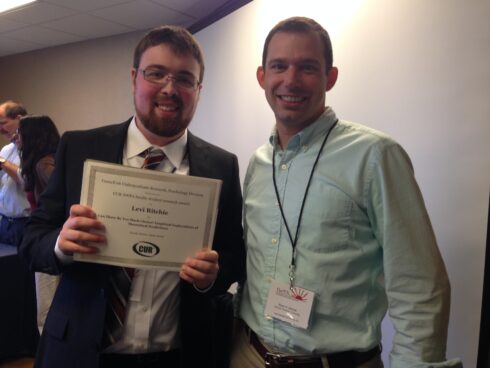
Figure 1.4. Levi Ritchie awarded Council of Undergraduate Research – Psychology Division award for best undergraduate research.
My approach to research at ACU
Nonetheless, I believe it is unrealistic for a person at ACU to continue operating near the same level at which they operated while at primarily research institutions. So, upon my arrival at ACU I developed a system to continue producing reasonably high quality research, albeit at a slower rate. For each new research project using this approach I attempt to assemble a team that includes one undergraduate research assistant and one programmer. Ideally, the undergraduate researcher desires to get a PhD and is looking for research experience to bolster their application. The idea is to leverage (1) my knowledge of the field and methodological design, (2) the programming ability of a collaborator who can create the experimental protocol, and (3) the willingness and time of the research assistant to recruit participants and collect data. Then I analyze the data with input from the assistant and the three of us obtain a conference presentation at a minimum. If the results are good enough then we even submit to an appropriate peer review journal.
Although the above process has succeeded in generating quality work, its major weakness is that once the undergraduate enters grad school and leaves ACU they have little incentive to continue working on the project, leaving me, as the field expert, to do the bulk of the work that remains. Due to this issue, I have learned to welcome opportunities to collaborate with faculty members inside and outside ACU, particularly when the duties are divided appropriately and all collaborators are vested in seeing the project through to a journal submission.
In conclusion, I am satisfied with the systems I have put in place as well as the quality of research it has thus far produced. I am pleased that collaborations with faculty inside and outside of ACU have begun to yield fruit and that the collaborations are quite diverse.