I have recently re-structured my understanding of service to the university in terms of professional consultation:
The university pays our salary, receiving a variety of services in return. Additionally, the university regularly hires outside consultants to advise and produce strategies for future endeavors. As faculty members, the university has ready access to experts in a wide variety of fields. Hence, our service to the university might best be construed as the university having consultants (us, the faculty) on retainer. While outside consultants are still necessary, we can offer depth of insight at no marginal cost.
This new perspective has helped me re-consider my service, thereby placing a higher value on it.
My university, college, and departmental service were initially characterized by an outgrowth of my love for research. In general, I think this fitting – it is the expression of my natural gifts and interests. However, as my time at ACU has extended, my service has found expression in other areas as well.
Below are my primary committees or areas of institutional service while at ACU.
University
- Board of Trustees: Long-Term Planning Committee (2018-2020)
- Faculty Senate (2015-2018)
- Faculty Compensation and Benefits Committee chair (2017-2018)
- Faculty Compensation and Benefits Committee member (2016-2017)
- Faculty Representative on the ACU ACIMCO Board (2015-2016)
- Undergraduate Research Festival Planning Committee (2014-2018)
- Undergraduate Research Council (2012-present)
- Undergraduate Research Festival Judge (2012-2018)
College and Department
- AACSB Accreditation and Assessment Committee (2018-present)
- COBA Analytics Task Force (2018-present)
- Marketing Lead Faculty (2016-present)
- AACSB Continuing Improvement Working Group (2016-2019)
- COBA Research Team chair (2012-2018)
- COBA Research Team member (2011-2012)
Expression of research
As chair of the COBA Research Team I led an effort to introduce an incentive and reward program for those who publish papers in higher quality peer review journals. This is important because the quality of publication outlets for a college is a reflection of the quality of research produced yet our tenure standards do nothing to differentiate between levels of quality. As I was proposing this incentive program we received word from our accreditation agency, AACSB, that we are now required to track impact, a proxy for quality, of faculty publications. And because tracking is often followed by more stringent requirements, our incentive system might prepare us for an inevitable AACSB standards change.
Furthermore, much of my other (i.e., non-committee) institutional service has also been research-centric, such as helping Jennifer Shewmaker, Laura Phillips, Dennis Marquardt, Ray Petit, or James Prather with their experimental design or analyses for their respective research projects.
Beyond service-related to research
Non-committee service
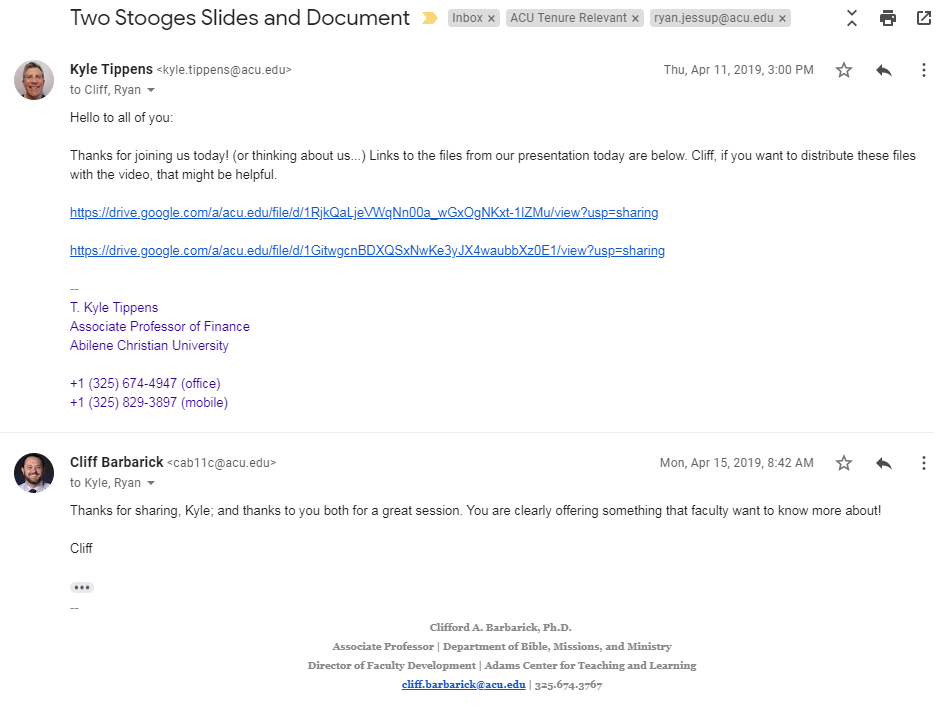
However not all of my service has been based on research. For example, I wrote software that enabled our departmental secretary, Kathy Garison, to prepare and distribute course evaluation results to all COBA faculty within a matter of minutes as opposed to the usual ten or more hours. Our associate dean at the time, Monty Lynn, presented me with two soccer balls, one for me and one for my son, in appreciation of this service. Kyle Tippens and I have given multiple presentations on investing in legal, tax-privileged accounts, first in COBA, and twice in the Adams Center, as part of our Two Stooges Investment Club. We were later informed by Cliff Barbarick that our talks generated some of the most interest they had seen. Also, in 2015-2016 I served as a new faculty mentor to Todd Womble. It was a mutually edifying experience!
Figure 3.1. Email from Cliff Barbarick informing Kyle and I that our talks are generating interest
Furthermore, I have served the honors college by teaching multiple colloquia and by serving as either the chair (Lily Assaad, Barrett Corey) or member (Allison Phillips) of students’ honors theses, or as internship adviser (Chase Balke) for multiple students.
Committee service
Lastly, the time I served on faculty senate — though far from my favorite — introduced me to a whole new component of the university and was very beneficial. For one, it allowed me to meet and regularly interact with valuable others across the university with whom I would rarely otherwise interact (e.g., Tim Head) as we considered important university matters. It also brought me to more familiar terms with ACU administrators (Susan Lewis, Robert Rhodes, Wendy Jones) than before. Additionally, it was the avenue that prompted my service on the Board of Trustees Long-Term Planning committee, service that taught me a lot about how board members view faculty (hint: they *really* love our university and want what is best for it) and enabled me to have meaningful impact on the university’s direction. The latter service spurred my new understanding of “service as professional consultation” described at the beginning. In sum, I have enjoyed serving the institution via my love of research but have also grown and broadened into other, non-research-related areas of service as well.