In a literature review and meta-analysis, Clayson (2009) finds that (1) course evaluations are higher for courses which give out higher grades, (2) course evaluations are negatively correlated with rigor (the more rigor in the classroom the lower the evaluations) and (3) the more objective the measures used to assess learning, the less the relationship between course evaluations and learning. A few of my favorite quotes from this article are below, all found on p. 27.
“We might expect, for example, to find no or even a slight negative correlation between evaluations and learning in classes such as marketing research, especially if the course is highly structured and statistical in nature.” [I assume that he teaches marketing research and was soon going up for tenure.]
“Consumer behavior might show any combination of associations, depending on how the students’ grades were derived. If test material attempted to measure understanding and application of theoretical concepts, we could expect to find no associations between evaluations and learning.”
“On the other hand, business classes that contain math applications and require more cognitive skills for students to demonstrate their level of competency may find the SET [student evaluations of teaching] to be relatively invalid.”
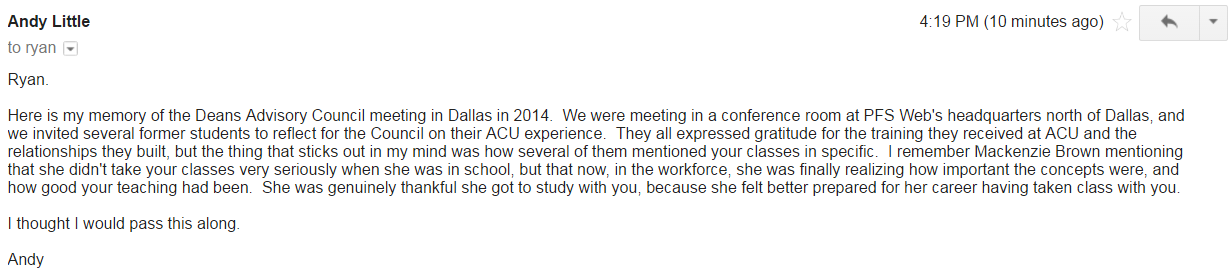
Personally, I feel that student course evaluations are good for some but perhaps not ideal for all that we ask of them. Students are well-positioned to indicate whether information was clearly presented and whether or not LMS tools were well-organized, among other things. However, students near the end of a course are not necessarily well-positioned to evaluate (1) how much they learned or (2) how useful the course will be for them in their future careers. I have often suspected that perhaps a better way would be to ask students a few years removed from the undergraduate experience what were their most useful courses because they are in a better position to evaluate their needs. This method would naturally have flaws as well. However, I was pleased when hearing that several former students who, upon being invited to meet with the COBA Dean’s Advisory Council, listed my courses as being among the most useful, as described in the email from associate dean Andy Little (Figure 2.4).
Figure 2.4. Email from associate dean Andy Little detailing when several alumni specifically mentioned my courses as successfully preparing them for their future careers.