
Celebrate Fair Use This Week!
Happy Fair Use Week 2019!
Fair Use/Fair Dealings week starts today, February 25, and goes through March 1. On fairuseweek.org, it states that this week’s purpose is to, “celebrate the important doctrines of fair use in the United States and fair dealing in Canada and other jurisdictions.”
Maybe before you begin celebrating, you might need a refresher on what exactly fair use means in the United States. Taken from the Standford University Library’s Copyright webpage, fair use is “any copying of copyrighted material done for a limited and ‘transformative’ purpose, such as to comment upon, criticize, or parody a copyrighted work. Such uses can be done without permission from the copyright owner.”
So under certain terms of fair use, you can use copyrighted material legally without getting permission. For some great examples of what fair use looks like, check out this Fair Use Fundamentals infographic.
How do you know if what you are doing with copyrighted materials falls under “fair use?” Just remember the acronym “PANE.”
P – Purpose – what is your purpose for using the work? Strong cases might be used for teaching, research, criticism, comment or news reporting (as found under Section 107 of the Copyright Act). If the purpose of using the work is transformative (being used differently than the work was originally created for) a stronger case for fair use exists.
A – Amount – how much is being copied? Using the least amount to achieve your purpose will provide a stronger case for fair use. The quality of the amount also counts. Even a small amount might go against fair use if it contains the most crucial elements, or the “heart,” of the work.
N – Nature of the work – is the work factual or creative in nature? Books and journal articles fall under the “creative” side, while dictionary entries and data are more factual. The more creative a work is, the weaker your case for fair use is.
E – Effect on the potential market – does your use of part of the work deprive the creator from revenue he would have otherwise gotten? If the most important parts (i.e. the “heart”) of the work are openly shared, then a person might not be willing to pay for the entirety of the original work.
Each letter represents criteria on a sliding scale from weak to strong. You have to evaluate your use under all four of the criteria and then make a final evaluation as to whether it would hold up under fair use. Each case must be evaluated on its own – there are no short cuts in determining a fair use case! You may have heard the myth that as long as you only use 10% or less of a book or 1 minute or less of a song it is okay – this is not true!!! Each of the four criteria need to be evaluated all together to make a valid judgement.
For more information on copyright and fair use, check out ACU’s Copyright and Fair Use research guide.
Click here for a tool to help you determine if you have a strong fair use case.
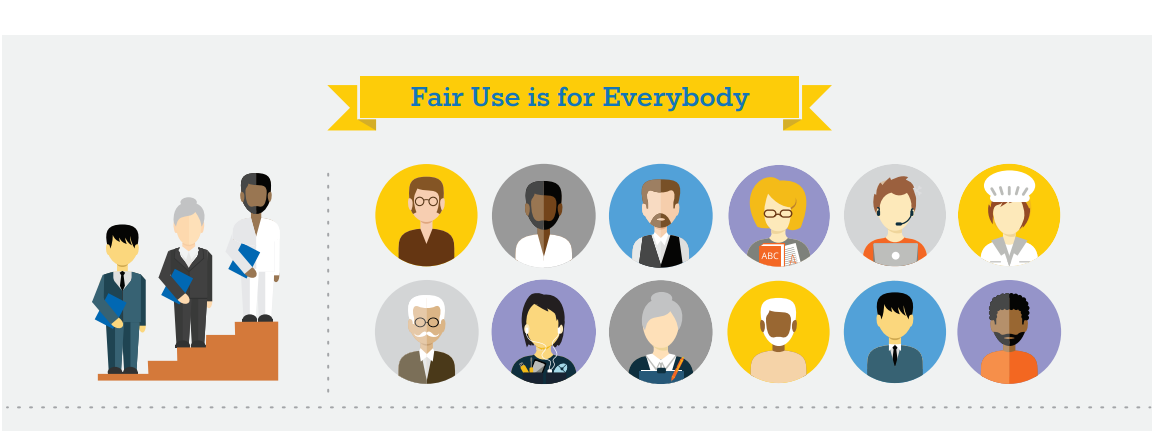
*Image Attribution: “Fair Use Fundamentals” by YIPPA and ARL, CC-BY-2.0