
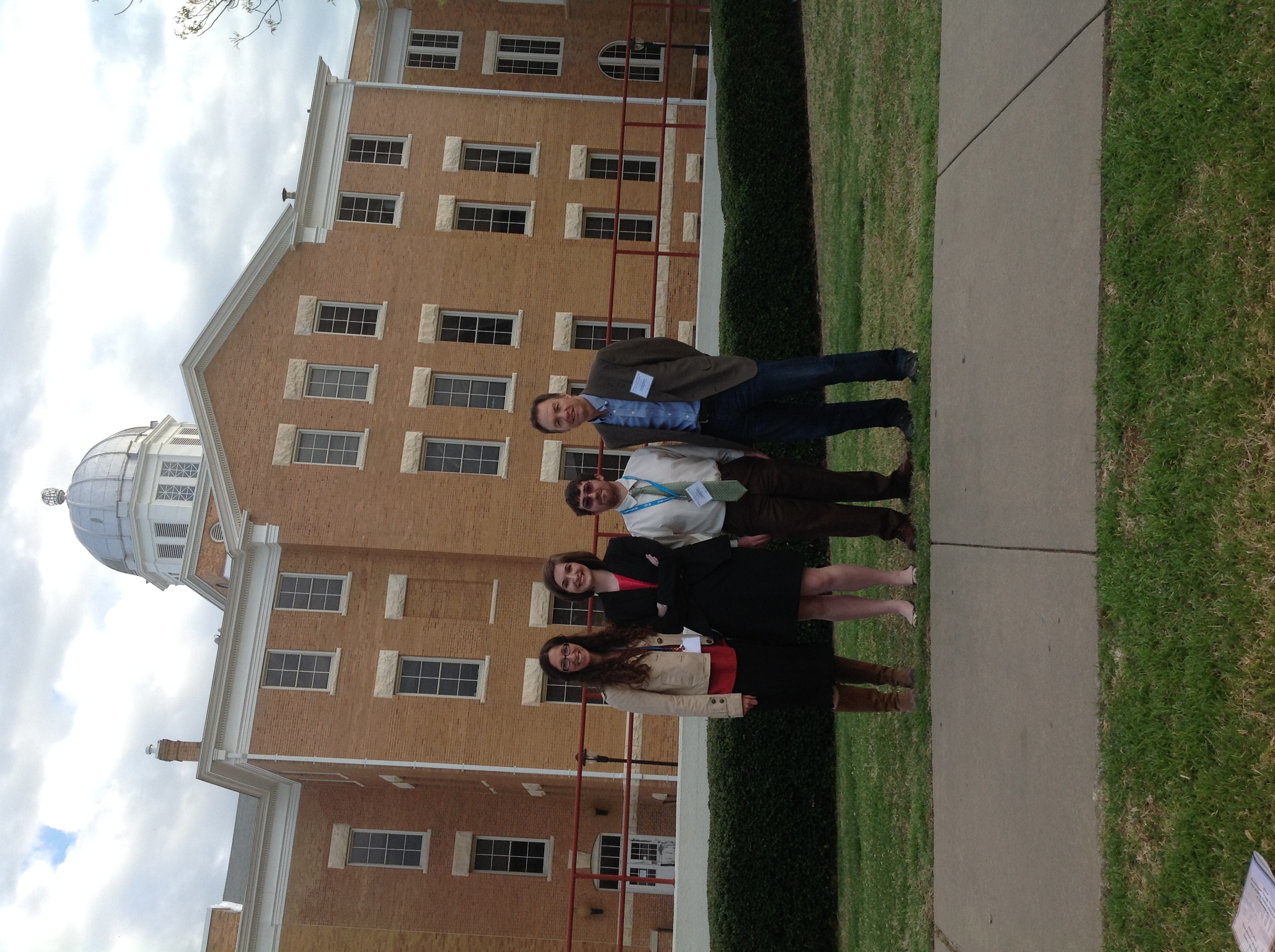
History students Abigail Fransen and Nicholas Fields with Dr. Ron Morgan and me after their presentations at the Phi Alpha Theta Regional Conference in 2014.
One of the things I most appreciate about teaching at ACU is the smaller class sizes and the opportunities to work closely with students across multiple semesters. Often, I may have a history or global studies student four or five times during the course of her college career. This allows me to build relationship and, sometimes, to help a student cultivate a particular research interest over several courses. ACU’s Undergraduate Research Festival and the McNair program also contribute to an environment that encourages and celebrates student research in a way that I did not get to experience in college myself.
I actively mentor student research by requiring scholarly research papers in all of my upper level courses in fall semesters. This gives students time to revise and expand papers from fall courses in order to submit to the Undergraduate Research Festival and the Phi Alpha Theta regional conference in spring semesters. (Note that spring semester upper levels also require a major writing project, but I usually use spring courses to introduce students to other kinds of history writing like book reviews and historiographical essays.)
During the 2011-2012 school year, four students from my Recent Europe class went on to present the papers they’d researched and written in the class at regional or national conferences. I continued to guide their research and revision beyond the end of the fall semester, and also workshopped the presentations with the students. Emi Johnson presented her paper entitled “C.S. Lewis and Secularization in Twentieth Century Britain” at the Phi Alpha Theta National Convention in Orlando, Florida in January 2012 (see Emi’s note about this here: 8_Student Note_Elliott). Jesse Backfisch, Luke Morgan, and Hannah Cunningham presented their papers at the Phi Alpha Theta Regional Conference in April 2012. I drove the students to the conference and watched all of their presentations in my capacity as Phi Alpha Theta advisor. All of them did excellent work. Jesse wrote about Simone de Beauvoir’s The Second Sex and its role in early feminism and existentialism; Luke’s paper examined both American and German national receptions of Kurt Vonnegut’s Slaughterhouse Five; Hannah Cunningham wrote a paper entitled Seeking the Truth: A Closer Look at Iris Murdoch’s Under the Net, looking at mid-twentieth century debates about language and meaning. I wrote letters of recommendation for all four of these students that year, as well, and counseled with them regularly regarding graduate school applications and the transition from college to grad school.
As I’ve mentioned elsewhere, more recently I’ve begun dedicating a week of class time in upper levels to Oxford-style research tutorials in which individual students meet with me to go over outlines or drafts. We also finish the term with mock conferences in which the students, placed in panels, present their research to the rest of the class, answer their peers’ questions, and generally learn what it feels like to give a research presentation. This approach was enormously successful in Mongols, Poppies, and Satyagraha in 2014–the students presented fantastic papers, asked each other great questions, and seven of them presented the following semester at either the Research Festival or Phi Alpha Theta. One example, Brooks Mendenhall’s “Conservation or Cultural Dominance?: The Future of Ecotourism in the Himalayas and Its Impact on Local Communities,” is available here: Himalaya Paper. Brooks, who graduated in spring 2015 and hopes to apply to graduate schools to study environmental history next year, revised and presented this paper at the 2015 Undergraduate Research Festival. In total, nine of my students from two upper level courses and the McNair Program presented papers at either the Research Festival or Phi Alpha Theta last year. The students’ names and paper titles are listed below.
| Richie Elmore | China: The Sleeping Giant of Monotheism | ||||||||
| Maggie McAlister | Mother Ganges Wept: Sexual Violence and Rape Culture in India | ||||||||
| Kelsey Kotara | Controversy of Religious, Economic, and Domestic Slum Life in Dharavi, India | ||||||||
| Adam Lubbers | The Views of Blood in Renaissance Europe | ||||||||
| Parker Pollard | John Calvin and the Ecclesiastical Government in Geneva | ||||||||
| Brooks Mendenhall | Conservation of Cultural Dominance? Ecotourism in the Himalayas | ||||||||
| David Wall | The Boxer Rebellion: A Holistic Approach | ||||||||
| Coleton Spruill | The Origin and Impact of the United States’ Geo-Political Military Aid in the World | ||||||||
| Abigail Fransen | Amazons, Angels, and Animals: Women’s Role in Renaissance Art | ||||||||
I’m so proud of what these students achieved and am hoping for similar results from my current Fall 2015 Europe in Crisis course.
Working with honors students and Master’s students also affords great opportunities for student mentoring. I have overseen several honors contracts for undergraduate students. In 2011, Amanda Arzingian did an honors contract (Arzigian Honors Contract) with a paper entitled “Rocks, Paper, and Sometimes Scissors” that she presented at the Phi Alpha Theta Regional Conference. I served as advisor for the project, which she wrote largely based on her experience of two summer internships with a museum near her hometown in New Mexico. I also acted as advisor for Luke Morgan’s 2013 Honors Capstone, Provenance of Western Literacy, which expanded upon a paper he wrote for my Renaissance and Reformation course in the fall of 2012. Luke also presented this project at the Undergraduate Research Festival during the spring of 2013. Emails documenting my role in both the Capstone and the Research Festival paper are linked here: Luke Morgan emails Capstone and Festival. In the spring of 2015, I oversaw an honors contract for in Ambyr Payne in Civilization I. She completed an excellent Annotated Bibliography highlighting significant women in ancient and medieval Western sources.
I sat on Jeremy Hegi’s MA thesis committee in 2011. Jeremy wrote a fine thesis on the work of Don Carlos Janes as a “one-man missionary society” in the early twentieth century, and I was delighted to contribute some of my own knowledge of global missions history to his project, and to converse with Dr. Doug Foster and Dr. Chris Flanders at the defense. My comments on Jeremy Hegi’s project, and emails regarding his defense, are linked here: Hegi Thesis notes, emails re Hegi thesis. Jeremy is now completing a PhD in American religious history at Boston University and will make an excellent professor one day soon. I’m also currently serving on two other thesis committees, for Brittany Taraba in Communication, and just recently for Wesley Racca in the Graduate School of Theology. Brittany, who has defended her prospectus (Taraba-Prospectus) but not yet the full thesis, is writing about presentations of gender in the television show Parks and Recreation, and Wesley will study trends in conversation about gender roles in each of the three streams of the Stone-Campbell movement.
In 2012, I received recognition from Senior Stewardship and the Provost’s Office for my mentoring of students: 2012_Scholarship Award_Elliott.
In the summer of 2014, I served as a faculty mentor for the McNair Program, working with history student Cooper Spruill. I can’t say enough about this experience! McNair is brilliantly run and supported by Dr. Steven Moore and Ms. Hilary Simpson, and the program pairs some of the best students at ACU with faculty in their areas of specialty. What I love most about this program is that it selects students who are really deserving of help and attention but may not have as much financial and personal support as the average ACU student, and gives them that attention and support. These students often go on to be enormously successful in graduate school and beyond. Cooper and I met at least once a week, and often two or three times a week, that summer to refine questions, consider alternative approaches, and then to edit, edit, edit. I enjoyed getting to know Cooper so well–he is an extraordinary person, in addition to being a fine scholar–and learned a great deal about both history and mentoring by serving as his advisor. I also was delighted to attend the formal presentation of the McNair scholars’ research in the late summer/early fall, where I was able to see several other former students of mine present. I was not able to mentor again in 2015 because of commitments to a new course in the fall, this portfolio, and the ongoing book project, but I hope very much to be able to serve as a mentor again next year. Hilary Simpson’s letter (also linked in the Service section under University Service) discusses my McNair role and is available here: Letter for Kelly Elliot.
Of course, some mentoring is not so much academic, but more related to personal issues and/or faith. I don’t ever want to encroach on a student’s privacy or pry where I am not wanted, but when a student asks for support through a hard time, I try very hard to be gracious, sensitive, and generous to them. A note from one of these students is included here: 3_Student Note_Elliott.
Reflections on Student Mentoring
Because, especially when I first started at ACU, I was closer in age to my students than to my colleagues, I have tried to let the students lead in terms of establishing relationship with me outside the classroom. That’s probably a good policy in general, regardless of relative ages. The result has been that I typically have a good rapport with groups of students in classes, and then within those classes a few individual students will come to office hours, or stay after class to ask questions about the course material. These conversations then often turn to subjects beyond the class: history in general, plans for jobs, churches in Abilene, relationships, graduate school, etc. Some of these students take classes with me three or four times, come to Phi Alpha Theta events, or go to church with me, too, which provides opportunity for more relationship-building. History student Emi Johnson asked me to hood her at graduation because of the role I had played in her undergraduate career. Jesse Backfisch, who is pictured in the photo that opens the Teaching section of this portfolio, talked with me regularly about coursework, what she might do after graduating, and personal struggles. I am still in touch with both of these women through Facebook and email. Jesse’s graduation note to me is included here: 7_Student Note_Grad Invite_Elliott.
My relationship with Ellen (Smith) Morgan and Luke Morgan is a good example of a mentoring friendship. Ellen and Luke took my Nineteenth-Century Europe course when they were sophomores, and I was a first-year professor. Both impressed me as students and as interesting people. I saw Luke again the following year in Recent Europe and Renaissance and Reformation, and Ellen the year after that in History of Asia. Ellen attended the Minter Lane church, where I also attend, throughout this time, so I was able to talk with her regularly outside of class. She and Luke started dating sometime in the middle of all of this, and when Luke decided to propose, he actually talked through his proposal plan with me and asked my advice! (I was very flattered.) In the months before they married, Jeremy and I talked with Ellen and Luke frequently about graduate school applications—I wrote recommendation letters for Luke—early married life, and the merits of institutional church vs. house church. We had them over for dinner the week before graduation and had fantastic conversation; they returned the favor in the summer after they married. We were sorry not to be able to attend their wedding (5_Student Note_Wedding_Elliott), but have enjoyed seeing them again when they visit Abilene. This is a couple whom I hope to watch succeed over the coming years. I was very proud of their work, their ideas, and the way they both conducted themselves as my students. Now I am glad to call them my friends, too. Luke’s recent email to a group of his ACU professors, including me, is linked here: Hello from Tech.
My sponsoring role in Phi Alpha Theta provides many opportunities for student mentoring. Students come into my home or into the homes of other faculty for Phi Alpha Theta events. And I began our graduate school application workshops with the explicit purpose of assisting students who would like to find out more about graduate school, whether it is for them, and how to apply. My colleagues in the department have been kind enough to help with this, coming in on a Saturday or a weeknight to give students feedback on their curriculum vitae, statements of purpose, writing samples, and just to offer advice about the application process in general. We open this event up to students beyond history; in 2012, we had students from political science and sociology as well as history. Our Phi Alpha Theta paper presentation workshops, held ahead of the spring regional conference, also create good mentoring moments. Both of these events—the grad school application workshop and the paper presentation workshop—arise out of the difficult experience I had as an undergraduate trying to struggle through these things on my own. I really felt that I lacked guidance in these areas, and so that’s something I want to correct for these students. Hopefully they don’t feel as lost and anxious about applying to schools, or presenting papers, as I did.
Phi Alpha Theta is, I think, a really important venue through which professors can extend basic hospitality to students, especially when they’re new. Students who are living in dorms and eating in the cafeteria all the time really seem to relish the opportunity to come into my home and eat a meal, or to talk casually about a movie, or to just spend time with other people who like history. It’s a camaraderie-making thing. Hospitality, both in and out of the classroom, is a crucial part of mentoring.