Overview of microbiology. Microbiology is my passion. I was trained as a microbiologist. I do my research in the area of microbial genetics. I have experience in this field. It is no surprise that BIOL 355 and BIOL 357 Microbiology Lecture and Lab have been the easiest courses for me to teach. It comes very naturally to me. As a consequence, the students in these courses typically rate me higher in all categories in the Student Opinion of Instructor Surveys than students in other courses. (See the graph below and the Reflections on Surveys for the graph comparing all courses.) I also receive the most positive comment. The best comment I have received is, “Dr. Huddleston has an ‘infectious’ enthusiasm for microbiology! Her passion for the subject made the class very enjoyable.”
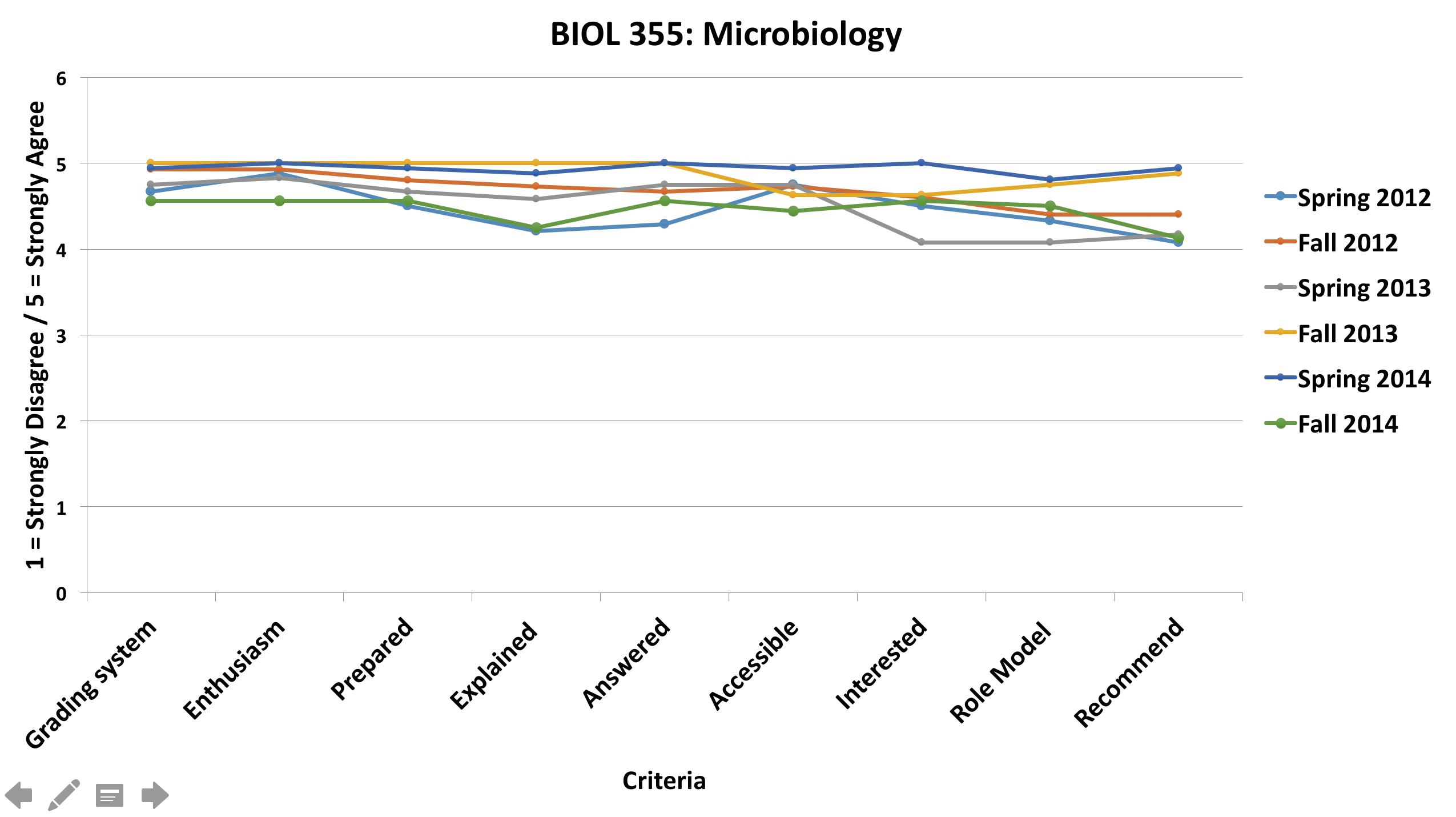
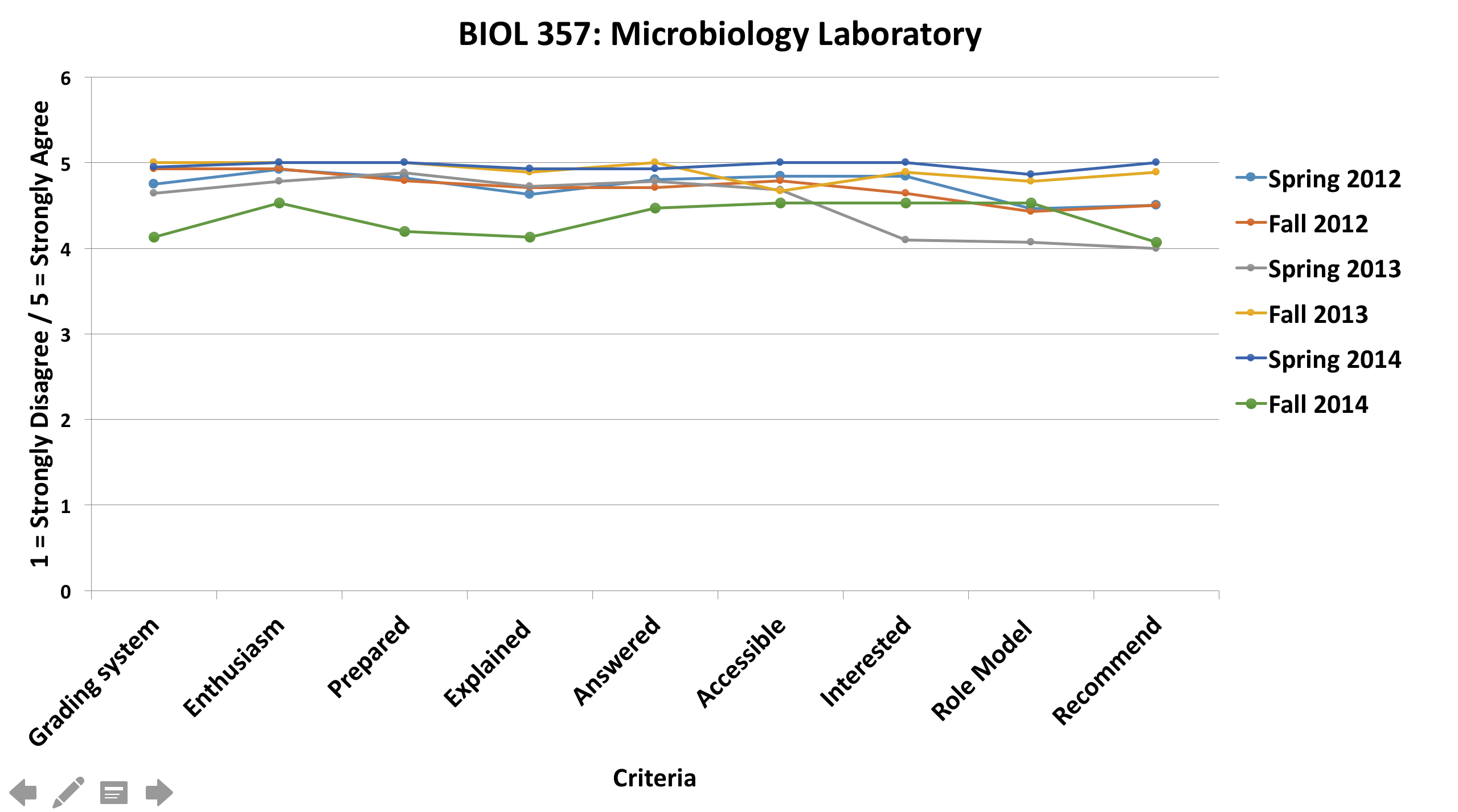
For the IDEA-CL evaluations, in the Summary of Teaching Effectiveness, there are three scores: summary, progress on relevant objectives, and overall ratings. I have two semesters of data where I averaged 3.9, 4, and 3.75, respectively. The overall ratings indicated that this is an average of an excellent teacher and excellent course.
I use a traditional lecture format to deliver content to the students. I typically teach this class at 8:00 a.m., so I have found that I have to make the class time engaging for the students. One of the themes that I often repeat during the semester at appropriate times and with great energy is “EVERYTHING is about microbiology.” As I say it, I think I come across as a totalitarian nut who thinks there are no other important organisms besides microbes. I intentionally use this recurring statement in this way to emphasize that microbes are integral to all life, essential in nutrient cycles, and in understanding important biological concepts like ecology, evolution, cell biology, and biochemistry. I always receive the most encouraging comments from student evaluation at the end of the semester. Here are some of their thoughts:
- I thoroughly enjoyed this class and have learned a lot. Dr. Huddleston is very passionate for microbiology and really knows her stuff, and she is very genuine, charismatic and caring for her students.
- I found this class very informative and I learned a lot because of Dr. Huddleston took time to answer all our questions. I found the classroom atmosphere very conducive to learning because it was very discussion based that is how I learn the best.
- I am so thankful that I changed my semester schedule at the last minute last year to take this course, because this has been one of my favorite biology courses in college! Thank you for for encouraging me in biology and building my confidence and interest in this field. Amazing teacher.
Teaching in the microbiology lab. Microbiology lab is a fun lab to teach. I use a lot of inquiry-based teaching and current events explanations. I use teaching assistants to prepare the lab space and materials, but I do all of the teaching and interacting with the students. I really enjoy teaching the microbiology lab. It is a lot of fun. Teaching students to look at microbes and set up experiments with them is a very rewarding experience for both them and me. I get to interact with the students in a less formal setting, therefore getting to know them better.
As an undergraduate at another university, my microbiology professor was also the lab instructor. I had a very rich learning experience. When I went to graduate school at a much larger university a few semesters later, I was the lab instructor. I quickly realized that I did not have the knowledge to help the students learn the way my professor had helped me. I felt sorry for my students and those in other labs taught by first-year master’s degree students. I have gained more experience and knowledge and no longer feel sorry for my students in this regard. I am able to instruct them and draw their attention to microbiological topics that I had not intended. For example, in the Spring of 2014 one of our experiments failed miserably because of widespread contamination. At first I was disappointed in the failure, but then I was able to turn the experiment into one where we looked at the contamination, deduced where it came from and how, set up an experiment to test our hypothesis, collected the data, and came up with a conclusion. Because of my previous experience, I can turn almost any lab failure into a teachable moment.
I make the lab a rich learning experience because I couple the lab and lecture in meaningful ways for the students. I see that lab and lecture components of a course to be intertwined and supportive of one another. Since I am always thinking about both of these I can refer to them in both courses and help the students make important connections.
Teaching strategies employed in microbiology lab and lecture. I discuss several of the major assignments that I employ in these classes and the rationale behind them.
5-minute microbe. The “5-minute microbe” presentations are given daily by students. They have 5-7 minutes to present information over an assigned microbial genus and can use one PowerPoint slide. I designed this assignment after several years of frustration over the way the diversity of microorganisms is typically taught. When I initially taught this lecture course at another university, I taught it the same way that I had learned it. I taught three chapters in a row covering a different microbial species every five minutes for two to three weeks of class. It was not an effective way to learn about these microbes. It was also a very exhausting and overwhelming method for both the instructor and student. When I came to ACU, I redesigned the method of delivery of this information so that the students presented it over the span of the entire semester. There are 36 different phylogenetic groups, genera, or diseases. The students are exposed to the information in smaller chunks and by different teachers. They are given time to process the information and ask meaningful questions.
Current events group presentations. The current events presentations are given the second day of lab each week by lab groups. There are always so many microbiologically relevant topics in the news that I do not get to cover in lecture. I designed this assignment so that the students are aware of the events happening right now that relates to course material. These events have included West Nile Virus, Ebola outbreaks, HIV “cures”, biofuel development, and vaccine development. One student commented in an evaluation, “She made mostly everything that she was teaching us applicable to the real world and made us think about how it would apply to us everyday!”
Hypothesis-driven independent projects. Each group formulates a microbiological hypothesis and then carries out the appropriate experiments and controls over a span of about four weeks. The students then write up the results in the form of a scientific article. I have them use the format used by the American Society for Microbiology journals. This type of assignment is important in teaching the process of science to undergraduate science majors. It falls in perfectly with the recommendations of the American Association for the Advancement of Science (AAAS) Vision and Change document.
Unknowns Activities. In the lab I have two different activities where the students identify unknown microorganisms. The first unknown bacterial cultures are given to the students and they identify them based on traditional methods, such as carbon utilization patterns and other phenotypic characteristics. This allows them to create and use dichotomous keys in order to logically determine the identities. The second bacterial unknown exercise was added in Spring 2014 and gives the students an idea of how modern-day microbiologists isolate and identify unknown bacterial strains. The students isolate their own unknown bacteria from vacuum bags, hot water heaters, or any other unusual environment they can think of and use PCR to isolate the 16S rRNA DNA and then have it sequenced. The students are taught how to think critically and solve microbiological identity problems in these activities. The students also enjoy these activities. One student said, “I liked the unknown experiment and doing the rRNA sequencing. It was a good way to actually see how microbiological research is conducted.”
Concluding thoughts. Microbiology lecture and lab have always been my easiest courses to teach to students. I am fully engaged in the material, so it makes it almost effortless to design projects and learning activities that are relevant and useful.