This course is a biology class for non-biology majors. I have students that major in a wide variety of different subjects, but have the most students from Teacher Education, Psychology, and Speech Pathology. I see this as a very important class. It is a chance for students to learn enough biology to understand how to make decisions about their current health, but more importantly giving them a foundation so in the future they can make wise decisions in medical situations, raising their own children, teaching other children about science, and in public policy. I predominantly teach about how the human body works, the importance of bacteria and viruses, and global resources and stewardship.
I have taught this course every fall since beginning in Fall 2011. The first time I taught this class, I struggled. It was my first semester at ACU and my first lecture course to teach non-biology majors. I decided to teach this class in the same way I would teach a majors biology class, but just go into less detail in the lectures. It was a disaster. In retrospect, that was a bad decision. I did not understand that non-biology majors needed for their instructor to use a different approach. My teacher evaluations were filled with negative comments such as:
- “Teach more at a student level instead of at a upper class/graduate level.”
- “Dr. Huddleston could be more specific when teaching.”
- “Appear to be less intimidated while teaching.”
- “The tests were unreasonable, when the class average is in the C or D range, something is wrong with the exam, not the students.”
- “I think what could maybe be changed is her overuse of powerpoints. I am a hands on leaner and learn by doing homework and class exercises and by barely having interaction I had a hard time paying attention or fully understanding.
- “I cannot really think of anything in particular that made me have an effective learning environment. Seeing science is my favorite subject, and see it taught so poorly and with a lot of detail missing really upset me.”
There were also positive comments about me being approachable and the Powerpoint presentations being accessible for studying, but the numerous negative comments greatly influenced how I approached this course the next time I taught it. Many of the above negative comments had some truth to them. I did not know how to teach this type of student. It is much easier to teach a student who likes biology enough to major in it than one who does not even care about the subject. One of my teaching goals for the 2012-2013 academic year was to redesign BIOL 101 to make it more accessible and meaningful to the students.
I selected a different textbook. I also asked the students at the beginning of the semester what topics in biology they were interested in learning more about. I integrated most of those topics into my lecture. In this way, the students felt they had some control over a class they did not really want to initially be a part of. I found that it was more engaging for the students when I lectured for 15 to 20 minutes and then had an activity for them to work on with their neighbors for 5 to 10 minutes and then have a class discussion about the topic. This kept their attention. They also knew that at any moment I might call on them for an answer. I also assigned more meaningful assignments, such as keeping a food diary for three days and determining the amount of calories and nutrients they received. This included a personal reflection on the assignment where many of them said they realized they had to change their eating habits! I felt like the students were much more engaged this semester than the first time I taught this course. Several of them told me they enjoyed it. My student evaluations were much better this time. It is somewhat odd to me because the same proportion of students earned As, Bs, Cs, Ds, etc as the first semester. They were just happier about it. I only covered about half the amount of the material this semester as opposed to the first. I intentionally sacrificed quantity for quality. In turn, I believe the students retained more information.
The first change that I made was to lecture less. Lecture over less material. Lecture in less detail. This was very hard for me to do since I had never been involved in a science class with so many interactive activities. I did not really even know how to come up with and implement interactive activities. I covered about 50% fewer Powerpoint slides each class meeting and did more interactive activities that I found on the internet, in textbook supplements, and some that I created on my own. Their comments and discussions in class reflected that they were learning more and understanding more about biology than the students in the first class. The next change that I made was to try to apply the class to their lives. I grouped them by major or career goals and had them give an oral presentation about how biology was relevant to their careers.
My initial goal was for them not to hate biology when they finished my course. Furthermore, I wanted them to be able to understand current events pertaining to biology. I continued this model with success for the past four years. In the Fall 2013 course, I changed the oral presentation topics from biology and career to a presentation about a current event in biology, such as Zika Virus or Ebola Virus. I changed from the biology and career format because I had so many groups of speech pathology majors and psychology majors who were covering the same topics. The presentations were becoming redundant. I now incorporate those career-specific topics into my lectures and have a wider variety of student presentations.
The last four times I have taught this course, I have received much better feedback from the students. Here are some of their positive and negative comments:
What did the instructor do that made his/her teaching effective?
- “There was a lot of interaction with the other students and the teacher that made things a little easier to understand. She answered a lot of questions that we had and made sure that we understood.”
- “I loved the fact that she was always so excited and interested about the subject, and that she tried to break up the lectures with group work. Most things were explained very well.”
- “She was very thorough, and sure to answer all of our questions. She also related the subjects to our everyday lives, making it easier to relate to and remember.”
- “I really like the fact that Dr. Huddleston made biology interesting. I have taken MANY biology classes during my time at ACU, and I had trouble passing them because I was not good at studying, but also because the teachers are so boring! I really liked the fact that she made biology relevant to me (I’m not a biology major) because I really don’t like biology that much. I’m not very good at it, and in all honesty I find it boring most of the time. However, Dr. Huddleston made it interesting because she talked about diseases, foods, and cancer which are all things that people deal with at some point in their lives. I also enjoyed the presentation assignment that we had to do, because it showed how biology is relevant in different majors/career. I also really liked the fact that she showed us how to use and epi-pen because that is useful for when I work with kids!”
- “She shared her passion for the subject and it made the objectives seem more attainable and realistic for me.”
What could the instructor do to improve his/her teaching effectiveness?
- “Provide reviews for tests.”
- “Sometimes depending on the topic the lectures would feel very long and need a enthusiastic boost.”
- “Teaching style is good. I just wish she could have provided us with some sort of review guide for our test because of the huge amount of information in each section.”
After the above comments, I started giving out a study guide. When I combined the student recommended improvements for the course evaluations from 2013 and 2014, 43% of the comments strongly suggested that I give a review for the exam. Until this point I had told them that their review is the powerpoints of the lectures and to use that as a guide for studying. The students did not respond well to this suggested strategy. I had been hesitant to give out traditional review sheets because I was afraid they would limit their studying (and learning) to just those sheets. In Fall 2015, I reluctantly added the study guide. The study guide is a detailed question sheet over every Powerpoint slide that I cover in class. The questions are available throughout the semester, so the student can work on this assignment daily. It has to be handwritten by the student and turned in the day of the exam in order for the student to receive full credit. The study guide ends up usually being about 30 pages handwritten. Honestly, if I were a student in my class required to do this assignment, I would absolutely hate it and feel like it was a tedious assignment. However, the students seem to appreciate it. I have heard no complaints. I usually receive comments like this one from Fall 2015:
- I think Huddleston did a good job teaching this course. I really liked receiving study guides for the tests; they helped me prepare and learn before taking the exams. The homeworks were interesting and I learned more real world knowledge from them.
There is still much room for improvement. I plan to add more interactive activities and critical thinking about biological topics.
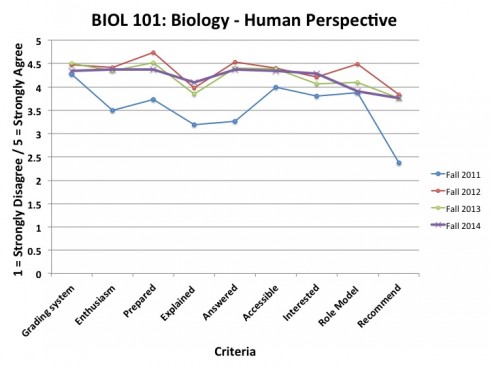
I have made significant progress in improving this course. This is evidenced by the student evaluations comparing Fall 2011, Fall 2012, Fall 2013, and Fall 2014 shown in the graph below. (Fall 2015 is not shown since it was not evaluated under the old course evaluation system.) I have improved in each category since the first semester. One of my lowest averages is in “The instructor explained the course material clearly.” This average increased slightly after I started assigning the test review. For this course, I always score the lowest in the “I would recommend this instructor to other students”. This could reflect the fact that most of the students do not like biology, or, possibly, I could do a better job teaching the course and making it more relevant and engaging for the students. This is a very subjective and vague question that is not particularly helpful to me when making adjustments in this class. This biology course for non-majors is the best example of how I have successfully taken constructive criticism and become a much improved teacher of these unique students.
For the IDEA-CL evaluations, in the Summary of Teaching Effectiveness, there are three scores: summary, progress on relevant objectives, and overall ratings. I have one semester of data where I scored 4, 3.8, and 4.2, respectively. The overall ratings indicated that this is an average of an excellent teacher and excellent course.
This course is still a work in progress. My ultimate goal is for these non-biology majors is to lead them into loving biology. I will be working on this goal for the rest of my career. Teaching this course is a great opportunity for me to accurately inform and impact the lives of students who will become teachers, speech pathologists, parents, writers, musicians, and politicians.