This is a list of my peer-reviewed publications and a patent that were published during my time at ACU to fulfill departmental requirements for Tenure & Promotion. Click on the blue text to read the full articles. The links will open in a new tab on the browser.
Lindsey, M., and Huddleston, J.R. (2016). Isolation of Halophilic Marine Bacterium from an Inland Petroleum-Producing Well. Submitted to Fine Focus, August 11, 2016.
This article is the result of an ambitious microbiology student. Maedgen Lindsey enjoyed the environmental microbiology project that he completed in BIOL 357: Microbiology Lab. He wanted to do a few more experiments and write up the study for a small publication. I decided it was best suited for publication on an undergraduate microbiology journal, Fine Focus. He took water samples from oil wells on his property in Merkel and isolated microbes, Idiomarina and Marinobacter, that are typically found in the ocean. Maedgen will be attending graduate school in microbiology in the Fall of 2016 at the University of North Texas in microbiology. I thought writing up this research and submitting it himself was an excellent introduction to the kinds of things he will be doing in graduate school. (I usually submit the paper and correspond with the editor instead of having the student do it.) He was surprised how hard it is to write a scientific paper and how many revisions it takes before submission can occur.
Preston, K. E., and Huddleston, J.R. (2016). Gram-negative, oxidase-positive bacteria in rainwater and wind samples. Accepted to Fine Focus, July 30, 2016.
Read the accepted article here. (The link opens in a new tab on the browser.)
This is my first peer-reviewed publication with an ACU student. Kathryn Preston began doing research in my lab as a McNair scholar. About ten years before meeting Kathryn, I had isolated what I thought to be Aeromonas from rainwater. I did not pursue this finding, but these preliminary results continued to pique my curiosity over the next few years. Aerobiology is a relatively new subdiscipline in microbiology in which the atmosphere is studied for the presence of life. Aeromonads are considered to be ubiquitous in freshwater. My hypothesis was that Aeromonas species are ubiquitous because the cells are transported through wind currents and rain to different aquatic environments. My one colony on one selective plate years ago supported this hypothesis. ACU students Sally Hays and Kathryn Preston worked on this research with me attempting to isolate Aeromonas from wind, hail, and rainwater samples. The original title of this work was “Isolating Aeromonas from rainwater and the atmosphere”. However, the results did not support my hypothesis nor the title of the manuscript! Not a single colony of Aeromonas was isolated. We had to change the title to be more reflective of what we found. We did find what we think are a couple of new species and many species of Pseudomonas and Sphingomonas.
After we were unsuccessful at isolating Aeromonas from rainwater samples, I was discouraged, ready to drop the project, and willing to move on to more interesting research. However, I felt like I should not just drop the project since Kathryn, especially, had put in many hours and good work into this project. So I came up with a plan to publish the paper with a different slant.
As a graduate student, I would have just let this project die, but I remembered something one of my non-official mentors taught me. Donna Alvermann is a literacy professor in the Department of Language and Literacy Education at the University of Georgia. She is extremely prolific in her publishing; Google Scholar says she has 354 publications. She publishes every research project she works on. She isn’t afraid of rejection. She and my husband wrote several papers together. When they would receive their scathing reviews and rejections, unrattled she would say, “We just haven’t found this manuscript a home yet. We have to keep resubmitting until we find it a home.” She always did. During this aerobiology project is when I decided to write up every piece of research that I or my students carry perform into a manuscript and get it published, no matter how small, insignificant, or disappointing I perceive the results to be. I feel like I owe it to the students who spend so much time doing the research. Preparing a manuscript for publication is a different kind of mentoring than teaching someone techniques in the lab. Teaching someone to receive rejections and respond to criticisms is yet another.
I decided that this aerobiology research would be most appropriate for an undergraduate journal. The results were not high impact, yet it was a good, solid study. We prepared the manuscript for a new peer-reviewed undergraduate journal specifically for microbiology research, Fine Focus.
Huddleston, J. R. (2014). Horizontal gene transfer in the human gastrointestinal tract: potential spread of antibiotic resistance genes. Infection and Drug Resistance, 7, 167–176.
(Cited 24 times as of August 2016)
Read the full article here. (The link opens in a new tab on the browser.)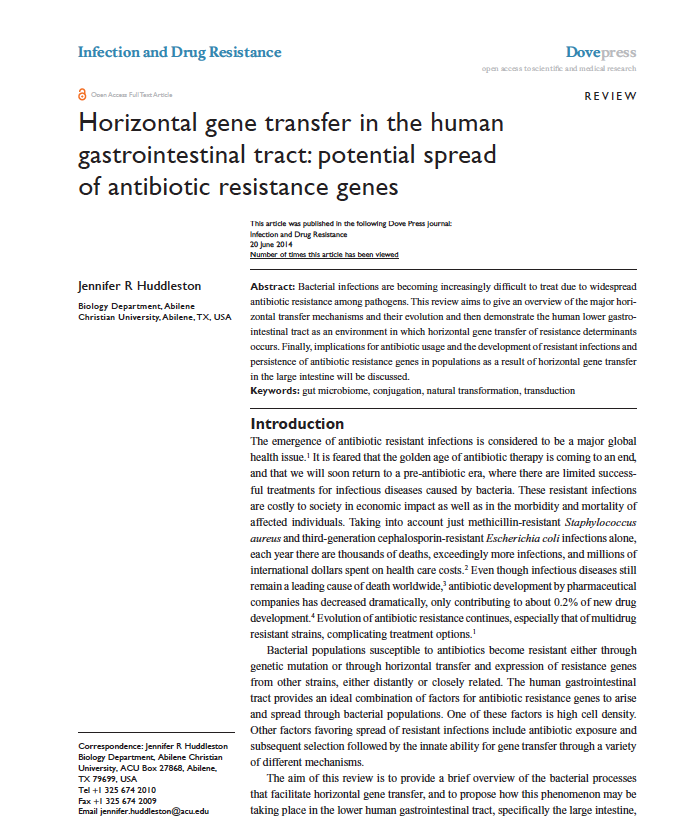
The editor of Infection and Drug Resistance invited me to write this review article because of my recent article over natural transformation (one of the mechanisms of horizontal gene transfer). However, I knew very little about gene transfer in the gastrointestinal tract before writing this paper. I thoroughly enjoyed doing the literature search for this paper. The information in this paper is terrifying – antibiotics induce horizontal gene transfer in the human intestine, resulting in increased antibiotic resistance. I was writing this paper at the time my infant son was going through three rounds of antibiotics for antibiotic-resistant ear infections. I lay awake at night worrying about how the antibiotics were altering his gut microflora and the long-term implications these treatments were having on his entire microbiome and on the antibiotic resistance profiles of his gut population!
Huddleston, J. R., Brokaw, J. M., Zak, J. C., & Jeter, R. M. (2013). Natural transformation as a mechanism of horizontal gene transfer among environmental Aeromonas species. Systematic and Applied Microbiology, 36(4), 224–234.
(Cited 6 times as of August 2016)
Read the full article here. (The link opens in a new tab on the browser.)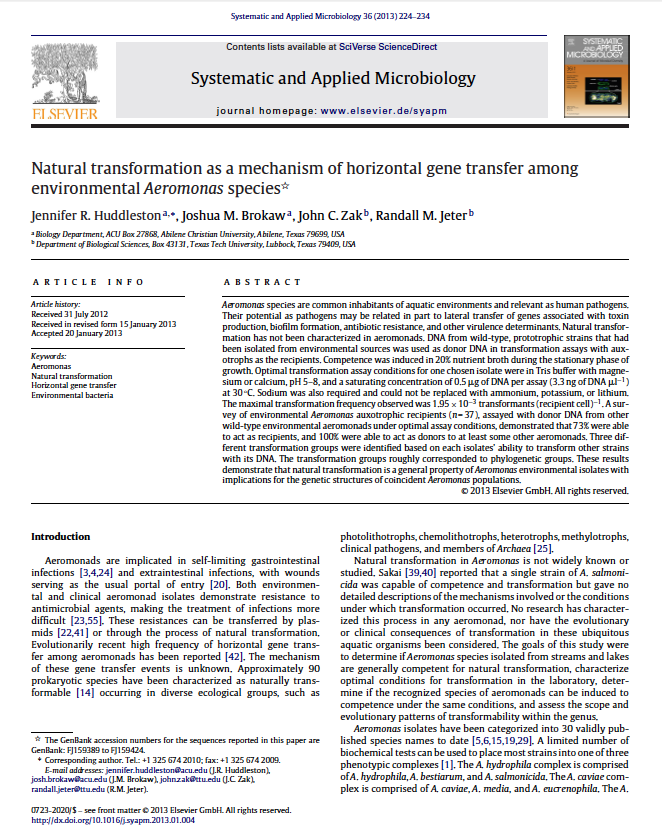
This article is the result of many years 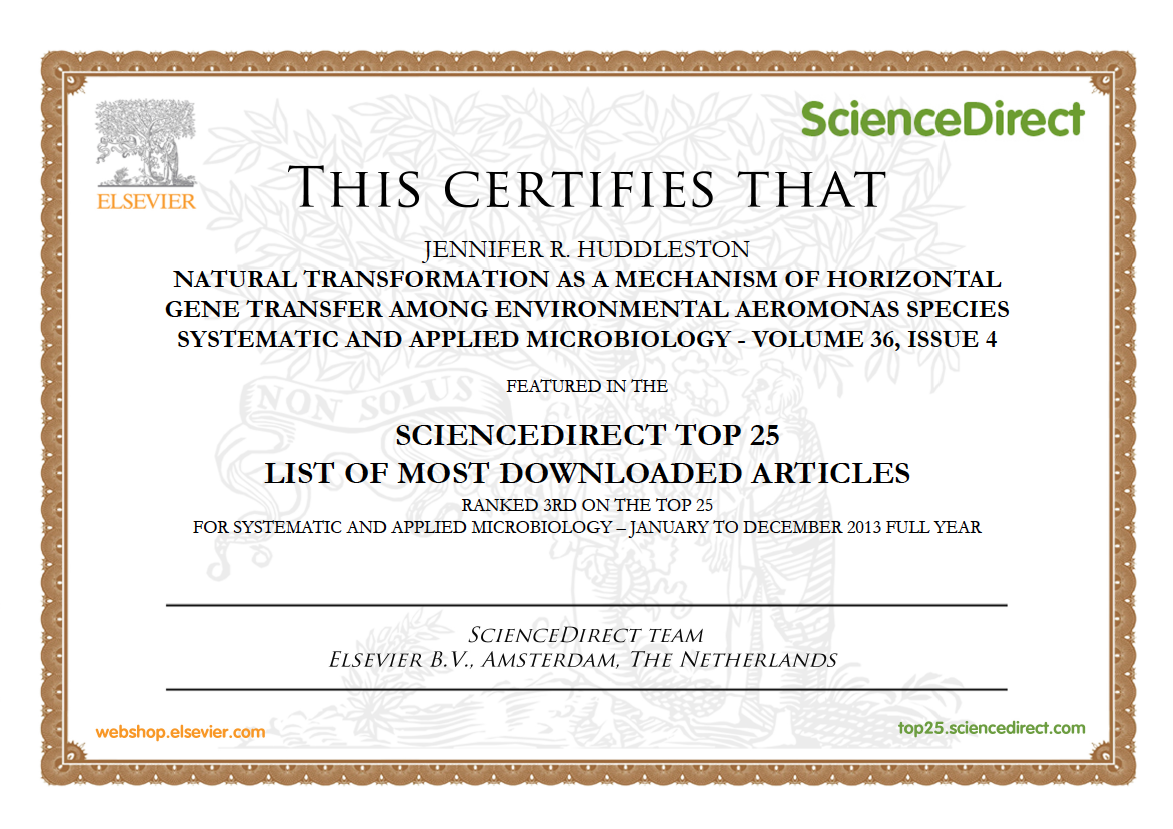 of work, both in the lab and in the preparation of the manuscript. The research is the bulk of my dissertation work. I submitted it off and on to various journals over several years. It seemed that each time it was rejected, two peer-reviewers liked it, the third always disliked it, and the editor always sided with the third reviewer. In the summer of 2012, I submitted this manuscript to the journal Systematic and Applied Microbiology in which the editor replied, “Your study is well structured, it reports novel data, and the topic is within the scope of our journal. I have therefore decided to ask you to prepare a revision in which you carefully consider the reviewers’ comments.” The requested revisions pertained to systematics and were absolutely impossible for me to do alone. My previous collaborator on this portion was overwhelmed with other projects and not particularly interested in pursuing this. Since Josh Brokaw is an expert in systematics, though not bacterial, I asked him to collaborate with me on these revisions. Josh looked at my data and reconstructed all of the analyses to the satisfaction of the editor. We were able to collaborate and create a manuscript that was so much better than the one I had initially submitted to the journal. In the years preceding this, I was never able to produce on paper what I envisioned in my head. I did not have the skills to do it on my own. After this collaboration, the manuscript was exactly what I had hoped it would be. This article also ranked #3 in the “Top 25 Hottest Articles” in the Environmental Science category in Systematic and Applied Microbiology. Click here for the ranking list. (The link opens in a new tab on the browser.)
Chung, D.-H., Huddleston, J. R., Farkas, J., & Westpheling, J. (2011). Identification and characterization of CbeI, a novel thermostable restriction enzyme from Caldicellulosiruptor bescii DSM 6725 and a member of a new subfamily of HaeIII-like enzymes. Journal of Industrial Microbiology & Biotechnology, 38(11), 1867–1877.
(Cited 15 times as of August 2016)
Read the full article here. (The link opens in a new tab on the browser.)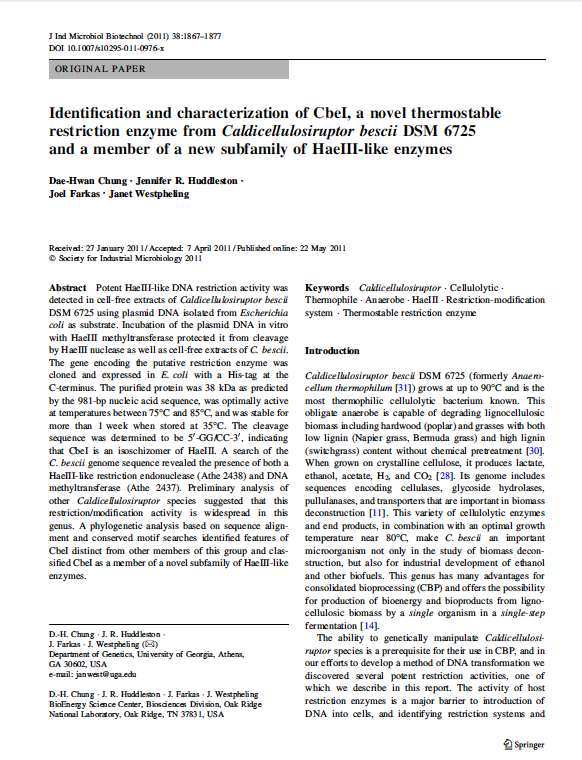
During my first position as a postdoctoral research associate at the University of Georgia, I worked in a lab that was part of a Department of Energy-funded BioEnergy Science Center (BESC). Our lab’s responsibility was to develop a genetic system for Caldicellulosiruptor bescii. This hyperthermophilic anaerobe was a candidate for the conversion of cellulosic material to ethanol. The problem was that no one was able to genetically manipulate it. Easy genetic manipulation of a microbe used in industrial processes is mandatory. For two years we struggled to successfully introduce DNA into this organism. We tried every conceivable method and each time we were met with failure. It occurred to me that the DNA was probably being degraded by restriction enzymes upon entry into the cell. A quick genome search showed that there were several probable restriction enzymes. One of these was similar to one previously known, HaeIII. HaeIII was originally described in Haemophilus influenzae. We extracted this new enzyme and named it CbeI. We did in vitro studies and determined that this enzyme was indeed what was degrading the DNA we were trying to insert into the C. bescii cells. We knew this was the main barrier to successful genetic manipulation of this important organism. Although this research was done in the lab in 2010, I continued to work on manuscript revisions while at ACU in 2011.
Westpheling, J., Chung, D., Huddleston, J., & Farkas, J. A. (2015, February 2). Restriction/modification polypeptides, polynucleotides, and methods. U.S. Patent Serial No. 8,962,333. Assignee(s): University of Georgia Research Foundation, Inc. Washington, DC: U.S.
Read the full patent application here. (The link opens in a new tab on the browser.)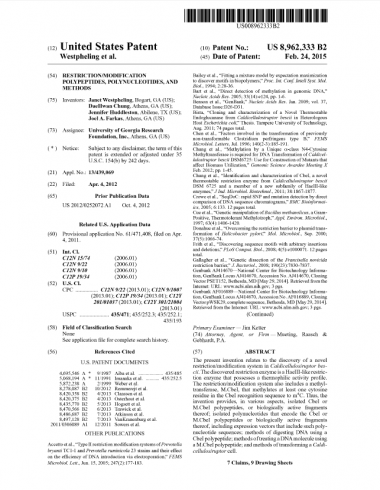
Since bioenergy is a rapidly growing and competitive industry, the primary investigator of this project decided that we should patent the CbeI mentioned in the above companion paper. Basically, if anyone in industry used CbeI to profit, its companion (and more important) enzyme, MCbeI, or any techniques published in the above 2011 paper, then the patent holders, especially the University of Georgia, would receive a small percentage of the profits. This patent application took much time to process with much discussion with UGA patent lawyers. I worked on this patent application and had discussions with patent lawyers while employed by the Biology Department at Abilene Christian University.
Chung, D., Farkas, J., Huddleston, J. R., Olivar, E., & Westpheling, J. (2012). Methylation by a unique α-class N4-cytosine methyltransferase is required for DNA transformation of Caldicellulosiruptor bescii DSM6725. PloS One, 7(8), e43844.
(Cited 30 times as of August 2016)
Read the full article here. (The link opens in a new tab on the browser.)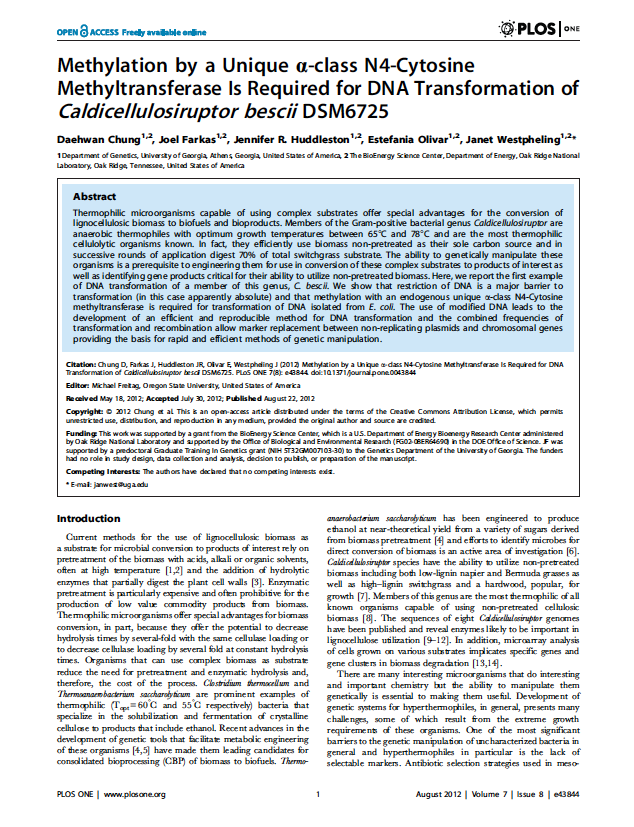
This is the last paper published as a result of my work at the University of Georgia. In my last month working in this lab, I started the experiments for this paper. I successfully protected DNA with MCbeI (methyltransferase) to genetically modify C. bescii. These experiments continued after I left. I worked on writing and revising the manuscript while at ACU. It took four years to develop and publish a genetic system for C. bescii. There have now been a total of sixteen papers published starting with these two key papers. C. bescii is now a very strong candidate to be used to convert plant biomass to ethanol.
A summary of this paper can also be read on the Green Car Congress blog. (The link opens in a new tab on the browser.)