
Insights from the Numbers
My first seven years, through Spring 2010, I repeated my fall and spring classes, with the exception of Falls 2007 and 2009 when I taught at Study Abroad. In general, I taught two sections of Introduction to General Chemistry and one section of Biochemistry I lecture and lab in the fall and two sections Organic and Biological Chemistry and one section of Biochemistry II lecture and lab in the spring. Starting Fall of 2010, my schedule began to vary due to the hiring of Dr. Sarah Lee and changing departmental needs. The list of courses taught can be found on the Courses Taught page. The student evaluation data is grouped in Tables I, II, and III for Fall, Spring, and Summer, respectively. The data is averaged and weighted for the number of students responding. Data for individual courses can be found in the Student Evaluation Data Tables.
Table I: Summary Student evaluations in fall courses by year.a
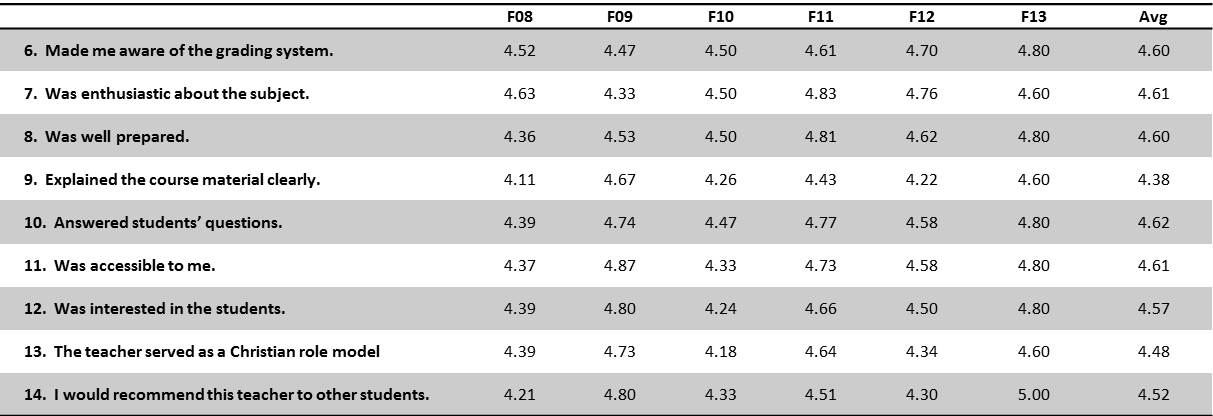
aData averaged in the tables corresponds as 5 – “Strongly agree,” 4 – “Agree.” 3 – “Somewhat agree,” 2 – “Disagree,” and 1 – “Strongly disagree.”
Table II: Summary Student evaluations in spring courses by year.a
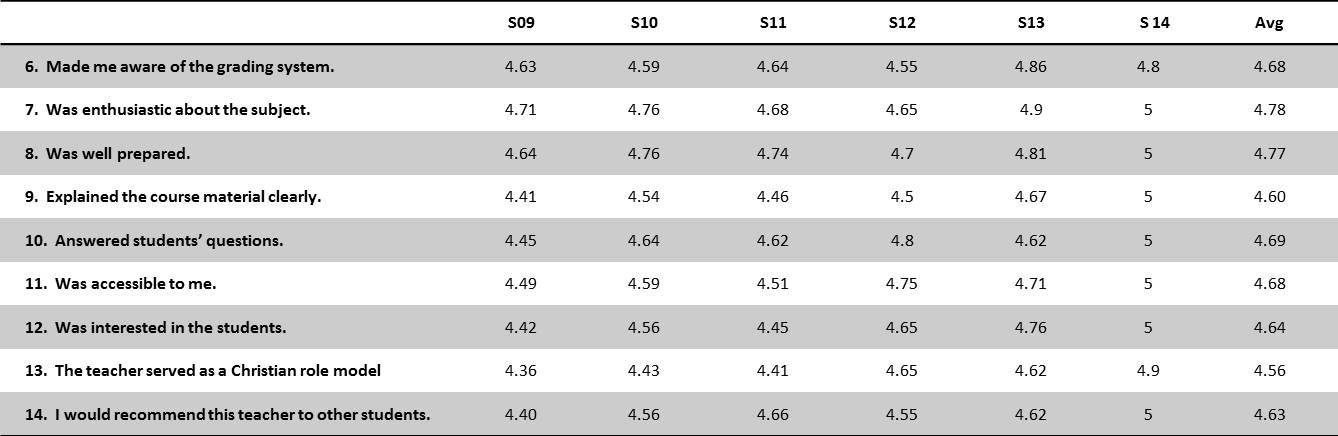
aData averaged in the tables corresponds as 5 – “Strongly agree,” 4 – “Agree.” 3 – “Somewhat agree,” 2 – “Disagree,” and 1 – “Strongly disagree.”
Table III: Summary Student evaluations in summer courses by year.a
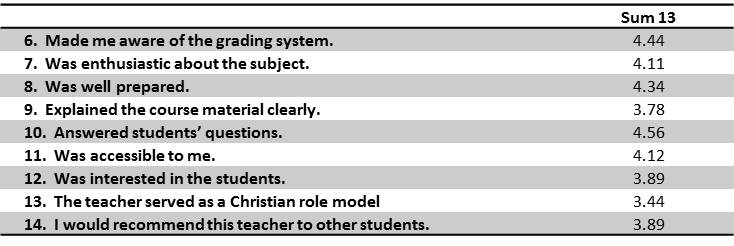 aData averaged in the tables corresponds as 5 – “Strongly agree,” 4 – “Agree.” 3 – “Somewhat agree,” 2 – “Disagree,” and 1 – “Strongly disagree.”
Overall, my evaluations from year to year have been roughly the same. My first few years of teaching saw an increase in these numbers, but as I hit my own groove in teaching they have mostly leveled off, albeit increasing slightly over the last five years. They do, however, vary by Fall, Spring, and Summer.
One interesting trend is the increase in score from fall to spring of the same school year, on years when I taught continuing courses in the Spring (’09, ’11, ’13). Because I taught the continuing classes, I had essentially the same students in the spring as the fall. The classes in the spring were smaller, because not all of the students who take the first semester course need the second semester for their degree plan. I believe these two factors influence the increase of the scores. Students being in a class for more than one semester allowed them to grow accustomed to my teaching, grading, and examination style. This led to an increase in questions 6-9. In addition, smaller classes and having spent two semesters together allowed the students and me to get to know each other better. This led to an increase in questions 10-14. I do not have a good explanation for why this also held true Spring ’10 and Spring ’14.
I only have one set of data for Summer courses. Summer 2013, I taught Chem 113 (Introduction to General Chemistry) and Chem 114 (Organic and Biological Chemistry) online. Less than half of the students from Chem 113 filled out the Student Evaluation and only one student filled out the form for Chem 114. While this is a relatively small data group to look at, I believe it confirms what I felt about teaching online: that it did not use my strengths in teaching. I feel one of my strengths is building relationships with students and being able to look them in the eye and see when they understand and when they do not. Being limited in my inability to have regular face to face interaction, lessened my ability to teach well.
My highest ratings have generally been in a preparedness, enthusiasm, answering students’ questions, and accessibility. As a student, I occasionally had professors who did not provide a clear grading scale, which I found very frustrating. I make a particular effort to provide a clear grading scale at the beginning of the semester and follow through with it. I also felt very frustrated when I felt like the professor did not have a plan for the day, so I try to go in with a structure and a plan. While I may not be enthusiastic about my subject every day, if I feel and/ or act bored with the material, the students will feel and act the same way. I try to be around as much as possible during the day to answer questions and allow students to call me at home. I feel that most students are aware of this and some even take advantage of my availability.
My lowest scores are consistently in explaining course material and serving as a Christian role model. Because of the nature of the courses that I teach, I know students will not always be able to understand the material in class. Biochemistry often takes time spent in study and contemplation to comprehend which cannot be done in class. In an effort to address this, I implemented Just-in-Time-Teaching and Peer Instruction as described in New Teaching Methods. Many students who take the Introductory Chemistry sequence struggle in math and science and therefore need to spend extra time outside of class working on the material. As I have broadened the types of classes I teach, I have had slightly different responses to this question. For example, two of the three semesters in General Science for Elementary, this was one of my higher categories. I am continuing to try new techniques to help students learn the material better.
The other area where I have my lowest scores has been in being a Christian role model. While they are not low scores, it disturbs me that this is the area that students perceive to be one of my weakest. I do feel this often has to do with how well my students know me. Study Abroad semesters this is quite high. Fall 2011, there was a series on Wednesday nights at Minter Lane that I thought my students would find interesting. When I mentioned this in class weekly, I had a much higher score. I also notice that in semesters in which I do not “click” with my students well, I tend to have lower scores in Christian Example. As addressed in Integration of Faith and Learning, this is an area with which I struggle. I am still trying to figure out the best way to handle my responsibility to teach chemistry and integrate/share my faith with students.
Insights from the Comments
My first several years teaching, I found the comments in student opinion surveys to be quite helpful. I found the students often pointed out things that I did not know I did in class and could then adjust my class to make it more hospitable to my students. However, as I have matured as a faculty member I feel I can more readily predict what the comments will say. I do still find them useful particularly when I am trying something new. A full list of the comments made by students in evaluations can be seen on the Student Evaluation Comments Page. Below I share some reflections for different courses.
Biochemistry I and II
My biochemistry students tend to be willing to share more opinions than the rest of my students. Generally the comments are positive. Comments such as “She was excited about the subject.” and “Great professor, shows interest in students and is very helpful.” are relatively common and very encouraging, but they do not help to guide me in my teaching.
As I introduced Just-in-Time Teaching (reading before class), Peer Instruction (in class questions and discussion), and Process Oriented Guided Inquiry Learning (in class group work), students’ comments have helped me reflect on my these new techniques. I had several comments in support in general for the overall techniques such as: “Your teaching method was great. I love the way that you structured the class- learning was much better than just lectures.” One thing that surprised me was that for the Just-in-Time Teaching, I really only had positive comments such as: “The readings before each class period prepared me for the lectures very well.” or even “As annoying as the homework is, it is helpful.” This, along with feedback from students who have graduated, helped me know I was one the right track with this technique.
Peer Instruction and Process Oriented Guided Inquiry Learning have both received mixed reviews. Peer Instruction received several comments like “I liked using responseware in class, it made me stay focused.” but a few negative comments such as “… I didnt think that class responses during class was efficient. Too much time was spent waiting for voting rather than teaching…” As is often the case with group work there were several comments that had diametrically opposed view points such as “More gruop (sic) work” and “Eliminate group work.” However, having both the bigger picture and an overall positive response to these techniques, I decided to keep using them.
The area where I receive the most negative feedback in my classes are on my biochemistry exams with comments such as “The tests were somewhat unfair. I was limited by my writing speed, not my knowlege (sic) of the material.” I am the first to admit that these are long tough exams, but this is a senior level biochemistry course. With being limited to 50 minutes for an exam, I always feel a tension there and do understand that. Occasionally a student will state in the comments that no one can finish the exams, but as class averages on the exams usually are above 80%, and most people finish, I take those comments understanding that they come from a slow test taker or underprepared student. While this has always been a concern of mine, I don’t know if I can or should make the exams shorter. I already pick and choose among the material I test on. I am trying to prepare students for professional and graduate school, and feel these tests must be difficult. I have tried to better prepare the students by warning them of the length and that they need to know the memorized portions of the exam material very well so that they don’t waste exam time trying to remember structures. I also feel that the use of Just-in-Time Teaching better prepares the students because many of the homework questions are similar to the exam questions.
Summer Online Courses
As mentioned when looking at the numbers in the evaluations, online teaching does not seem to play to my strengths. This was also reflected somewhat in the comments, mainly because they wanted more explanation, though to be fair, not a single student took me up on my offer to have Skype help sessions. There were many positive comments about the podcasts that I employed and my ability to respond to students such as in response to “What did the instructor do that made his/her teaching effective?”: “Detailed videos. Responded to emails fairly quickly. Patient.” Mainly the negative comments were a desire for more podcasts, “Use more videos to explain the complicated items. Giving us just more reading material does not always help us understand what exactly is going on.” These did help me see that I was on the right track with these classes. If I were to teach online again, I would try to add additional podcasts and push students to video chat with me for help more often.
Other Classes
Most of my non-majors classes did not have many comments, and most of these comments were generally positive. Comments such as “She did a really great job of covering everything we had questions on, made chemistry exciting, and was always open to discuss things further,” from Consumer, especially the part about making chemistry exciting, showed me that I met one of my overall teaching goals. Occasionally in these classes I will have a comment asking me to slow down, particularly in the Introductory Chemistry sequence, but usually I spend as much time in class on any given topic as possible. I generally look forward to reading the comments from these classes, although they often do not provide me a great insight into my teaching.
| Previous Page New Teaching Methods |