This fall we published our second annual report in iBooks Author, a way to provide the campus a glimpse of what we’ve been up to in the last year and to continue to stretch our conception of electronic texts. Just wanted to share links to those to projects.
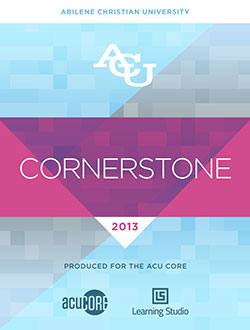
Cornerstone 2013 ebook
Last spring we began meeting with faculty from the freshman seminar program at ACU called Cornerstone about the possibility of publishing our own electronic textbook. This week we shared the result of that work when Cornerstone 2013 went live on the iBookstore.
The book is the product of several months of planning, writing, and editing before we brought the content into iBooks Author for final designs.
Cliff Barbarick and Karen Cukrowski worked with me on editing chapter submissions and then beginning to think about how to incorporate interactive media elements. Nathan Driskell put in many hours to bring the design to this level of maturity this quickly and was also a huge help in thinking through how to integrate media assets into a book that needed to emphasize strong writing and reasoning.
A remarkable first effort that we’re really proud to share with students next week.
Photo Walks this summer
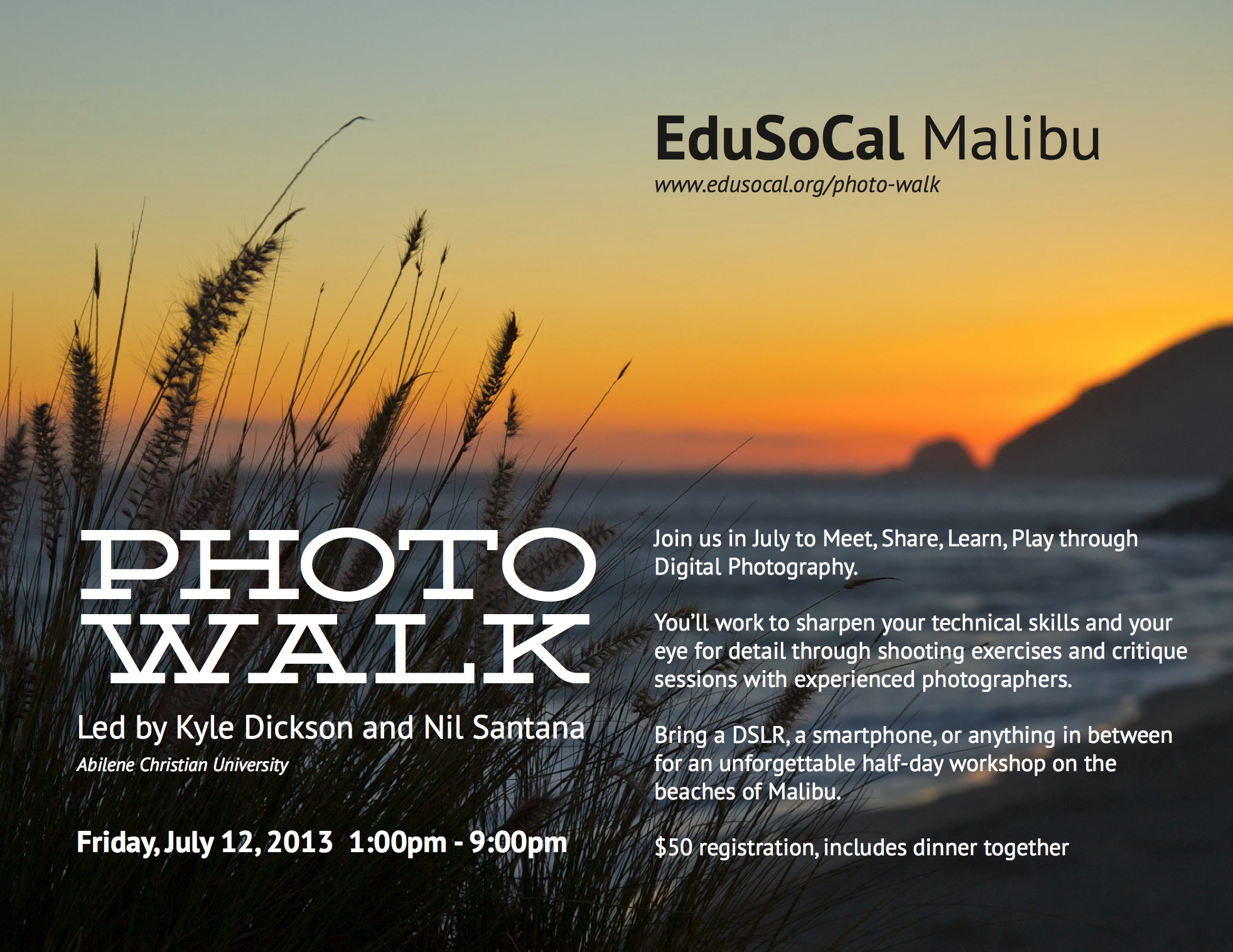
This has been a full summer anyway, but in the midst of other Learning Studio projects Nil Santana and I found time to lead a couple photography workshops.
In June, we were with good friends from the New Media Consortium and led a two-day pre-conference photo walk on Hilton Head Island in South Carolina. Some great time meeting folks from around the country wanting to improve their photography and experiment with low-light and time-lapse as well.
Then in July while I was teaching a class at Pepperdine, we led a group from EduSoCal on some of my favorite beaches in Malibu. It was a full day that ended with some of the thickest fog I’ve seen, transforming Southern California to Sussex, but we had a great time.
We Are Makers premiere
After several months of work with Nathan Driskell and Mathew Bardwell in the Learning Studio, our first short documentary premiered this last week. We Are Makers is an introduction to the workshops and people behind the Maker Movement.
It started as a series of conversations at ACU around what a makerspace would bring to undergraduate programs on campus and really sparked a lot of energy that led to a full-blown film project. We enjoyed really generous interviews with Dale Dougherty from Make Magazine along with folks from Etsy, School of Visual Arts, and the New York Hall of Science, among others.
We were delighted when the New Media Consortium gave us a slot at the summer conference in Hilton Head to premiere the film. James Langford joined me for a presentation after the screening that kicked off a great conversation that spilled out into the hallways. Just a great opportunity to begin sharing the film more broadly.
- wearemakers.org – additional interview footage
ABSTRACT: The advent of 3D printing and the $40 micro-controller has sparked a renewed interest in Making and desktop fabrication. Teachers, librarians, and museum educators are taking a closer look at the DIY, hacking spirit behind the Maker movement and are asking how it might complement their use of problembased or challenge-based programs. The presenters will share work on a short feature produced by the AT&T Learning Studio at ACU that shaped campus consensus about the Maker movement, as well as a vision for its impact in K-20 education.
Studio hits the mountain
Just a quick update on a project I produced for my dad. In 1975, he and Cleddy Varner began teaching the Beginning Snowskiing class at ACU. I was on that first trip, not yet old enough to have my own poles (a source of some consternation at the time).
As the 40th anniversary of this particular class approaches, and as I’ve been able to share the mountain at Red River, NM, with my own son, I was just looking for a way to somehow connect the two experiences. My son Colin and my father Curt joined me for numerous rides up the chairlift, but on a couple of those I brought a Zoom digital audio recorder along.
The video was all shot on a Canon 5D mkII. It was my first time shooting with an ND Fader filter to help limit just how much of the unseasonably sunny day came into the lens, a great boon to shooting snowy scenes but a bear to focus reliably without a monitor.
“Beyond Analogue” this spring
Last summer I was invited to contribute a chapter to Les Watson’s survey of new approaches to space design in learning spaces and libraries. I’m delighted to have it on its way and was excited to see the volume appear (prematurely) in Amazon. Since the publication date is actually before the deadline for my final revisions, it seems optimistic, but looking forward to seeing this international survey of learning space design projects.
Better Library and Learning Spaces
ISBN: 1856047636
Publication Date: August 31, 2012
Making the most of library spaces can be both an exciting and challenging project to tackle. Better Library and Learning Spaces gives librarians, educators, designers, and students an innovative toolkit filled with ideas for transforming spaces in creative ways. This practical guide explores new models of learning and the technology revolution; the role of the library, focusing on new sustainable models; and the effects of spaces on identity and behavior. Filled with insights and ideas from international experts, this book is a resourceful guide to implementing change in library and learning environments.
NMC: Ideas that Matter – 20 Voices
I was honored last summer to be included in a film produced by the New Media Consortium and friends Bill Frakes and Laura Heald at Strawhat Visuals. Since my first summer conference in 2008, the NMC has been a source of creative energy and encouragement through formal events and individual collaborations.
Thankful to be a part of this group.
Visual Storytelling experiments
Over the last couple years I’ve enjoyed reconnecting with photography through our work with Nil Santana. Together we’ve led a number of workshops with beginning and intermediate faculty photographers, shooting on high-dollar cameras and smartphones. Over and over again we’ve heard colleagues reflect on the way attending to the changing light, movement, color, and basic compositional elements provides a more personal reminder to be fully present in each moment.
After seeing hundreds and hundreds of photos taken within a several square block area of the Texas hill country, you’d think you would have exhausted the possibility of the camera to show you something new or surprising. I think you’ll see in the work of faculty from these workshops just how various even a single street corner or building can be when we bring our own lens to it.
One personal challenge over the last year has been to begin to connect this desire to see each moment more clearly with the remarkable potential of DSLR cameras now to capture high-definition video. The following pieces started as technical experiments with a new camera or editing software and turned into something I was surprised to be quite proud of. Enjoy.
Teaching with Digital Storytelling
Last fall we worked with faculty from across campus on a Digital Storytelling pilot. We set out to take the essential elements of the 3-day workshops the Center for Digital Storytelling hosted on our campus last summer and bring them to classes of 20-30.
Here are a few reflections from faculty teaching classes in Math, Psychology, and Cornerstone.
Cherisse Flanagan – Psychology
Stephen Johnson – Honors Cornerstone
Jennifer Shewmaker – Psychology
It’s been personally rewarding to work with these faculty members and so many others, creating a community that honors the power of story to shape our communities—personal and professional. While I’m thinking about it, here is my own digital story from our very first workshop last May.
Digital Storytelling eBooks
The summer of 2011, I worked with a group of K-12 and Higher Ed teachers at the ADE event discussing the potential of digital storytelling across grade levels. The following e-book is something I put together to help faculty using storytelling in their classes for the first time. The exercises build on work we’ve been involved with at ACU for a number of years, particularly in developing a college writing curriculum in 2007 using the This I Believe essay then airing on NPR. Thanks to Dr. Cole Bennett and the many other colleagues in the English department who have helped shape my thinking on the value of first-person narrative.