Philosophy of Teaching
My in-laws have a saying that lies at the heart of my philosophy of teaching: “If you can smell yourself, other folks been smelling you for days.” During my second or third semester as a teaching assistant at Baylor University, I remember coming home after a rather lifeless class on essay revision to confess that this phrase had come to mind. “Today,” I told Camille, “I bored myself.” Even now, almost ten years on, I realize that there is a portion of my preparation for any course that begins with avoiding boredom.
To put this positively, I believe that as Paul urged the Romans, “in view of God’s mercy,” we should offer ourselves—body, spirit, and mind—as “living sacrifices, holy and pleasing,” or similarly in Ephesians, “as fragrant offering[s]” to God. Paul firmly connects this commitment to the life of spiritual and intellectual discipline when he calls his readers to be critically and culturally aware: “Do not conform any longer to the pattern of this world, but be transformed by the renewing of your mind” (Rom. 12:1-2; Eph. 5:1-2).
 The life of the mind is a life of continued seeking, asking, and knocking. The life of critical enquiry, as that of any moral training, is a life of attending to the self and its relation to the larger world, not content simply to conform or deny, but to “test and approve” every thought or action. This kind of teaching—shaping the lives of students as well as our own—can hardly be boring. These kinds of conversations—seeking the wellsprings of truth, tensions between worldviews, the broken lights of the eternal in the everyday—can only be described as vital and transformative.
Yes, but what does that look like in the classroom? On a daily basis, in courses as wide-ranging as upper-level seminars and sophomore surveys, first-year composition and freshman seminar, I seek to raise genuine questions as often as I return to familiar territory, to challenge myself to teach new texts alongside authors that reward regular rereading. I try to avoid even the whiff of boredom in myself which translates so easily into intellectual apathy, instead seeking to frame old stories, ideas, or questions in new ways in the classroom or in alternative environments through distance education or study abroad. The results are not always what I anticipated. My career thus far has taken several unexpected twists and turns, but I seek to honor Paul’s injunction to offer my teaching as a fragrant offering to God, the author of all wisdom and truth.
Thematic Threads
In reflecting on not only my teaching but also my scholarship, service, and collegiality in the following portfolio, I have identified three recurring threads that weave through the narrative summaries of each section.
 Integration. My disciplinary training in graduate school was in critical strategies that read literature within larger historical or cultural contexts. That habit of mind has shaped much of my teaching from assigning group research presentations on cultural topics to developing curricula for humanities courses in Oxford or the Summer Online program. One self-evaluation from 2001 described the use of interdisciplinary research in Major British Writers to appeal to many different majors: “Though every student may not connect with every author, the course holds something for those with backgrounds in theater and theology, the humanities as well as the developing sciences” (see self-evaluations in Appendix F). As the university prepares to develop newly integrated courses for the General Education curriculum, I want to draw on this experience in working with colleagues to “build distinctive and innovative programs” (21st Century Vision).
 Technology. From my first semesters at Baylor teaching with networked writing software called Daedalus to training colleagues new to Blackboard or iTunes U, my career thus far reflects a series of experiments into how technology can increase student engagement and success at all levels. In 2003, I reflected in my self-evaluation, “I continue to use Blackboard as a means of archiving course materials and assignments but have yet to take full advantage of its communications tools for extending discussions beyond the classroom.” Research and development in fully online courses in 2004 and then in hybrid teaching in 2005 has led to publications and presentations on the effective use of technological tools and strategies to drive learning. In the last six months, our work developing the iPhone proposal raised challenging questions about the classroom of the 21st century that already have begun to “expand ACU’s Christian influence and educational reach nationally and internationally” (21st Century Vision).
 Faith. In a 2000 self-evaluation, I described the growing need for students to write about personal and spiritual topics in composition classes: “Though students often have some difficulty trying to describe or explain their own religious experience in their own words, relying on superlatives or sectarian jargon, they can only develop a vocabulary for such discussions through practice.” Over nearly a decade I’ve developed freshman-writing assignments like theological film reviews and This I Believe essays that challenge students to think critically about cultural attitudes or contribute their own personal voice to a community dialogue of belief. In sophomore surveys and majors classes I’ve asked students to reflect on mortality statistics in medieval England or the effects of poverty on Victorian London before drawing connections with their own culture or faith tradition. My approach has certainly been shaped by a department committed to teaching informed by faith even as I’ve worked with colleagues to develop national curricula for writing about belief and will partner with KACU again this fall on a community version of This I Believe–Abilene. Through such assignments, I’m committed to helping ACU “deliver a Christ-centered, unique experience that draws students into community” (21st Century Vision).
Teaching Responsibilities
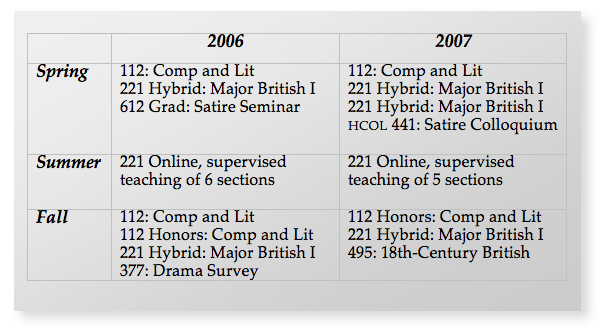
My teaching assignments in the department have varied widely over the last eight years, combining general literature and composition courses with upper-level literature surveys and graduate seminars. The following listing offers a glimpse of that variety over the last two years.
Freshman Composition. As a part of our commitment to the general education program, every member of the English faculty teaches one or two composition courses a semester. ENGL 111: Composition and Rhetoric reintroduces first-year students to the writing process and asks them to hone their skills in a number of modes. Through reading and discussing essays written by professionals and their peers, we also sharpen their understanding of key rhetorical strategies.
ENGL 112: Composition and Literature introduces students not only to academic writing and research but also to strategies of critical reading and thinking. For the past nine years, the department has employed an anthology of Christian literature—Shadow and Light: Literature and the Life of Faith—edited by our colleagues Steve Weathers and Darryl Tippens. With such an ecumenical gathering of texts and authors, we are able to discuss significant questions about justice and mercy, bigotry and grace, covetousness and generosity as we refine our students’ approach to reading and interpreting challenging texts. Both classes typically enroll 25 students per section with at least five essays required of each.
Sophomore Survey. At the sophomore level, we also teach general education surveys introducing key authors and texts in British, American, and world literature. In ENGL 221: Major British Writers I, students encounter texts from the Middle Ages to the eighteenth century, following Britain’s history from an island to a burgeoning empire, and in ENGL 222: Major British Writers II, extending that empire through political influence, industry, and religion into the twentieth century. In both courses, I select readings that not only reflect key themes and threads in each story—changing views of gender and race or nature and technology—but also represent the many voices that have contributed to crafting Britain’s national identity.
These classes typically combine short lectures with a discussion format where around 25 students move beyond comprehension of challenging texts to ask critically aware questions about the genres, cultures, and values that formed each work. Over the last five years, I’ve taught surveys in a two-week intensive semester and as a combined humanities block in Oxford, with the summer online program, and in a hybrid format meeting both on-campus and online.
Upper-level Literature. Finally, my upper-division responsibilities include a number of majors and graduate-level classes. ENGL 495: Eighteenth-Century British Literature is a junior-senior survey of authors and genres from the English Civil War through the American Revolution. The battle lines within the period have been no less fiercely contested, and class lectures and discussions move from defining the period—the Age of Reason, Enlightenment, or Age of Sensibility—to identifying the received Canon of authors in ancient and emerging forms like satire and the novel. The course is an upper-level selection fulfilling the British Literature requirement and can be taken for graduate credit.
I also teach ENGL 377: Drama regularly, with alternating emphases. This is a reading-intensive survey of ancient and contemporary plays. Teaching the course in Oxford twice, I chose to focus on British playwrights students would have the opportunity to see performed during the semester. This unique venue allowed the opportunity to discuss Shakespeare’s use of verbal scenery before touring the restored Globe in London or to write theater reviews of productions they had just seen in Stratford or the West End. When teaching the course in Abilene, I’ve gone back to the Greeks for readings in the ACU amphitheater or shifted the focus to American and British authors after Shakespeare. The course is an upper-level selection fulfilling the genre requirement and can be taken for graduate credit.
Other Preparations. In addition to these standard assignments, I’ve taught graduate students, Honors students—both in university seminar and an honors colloquium—and team taught ENGL 299: Introduction to the Major with Cole Bennett and Nancy Shankle. When teaching in Oxford the spring semesters of 2003 and 2005, I also developed courses particular to study abroad like HUM 222: Western Heritage in England, a 6-hour humanities block, and a fine-arts elective HUM 240: Oxford through the Ages.
Course Development
In the last two years, my attempts to integrate the sophomore survey within a network of social, political, religious, and artistic trajectories has led to several unique opportunities to demonstrate how this type of integrative teaching might serve the larger general education curriculum.
 Humanities Abroad. In the spring of 2003, I developed the curriculum for a new Study Abroad course, HUM 222: Western Heritage in England. This six-hour course provided students in Oxford a unique opportunity to earn credit for Western Civ II and Major British II as they visited historical and literary sites that bring these events and authors to life. The course combined traditional writing and reading assignments with thematic tours of the British Museum in search of artifacts that fired the Romantic imagination or an afternoon on the banks of the Thames discussing the poetry of Gerard Manley Hopkins and the English landscape. The course enrolled 24 students the first semester and continues to be a cornerstone of the Oxford curriculum (see letter from Kevin Kehl in Appendix A).
The following summer I received a stipend from the Adams Center to formally develop this curriculum into an instructional notebook for faculty teaching humanities for the first time. In an interview for the Adams Center’s Focus on Faculty in 2004, I described the project and its impact on my later teaching: “Since our return, I’ve been looking for ways to remind students of the relevance and immediacy of voices from the past. Teaching—whether the subject is Beowulf or the Battle of the Boyne—is the process of bridge building, and the more I can connect the content of the course with the world they know, the more students will be able to incorporate learning into their lives.” The final notebook includes course plans that integrate not only content from the history and literature texts but curricular travel assignments within Oxford or across England (see sample resources and the notebook CD in Appendix T).
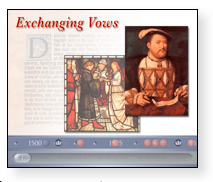 Summer Online. In the spring of 2004, I was approached to develop one of the first two courses in the university’s new Summer Online program. ENGL 221: Major British Writers I was reconceived for this new medium as an opportunity to draw students’ unique areas of expertise into discussions and projects that helped them to connect more fully with key authors and texts. Working with the Adams Center, I developed 15 learning modules (with corresponding timelines, media clips, web research assignments, and discussion prompts) that moved students from Beowulf’s first boast through Gulliver’s final complaint without ever meeting in Abilene (see sample modules and assignments in Appendix I). In our first four summers, I have supervised 20 sections of 221 Online with students choosing between a 5-week or 10-week semester covering the same material.
In subsequent semesters, my role as course supervisor has included further revision and updating of course content and policies as well as training and support of faculty members new to teaching online (see letters from Carol Williams and Jonathan Wade in Appendix A and Erik Rishel in Appendix C). The course has been used as a model in developing later summer online courses and recognized in a national exemplary course competition hosted by Blackboard.
Hybrid Teaching. The spring of 2005 I began experimenting with ways to reintroduce assignments and learning objects produced for the online course back into sections taught during the long semester. With the support of another Adams Center summer stipend, I began researching best practices in hybrid or blended teaching models. In most situations, hybrid teaching combines the strengths of online learning—personal investment and independent thinking—with those of face-to-face instruction—personal interaction and accountability. Since then, I’ve taught 6 hybrid sections and my tentative conclusions are that hybrid courses can challenge the most fundamental assumptions about how we teach, but they are not suited for every student.
Even in my fourth semester, evaluations continue to be sharply divided in a mode that, as in online classes, expects students to take a more active role in their learning. Students who might sit at the back of the traditional survey—showing up, as one student told me, “to get my D and be on my way”—wash out early in the more active environment of a hybrid class, a feature also shared with online courses. Most students that remain after week 2 or 3 are more invested in the course given their regular contributions to discussions online though some can become frustrated with these regular contributions. The attrition problem in both hybrid and online classes deserves more study; however, on a campus where students report studying only 5 hours a week on average, these models may actually raise the level of academic challenge in some of our high-enrollment Gen Ed courses (see letters from Lauren Baker and Grant Smith in Appendix C).
Faith and Learning
For more than a decade the English faculty have been encouraging one another to develop practical pedagogies informed by recent scholarship on Faith and Learning in our discipline. The publication of the Shadow and Light anthology, the MA comprehensive exam list on Faith and Literature, and the recent Inscription conference <http://www.acu.edu/inscription> have positioned the department as an active participant in this national dialogue.
In 2004 as I developed the summer online course, I wanted to articulate a position on faith and learning that represented my own philosophy of faith-based instruction in ways that our students could understand and our online faculty could share. This statement is now a central part of all my syllabi.
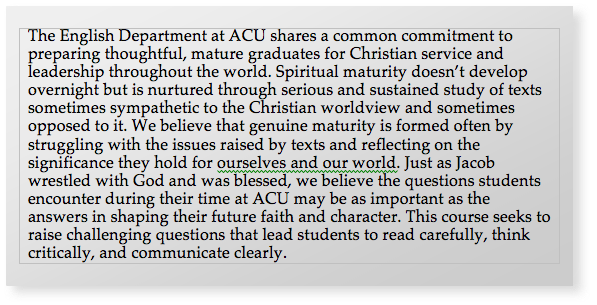
Integrating faith and learning has long been a part of the culture of the English department and continues to inform all aspects of my teaching from text selection to lecture or discussion design. Many assignments in our British surveys—from Beowulf to Bunyan, Tennyson to T. S. Eliot—center on men and women of faith living in ages compatible with or antagonistic toward their Christian belief and art. Drawing students’ attention to the complex heritages of faith and doubt in the readings can only make them “more aware of the Christian worldview” (Departmental Goal #3). Certainly, this type of exploration is encouraged by class sizes capable of involving diverse voices and subject matter informed by the unique expertise of many disciplines and majors.
The anthology we used was not only a challenge academically but also spiritually. I found it very interesting to read. Dr. Dickson also allowed us to integrate our spiritual concerns and Christian walks into our work. I have never had that opportunity before, and I really appreciated that. (112h, F05)
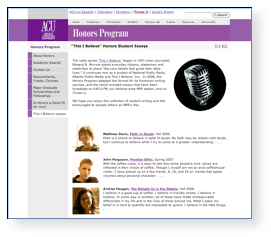 In 2006, not content to limit dimensions of faith in my ENGL 112 classes to readings from Flannery O’Connor or Leo Tolstoy found in Shadow and Light, I was looking for a way to challenge students new to the university to claim a personal creed or belief. The This I Believe essay, modeled on the popular NPR series, encouraged first-year students to think seriously about the kinds of commitments that motivate them toward compassion and service in their daily lives. Though I reflect on the assignment elsewhere (see 2006 self-evaluation in Appendix F), for me the opportunity to connect abstract belief to concrete action mirrors the connection we’re seeking between theology and teaching. At the end of the day, I believe that we’re all formed through the struggle to understand the positions of others. As we charitably interpret and evaluate beliefs different from our own, we’re called to more consciously articulate the messages we share with the world (see examples of student writing in Appendix G or at <http://www.acu.edu/thisibelieve>).
I liked the This I Believe assignment. I feel like the series of drafts really taught me how to revise and edit a lot better. (112h, F06)
I’m not going to lie, it was really difficult to write the NPR essay. It took a lot to put my feelings into words, well, clear words. I’m just starting to understand who I am and what I want to do with my life. It really helps to start with the most basic part of me, what I believe in . . . In retrospect, I really appreciate the opportunity this assignment presented. (112h NPR Reflection, F06)
Teaching Methods and Strategies
One thing this opportunity to reflect seriously upon my first decade has impressed upon me is how my classroom today has been shaped and molded by many diverse experiences. Though a cursory survey of syllabi would reveal certain distinctions of purpose and approach between majors survey classes and general education courses, much of my core methodology for motivating students and focusing their energies remains the same.
After reviewing my faith and learning statement, it’s clear that questions play a central role in my classroom. Though I would not describe mine as a strictly Socratic method, I do try to break most class days into 20-30 minute segments that move fluidly from lower-level analysis to higher-level reflection and synthesis. In any given week, the following strategies and assignments are likely to appear in my courses.
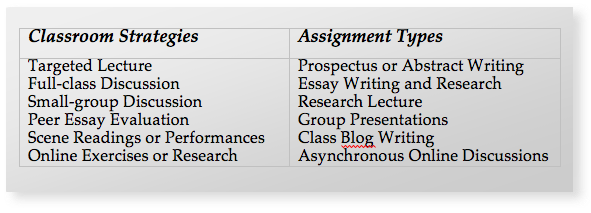
The Discussion Classroom. I have come to believe that the success of classroom discussion depends largely on motivating students to come prepared, so most class days also begin with the necessary evil of a reading journal or quiz. These steps provide students with the regular accountability vital to the success of any reading-intensive course.
The quizzes everyday, and the short responses, helped me stay on track with the course. It motivated me to stay on top of the readings, which saved me from cramming for tests. (221, F01)
As I suggested earlier, for discussions to be meaningful the questions need to be open to interpretation and original thinking. I always begin with familiar lines of questioning that ask students to consider what we know as readers—what we can agree upon about the basic elements of plot, character, or theme or what critics have said about a troublesome passage—before leading the class into less familiar territory, challenging familiar definitions, categories, or commonplaces as I press them to think more independently. In a large group, as you can imagine, this type of higher-level thinking is intimidating for many. For this reason, I frequently break even small classes of 25-30 into workshop groups or reading communities of 4-6 where they come to feel more comfortable testing ideas or developing arguments (see sample small-group questions in Appendix H).
I really like that there was a lot of class discussion and never felt afraid to ask a question or provide my opinion, so that definitely created an environment more conducive to learning. I also felt like there was enough lecture and direction to assure me that I was actually learning something. (495, F05)
More recently, I have begun to complement these in-class activities with Blackboard discussion assignments that extend or sometimes replace our regular class meetings. Though this format typically requires at least as much time and planning as in-class assignments, the dynamics of asynchronous discussion typically draw out different students than those who regularly assert themselves in the classroom. In an online discussion, my role shifts from the chief director of the conversation to the skeptical audience, challenging their assumptions and raising timely questions.
Blackboard was very helpful and interesting. I also liked the online responses better than traditional paper assignments because it allowed for more freedom to choose topics that I was interested in. (221, S01)
Made us participate in online discussions, especially with replies—had no chance to be too passive. It was also good when the instructor participated in the online discussions. (221, S06)
The “Teacher-less” Classroom. Though student-centered teaching does encourage students to take an increased role in their own learning, I believe the instructor plays an essential part in creating the environment where learning can take place. One surprising refrain in evaluations from online and hybrid sections of ENGL 221 has been the anxiety created by the freedom of these models. While Blackboard discussions encouraged independent thinking and confidence, students missed the leadership and expertise of trained professionals partnering with them in the learning process. This experience has highlighted two roles I continue to hone in my own teaching.
The first is that of a host welcoming students to the table. Darryl Tippens used to describe the classroom as a “site of hospitality,” and I think the general tone of any class—whether encouraging or discouraging engagement and participation—is set by the teacher. In our diverse online faculty, I have observed many effective approaches to welcoming students into the free-form virtual classroom and honoring their contributions to learning. This experience has changed the way I plan the first two weeks of any class to immediately move students into purposeful activities that ask them to connect their worlds of knowledge with the course goals (see 112 Online Journal assignment in Appendix G). Revealing a commitment, even an enthusiasm, for goals and objectives at this stage also welcomes students in to engage the purposes and content of the course.
The relaxed setting made me feel comfortable and at ease in the classroom. (111, F00)
It’s hard to openly hate what one person loves so much. He really encouraged us to want to understand the importance and beauty of literature. (222, S02)
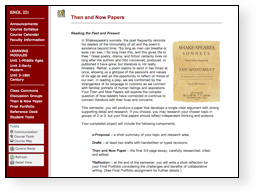 The other role is that of the content expert. One goal of literature courses identified in the department’s Centrality statement is to develop assignments that “improve cultural and historical awareness—to connect past and present; trace the historical development of ideas [and] themes” (Centrality of the Program 27). As with any course seeking to be more broadly integrative or interdisciplinary in approach, this requires an experienced guide capable of leading discussion into promising territory and sometimes detangling faulty assumptions or errors of fact. For the past few years, I have worked to introduce discussions exploring cultural contexts of texts we’re studying or seeking contemporary relevance or resonances for readers today (see Then and Now Paper assignment in Appendix I). This two-pronged approach to making the past immediately accessible in the readings has helped my students begin to ask more thoughtful, informed questions in their own thinking and writing.
Dr. Dickson’s personal anecdotes and illustrations from his own experiences with the plays were very valuable—but it certainly made me wish I were taking this class in Oxford! (377, F05)
Professor Dickson has a firm grasp of literary history. The most effective portions of his class were the lectures on the time of the writer, political issues, environment, and social structure. (221, F01)
Working Together. One type of assignment that helps students demonstrate this awareness or understanding is group presentations. As I began to accentuate historical, social, and cultural contexts in Major British Writers, I asked students to draw on their own areas of expertise in research presentations (see Group Project assignment in Appendix H). Individual groups were asked to introduce the class to subjects from medieval mysticism to modern trench warfare before making clear connections with one of our assigned readings. When poorly planned, group work can become burdensome and unfair to the best and brightest, but I try to communicate detailed expectations to students early and then follow-up with peer evaluation surveys that help clarify how individual group members should be evaluated. When possible, I prepare the class to ask questions of the presenters to create a more attentive, engaged audience and then take a few minutes after class to discuss strengths and weaknesses with the group to help them reflect on the process as well as the content of their presentation.
As a Bible major I’ve taken several classes that did not deal directly with my major (Math, Science, English, etc). Of those this is one of the few that made me feel that just about everything I did for the class had a real purpose. I feel like aside from making the class more interesting it gave the teacher more credibility. (221, F02)
The best group assignments can increase investment in the course material. In 2005, after experimenting with scene readings in an Oxford section of ENGL 377: Drama, I introduced performance more consciously as a literary analysis strategy to drama students back in Abilene. Students began the semester presenting short scenes from Plautus, Sophocles, and Euripides in an afternoon festival in the ACU amphitheater. Then groups signed up for Scene Studies in which they presented rehearsed—though not memorized—performances of a chosen scene to deepen our appreciation for character development or approaches to dialogue. Several students commented on how these exercises affected their interpretations of characters or themes by allowing them to experience a play rather than simply read the script.
The technique of this play was almost painful to read silently . . . However, when our scene study group began reading it aloud, it really came to life . . . After going through the play getting into the characters, it completely changed my perspective on the play. (377 Play Critique, F05)
Alternative Assessment. Finally, over the past eight years my attitudes toward student assessment and evaluation have changed considerably. In any reading or writing class, there’s a healthy skepticism to an entirely objective method claiming verifiable distinctions between work constituting a 91 rather than a 92. Over this time I’ve worked and reworked rubrics to identify my criteria for students and attempt to consistently apply them in objective ways, and while this was a worthy goal, it often shifted our focus from student work to my assessment of that work.
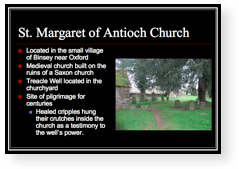 In 2004 my experience with colleagues in the Adams Center moving ENGL 221 online challenged me to experiment with alternative assessment and creative projects for the first time. As a part of the online curriculum, we developed Mid-Term Projects that combine the benefits of personal research and reflection with original analysis of an individual reading. The products have been as unique as our student populations, from movie reviews written by the Wife of Bath to webquests investigating Anglo Saxon cultural identity. As part of each assignment, students develop criteria modeled on the course objectives and then reflect specifically on how their project demonstrates growth or learning in these areas. I’ve adapted the summer online assignment for the use of hybrid students as well.
I believe that I learned more from this project than I did from any other project in any other class this semester. When I decided to create a PowerPoint on England’s social class system and its relation to Shakespeare’s Twelfth Night I had no information on social structure. I believe that while completing this project Shakespeare’s Twelfth Night became my favorite reading of the semester. This was because I was able to understand characters like Malvolio and Maria better. (Hybrid Portfolio, F06)
In 2005 these experiments encouraged me to assign iMovie presentations in one of my study abroad courses, HUM 240: Oxford through the Ages. In place of a formal classroom presentation, students researched a historical period in groups and presented key themes through a scripted video walking tour. One group introduced sixteenth-century Anglican martyrs in their last words while another sent their own Bill and Ted back to medieval Oxford for help on an upcoming test. As with the 221 projects, these video presentations were uneven in quality, but they successfully raised the level of engagement in personalizing the learning. This fall I’ll be adapting this assignment to a podcasting presentation for majors in my ENGL 495: Eighteenth-Century British Literature (see Coffeehouse Podcast on iTunes U or in Appendix K).
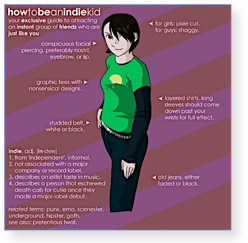 Finally in 2007, I asked honors students in my HCOL 441: Satire Colloquium to conclude the semester by producing their own original satires. The content and focus of this work varied widely—from a Modest Proposal for arranged marriage at ACU to an updated version of the Apostle’s Creed to better reflect beliefs today—and students explored a variety of forms—including poems, editorial cartoons, and an animated film (see examples of Satire Project in Appendix L). Whether brilliantly incisive or mildly amusing, these projects moved students beyond a simple appreciation of satire, challenging them to understand its strategies and motivations from the inside. As I confessed to Chris Willerton at the end of the semester, these projects were nearly impossible to assess fairly given the wide range of student abilities and investment, but the process itself provoked more sustained and critical attention than would a typical 5-7 page research paper.
Half-way through my project, gleeful at the prospect of poking fun at other people and looking smart doing it, I realized what should have been glaringly obvious from the beginning: I was satirizing myself . . . Satire is not just about being funny; there’s supposed to be something at the heart of it, something to be exposed and led to reform, an intent for change to take place. So I ended up pondering a different question: Can it change the satirist? . . . I concluded that this project was worth the time and effort even if it doesn’t say anything relevant or meaningful to anyone else that sees it, because it did its job: it made me take a critical look at myself. (HCOL 441 Reflection, S07)
Alternative assessment techniques introduce many challenges concerning fair and equitable evaluation of products in radically different media; however, the pay-off usually comes in the impossible to quantify “increase” in appreciation and love of a subject in which students have invested more deeply and personally.
Technology Integration
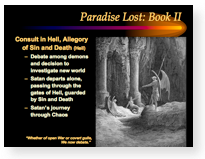 In keeping with the English departmental objective to “increase the pedagogically-sound use of technology,” I continue to experiment with different approaches to integrating media and technology in ways that serve each particular course. In 2000, I developed PowerPoint timelines and overviews of longer literary works even as I asked students to think critically about the uses and abuses of PowerPoint as they designed their own presentations. In 2002, this conversation turned into a series of departmental TechTeaching lunches funded by the Adams Center I led with Debbie Williams on strategies for teaching composition and literature in newly wired classrooms and labs.
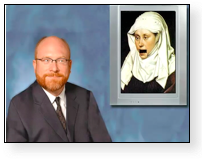 I frequently introduce textual discussions with a series of images or an audio or video clip that provides some context for the planned discussion. As students consider incorporating media into their own projects and presentations, I again ask them to ensure that these images and clips serve specific learning objectives. This purposeful integration of media into my lectures, not simply as background window-dressing but as a thematic entrée to the text, became the litmus test for all film and audio clips that I introduced into the ENGL 221 Online course. Scenes from Gladiator and Bruce Almighty and original interviews we recorded with Eric Harrell (on staging a production of Twelfth Night) and Bill Rankin (impersonating the medieval mystic Margery Kempe) helped stimulate thinking in my modules as students prepared to discuss the readings online. Working with Doug Darby in Distance Education, audio and video were first presented through Flash in 2004, as a Companion DVD in 2005 and 2006 (see Appendix I), before being moved entirely to iTunes U in 2007. This last step made all content more widely available to classroom teachers of on-campus sections as well.
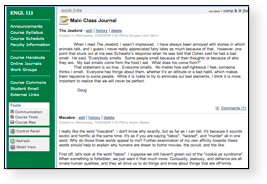 In my first-year writing classes ENGL 111 and 112, I often use computer lab assignments to encourage students to complete important steps in the writing process. In the past we’ve talked a great deal about invention or prewriting in class while few novice writers appeared to benefit from these discussions in practice. In 2001 I developed online worksheets that students now download from Blackboard and complete in class as I circulate. In many ways, these lab assignments accomplish something comparable to conferences on individual topics, heading off known difficulties early in the process. The worksheets then have the added benefit of being available to students who miss class, so they can complete a daily assignment before returning the next class meeting. More recently in ENGL 112, I’ve replaced exercises with weekly posts to a class blog to get students writing regularly during the semester. These posts encourage thinking about literature and framing arguments long before they turn in their first essay. Blackboard offers the perfect environment for these interactions and I like the model; however, every semester I find it difficult to keep up with the blog once papers start coming in.
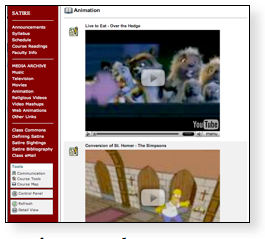 This past spring when teaching the Satire Colloquium, I embedded a couple dozen YouTube links to representative examples of contemporary satire into our Blackboard course. With minimal production investment, the course introduced students to key strategies and themes before asking them to post original definitions of satire along with analyses of individual examples into a class blog. This hybrid format—meeting online two weeks before our actual colloquium weekend—situated our discussions of Swift within a broader contemporary context I was never able to achieve in the more structured environment of a graduate seminar.
As in my experience teaching abroad, I believe teaching online or in a wired environment offers faculty the occasion to raise fundamental questions regarding what we do and why we do it. These reflections are always meaningful if they jostle us out of familiar routines and ask us to foreground our pedagogical goals as we seek the tools and strategies that best enable us to achieve those goals. Technology in this view remains simply another tool—if a powerful tool—to help encourage student engagement in every stage of learning. This became a central theme in the iPhone proposal and its vision of the 21st century classroom; the case studies I produced with contributions from colleagues like Jonathan Stewart, Kenneth Pybus, or Tracy Shilcutt underscore this principal (see Appendix W).
Student Evaluations
Over my first decade of teaching, both at ACU and at Baylor, I’ve grown fond of reading student evaluations. They’re truly democratic in leveling the classroom and giving the extroverted A student and the D student lurking in the back the same voice. Like other teachers, I receive my fair share of wholehearted praise and blame, neither of which I suspect I fully deserve. Often students in the same section will commend and condemn the same assignment or teaching technique. Not surprisingly many see entertainment value—usually measured on a two-point Likert scale from Interesting to Boring—as the greatest educational good and proceed accordingly.
Summary. I offer the following summaries drawn from 850 student course evaluations as a quick overview of teaching effectiveness. Student totals and sections taught have been broken out based on the types of course.
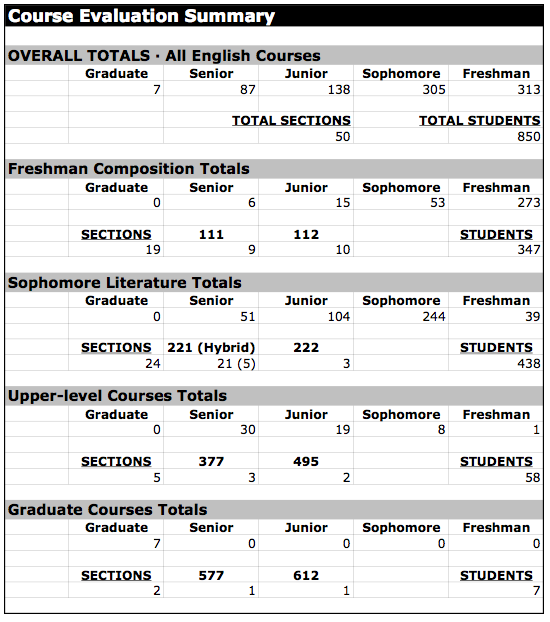
Comments. I’ve often told friends that teaching effectiveness is 60% personality and 40% charisma. The university clearly agrees since the course evaluation instrument used since I arrived in 1999 is titled simply, “Student Opinion of Instructor.” Reviewing my evaluations as a part of this process, I was not surprised to see how directly students connected their learning with me personally. Certainly the most gratifying of these comments turn a personal connection into a connection with the material:
I avoided taking this course for a long time. I was intimidated by the thought of old English writings and poetry. Mr. Dickson presented the information in such a way that made it easy for me to complete a course I dreaded heavily. Thank you for opening my eyes to Literature. (221, F01)
In Appendix D, I’ve included a representative sample of student comments for all courses I teach regularly. For now, here are a few of my favorites.
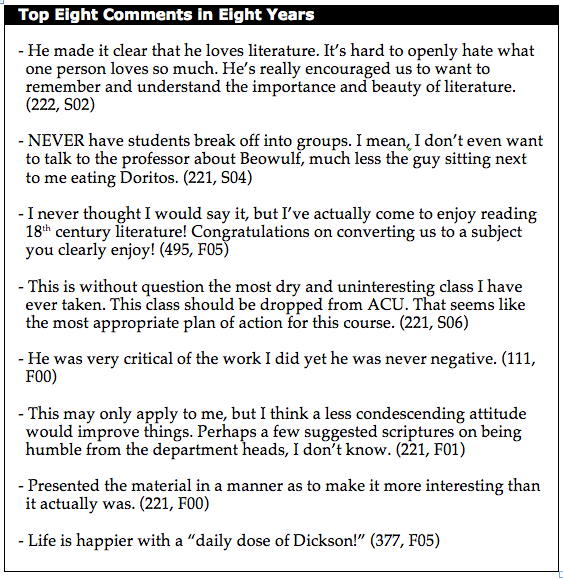
While course statistics represent the hard numbers of the evaluation, measured to hundredths of a point, student comments continue to provoke my thinking about the way I teach and learn from semester to semester.
False Starts and Missteps
A document like this may give the impression of completion or achievement when looking back on sixteen semesters from the comfortable vantage of the present. After my short apprenticeship into the art and craft of teaching, these confident declarations more truly represent my most recent positions on assessment, student motivation, and new classroom models. As a quick look at the course evaluation comments will show, in my best semesters teaching Gen Ed classes I’m often batting .500. Before looking forward into the next five years of teaching, it seems helpful to look back over recurring themes in student evaluations I still struggle with. (Yes, my first misstep is beginning the last sentence with a passive and concluding with a preposition!)
Humor. I could attempt to present my use of humor in the classroom in terms of pedagogical goals and outcomes, but the truth is I’ve always wanted to be funny. Lacking the nerve—or in Abilene, Texas, perhaps the venue—to go into stand-up-comedy, I regularly attempt to coat the bitter pill of learning with laughter. The Roman poet Horace was perhaps the first to connect teaching to comedy when he said poetry should be dulce et utile, educational and entertaining or “useful” and “sweet.” My reviews in this regard are decidedly mixed:
I enjoyed his jokes. They really weren’t that good, but I laughed. (111 F04)
He used humor that only the students who were listening caught on to—that encouraged me to listen. His high vocabulary required me to listen and pay attention—not all teachers have that ability. (112, S01)
The tone of my classroom has been shaped as much by Hawkeye Pierce as Parker Palmer and when studying Shakespeare’s tragedies or Swift’s satires, I regularly encourage students to look for the meaning behind the mirth. From my first year at ACU, I’ve heard from students attracted and repelled by my particular approach. A student in a sophomore survey my first semester commented on how my humor involved students in class discussion:
Very positive—made students feel good about responses—sarcastic sense of humor was great! Helped add a more laid back atmosphere. (221, F99)
Another student in the same class, reacted less favorably.
His condescending style of insulting students doesn’t sit well. I, for one, am not intimidated by him. He didn’t answer questions clearly. In fact, he often insulted students who asked questions. He was very rude sometimes, and I was tempted to punch him for being a smart-ass. (221, F99)
I’ve yet to discover any solution to this difficulty. As I’ve become more comfortable in the classroom and at ACU, I think I’ve tried to be more self-deprecating than bantering, attempting to diffuse some of the power dynamics in the classroom through occasional jokes at my own expense, but balancing the seriousness of academic training with a lightness of presentation—gravitas with levitas—can be tricky. I’ve reflected in my 2006 self-evaluation on the experience teaching my first graduate seminar on satire as the “unexpected difficulty became communicating academic seriousness to subject matter assumed to be frivolous or playful.” There are no easy solutions to striking such a delicate balance but as my sense of humor and genuine interest in the literary history of laughter will likely remain constant, I continue to seek light-hearted ways to communicate my genuine commitment to learning.
Expectations. Another theme that recurs in course evaluations at all levels is the question of workload. My own conflict on the topic is reflected in student comments from two composition classes last year.
Quit grading so hard even though it’s college. (112, S07)
His expectations were high and unwavering. He provided multiple medias to learn from: movies, literature, lecture. He used different learning techniques for all types of learners. (112, F06)
Students sometimes comment on their frustration with the difficulty of material or assignments, pointing to a course placing unreasonable demands on BAS (221, F00) or international students (112, F06). (For an interesting note from a student with ADD, see Grant Smith’s letter in Appendix C.) As flattering as it can be to be perceived as the hard teacher, I’ve been far from consistent in communicating effectively to “all types of learners.”
Rather than teaching to the middle of the pack, I think I typically teach to the upper third, the vocal minority who participate fully in a discussion class. A symptom of this tendency is my insistence on stretching students’ working vocabulary. Many of my literature syllabi include the following admonition:
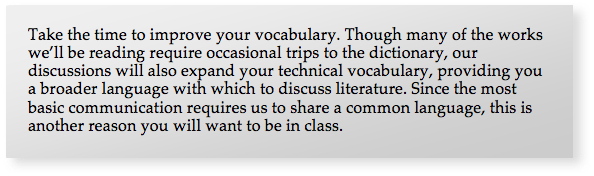
I’ve never given vocabulary quizzes and—other than literary terms—I rarely write words on the board, but I don’t see how we can stretch our students’ thinking, writing, or argument with the meager word-stock many bring with them. Understandably, some students rise to the challenge of keeping up while others see my chosen style as elitist and an obstacle to learning.
He’s funny and he uses big words. It’s like a vocab lesson every time we come. (377, F05)
Explain clearly and with plain language the aspects of the play that he wants us to notice. Some of the words that he used were unfamiliar to us and as a consequence we spent most of our time in confusion. (377, F06)
The broader concern is a real one. When students don’t feel like I’m speaking their language, they’re likely to feel abandoned in the classroom. High expectations alone can never invite students into the learning project. This last spring I taught a miserable section of ENGL 112. As I continued developing the This I Believe assignment, I was focused on the course but for whatever reason I never really connected with individual students in the class, so every TR morning at 9:30 I walked into the Ad building, gave a quiz, led a discussion or writing workshop, and left. One student illustrates this disconnect:
Dr. Dickson has not really taught me anything this year. He tries to get out of teaching by doing brainless things in class that require no thought or time to teach. He never has taken the time to make me feel like I am an important student in the class. (112, S07)
 This comment reminds me that expectations cannot be divided from personal interaction. The spotty attendance, lethargic interactions, and ultimately joyless writing last spring were all tied directly to my skipping the most essential step. I assigned the This I Believe essay to help students discover their voice, the “I” of the writing, without making this student feel like he or she was individually important. Looking back at a high point of personal interaction and connection, I can make the same point positively. In 2003, one of my Oxford students concluded our semester of 6 hours a week in the classroom and many more living and learning alongside one another with the following observation:
Was realistic in expectations of students and was interested in students. In establishing a connection with students it encourages the student to try to succeed if for no other reason than to earn the respect of a teacher that he/she also respects. (HUM 222, S03)
Graduate/Undergraduate. Teaching my first graduate classes, as I’ve said elsewhere, after years toiling in the vineyards of Gen Ed, has been a surprisingly frustrating experience. The opportunities to engage texts I love at a level beyond plot and character analysis and to work with motivated and highly skilled writers have certainly been welcome. However, in each of these interactions, I’ve remained somehow unsatisfied.
One reason for this dissatisfaction is 500-level classes. When necessary, we still allow graduate students to enroll in undergraduate courses by completing an additional research lecture or seminar paper. As I noted in my 2005 self-evaluation of ENGL 377/577, the result can be frustrating for both camps. That fall I scheduled additional tutorial sessions for the grad students where we met to discuss papers they’d written in lieu of a typical class day. What surprised me was that both groups preferred these days.
I liked all of our discussions except when the grad students were here. They were intimidating. (377, F05)
The grad tutorials are a good idea, as are the tutorial papers. I liked meeting and discussing ideas with the professor and other grad students. (577, F05)
In my 2006 self-evaluation, I reflected on a different surprise in working with my first passively hostile graduate student. The student and I have been amiable since the class, but I’m still baffled by my own inability to redirect his early antagonism in a more positive direction, especially in a class where ridicule and jeremiad are on the syllabus. In the spring I’ll be teaching a grad seminar in Restoration Comedy, and I look forward to working with more experienced graduate faculty to reassess my approach to seminar teaching.
Hybrid Learning. My most recent experiments in the classroom have also led astray as many students as they’ve converted. Since 2005, I’ve been experimented with several approaches to hybrid teaching. In our first summer teaching ENGL 221 entirely online, over 90% of students reported both that the course “challenged me academically” and “presented thought-provoking ideas” often or very often (see 2004 online evaluations in Appendix I), so I was eager to rethink my long semester survey classes in light of this experience. All of my sections of the hybrid 221 have been scheduled on MW or TR, so I’ve taught semesters that began each week with an online assignment before meeting later in the week, semesters that inverted the order to begin each week in the classroom, and semesters that alternated weeks in class and online. For all of my outside research into best practices and experimentation followed by feedback, I still get comments counseling,
Get rid of this online nonsense and just teach the material. (221, S06)
Such students have resisted any alternative to the time-honored lecture format. As I reflected in my 2006 self-evaluation, students have been quick to overlook the significant role the instructor plays in guiding learning online:
I did not enjoy this class at all, and normally I am a big fan of English literature. I felt as if most of what I learned was self taught and I don’t appreciate spending nearly $1500 on a class that I did not feel I was getting a lot out of. I don’t think ACU should continue hybrid courses. I believe they are highly ineffective. (221, S07)
The evident frustration of such statements is understandable in a format that expects so much of students, both in extensive reading and regular contributions online. One side-benefit for a class that sets out in the syllabus “to help students develop skills to analyze and interpret texts and authors through strategies of close reading” is in these regular textual interactions, either reading modules and instructions or posting to online discussion boards. One student underscores this very benefit:
I was not a fan of the hybrid class style. I also believe that being forced to write as much as I have in this class, although it was not a pleasant experience at first, has improved my writing skills and confidence a lot. (221, S07)
For all the false starts represented in my student comments and self-evaluations, taken together the syllabi, assignments, and student work that follow in the appendices illustrate periodic encouragement to retrace my steps and begin again. The frustration of failed rubrics or lesson plans can be immediately righted with a comment like this one from a hybrid student:
Great teacher that I will remember for a long time who has left an impact on my life. (221, S06)
This past May, late in finals week, a student stopped by I hadn’t seen in a year and a half. He was a graduating math major who just wanted to come by to tell me that our eighteenth century Brit lit class had been “the most enjoyable and thought provoking course that I had while at ACU.” I asked him to send me a note at the end of our conversation that concludes,
I am almost positive that my career will probably not require much knowledge of 18th century British literature. However I know that your course required students to think critically and independently, as well as distinguish connections by identifying threads between what may seem at first glance totally unrelated objects. This learning skill is pertinent regardless of a student’s major field of study and for this I am extremely grateful. Thanks for all that you do. (See letter from Matt Wickes in Appendix C.)
It is the unexpected interaction like this that keeps me revising my syllabi semester after semester, developing assignments that ask new questions or explore student learning in new ways. The anonymous notes, the emails sent mid-way through the next semester, like the tenth leper returning to the teacher to show he wasn’t sleeping through the test—it is these unquantifiable data points that bring me back to the classroom each August ready to risk another false start.
Next Five Years
 In a 2007 presentation titled “Genius: 2012” for the New Yorker Conference, Malcolm Gladwell described what he called the 10,000 hours rule. He said that “in almost any field where there is some kind of expertise and special cognitive requirements, it takes about 10,000 hours to move to mastery. And what’s really interesting about this 10,000 hours rule is that it applies virtually everywhere.” Whether setting out to become a chess grand master or a tennis prodigy, what is needed is a period of “concentrated deliberate practice.” In other words, he concludes, the kinds of complex modern problems that will face us in the future reward persistence more than genius. For many of us this is good news.
Gladwell’s conclusions focus on the careers of two twentieth-century mathematicians, and he estimates that the 10,000 hours rule for a university professor works out to about seven years of focused, deliberate attention. Looking back on my first 3,000 hours in the classroom and many thousand more developing lecture and discussion materials or pouring over student papers and exams, I have a hard time conceiving of myself as a master teacher <http://www.newyorker.com/online/video/conference/2007/gladwell>.
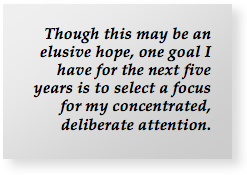 As I’ll illustrate in the remaining three sections, several thousand of those hours have been focused on research keeping current in seventeenth- and eighteenth-century literature and criticism, developing new areas of expertise in distance education and the humanities, providing leadership in the department and across campus in online and hybrid teaching and with the study abroad program. I’ve helped write proposals for initiatives from the Learning Commons and the new Mabee Library Auditorium to the iPhone in Higher Education. I’ve served with colleagues to put on conferences with the Southwest Conference on Christianity and Literature here at ACU and presented on a wide range of literary and pedagogical research at national and regional conferences.
In looking back, I can list a dozen projects and emphases with which I’ve been integrally involved, but this dispersal of effort seems to fall short of the mastery Gladwell describes. Though this may be an elusive hope, one goal I have for the next five years is to select a focus for my concentrated, deliberate attention.
Scenario A. I’m fortunate to have a deep love of the material I teach in upper-level and graduate classes, so one option is to set aside time to develop my early research into the Augustan satirists (Swift, Pope, and Gay) and their relation to the social and artistic topographies of the city of London.
Scenario B. I’ve also been thankful to work closely with the Adams Center on several occasions, so a second strong option would continue work I’ll begin this fall as Researcher in Residence into media on converged devices like the iPhone and their impact on the 21st century classroom.
In putting together this portfolio, it’s become apparent to me that I can’t adequately do both. In the next few months I’ll continue to work with the Adams Center podcasting initiative and the iPhone advisory group on campus, so for now my focus will likely remain with the second scenario; however, I’m also scheduled to teach a graduate seminar in the spring and look forward to the opportunity to pursue research into the world of Restoration theater in late seventeenth-century London.
Whether I continue laboring in the two worlds of eighteenth century literature and twenty-first century technology or choose a more tightly defined focus, I hope the next five years will bring as many unexpected opportunities as the last five.