
My Response to Student Evaluation and Feedback
I taught at Cascade College for five years before I joined the ACU faculty. I am very grateful for my teaching experience at a small Christian college, where literally everybody knew each other. When compared to Baylor University, Cascade was so small that it was like a big extended family where personal relationship with faculty, staff, and students mattered very much. I’ve transplanted the same attitude to ACU, just as I “transplanted” a small portion of the Northwest to Abilene (That is how some of my neighbors talk about my yard). At ACU I teach basically the same courses I taught at Cascade.
Courses I teach regularly include: BIBL 211 Message of the Old Testament, BIBL 211 MOT Syllabus Fall 2016 Cha, BIBL 458 Abrahamic Faiths, Cha BIBL 458.01 Abrahamic Faiths Syllabus (Spring 2014), BIBL 454 Prophetic Literature of the Old Testament BIBL 454 Prophetic Lit Fall 2016 (Cha), BIBL 101 Jesus: His Life and Teachings, Cha BIBL 101.T06 FALL 2015 Syllabus, and BIBL 102 Life, Literature and Community, BIBL 10205 Life, Literature & Community (Spring 2016). Other courses I’ve taught upon request were: CORE 110 Cornerstone and BIBL 453 Devotional and Wisdom Literature, BIBL 453 D & W Lit Syllabus (Spring 2013). A new course I developed with Kyle Tippens of COBA is BIBL 640 Biblical Perspectives on Stewardship, Biblical Perspective on Stewardship – Syllabus.
BIBL 211 is basically the same course I taught at Cascade with a different course title, Story of the Old Testament. BIBL 454 is a combination of two courses on the Prophetic Literature at Cascade – BIBL 4243 Old Testament Prophets: 8th Century Prophets and BIBL 3243 Old Testament Prophets: 7th – 5th Century Prophets. BIBL 102 was new, but I taught Story of the New Testament at Cascade, surveying the entire New Testament in one semester. Thus BIBL 102 required a little adjustment, but Mark A. Powell’s common textbook with other resources provided by Baker proved to be very helpful. I used Powell’s Fortress Introduction to the Gospels as a textbook at Cascade, and I taught other New Testament courses at Cascade like Matthew, Acts, and the Prison Epistles, so the transition was smooth. Since Abrahamic Faiths deals with Judaism, Christianity, and Islam only, it is a smaller scale of World Religions, which I taught at Cascade, but I have been able to focus on Judaism, Islam and Christianity in depth now.
I vividly remember the first semester at ACU when I was eager to get to classes and had high expectations for my students at ACU. After all, it is often told teachers must have high expectations for all students. Cascade had an open-enrollment policy. My expectations for ACU students were naturally higher than the one I held for Cascade students. However, I quickly found out that students are students. No doubt I’ve had exceptional students who went on to do further studies at the most prestigious, top tier schools. Noemi Palomares and Jake Jacobson, for example, were exceptional students. Haley Conaway was not even a Bible major, yet she understood every single thing I discussed in class. I am very grateful for those exceptional students. I am also very grateful for those students who complain about how hard my class is. Often it is they who help me to assess and re-asses my teaching in a way that is more conducive to learning and to try my best to perfect the art of teaching, which is a never-ending process.
The first semester was rather uneventful for the most part. I typically start my class with a daily quiz to encourage my students to take an active role in learning, to diversify grading for the semester so that not everything hangs on major exams, and to orient my students to the topic of the day even if they did not read the reading assignment for the day. I also end each session with a 1-point essay in which students discuss in a group the lecture of the day and come up with their reflection on the topic. In so doing, I cover both descriptive and normative tasks of biblical interpretation in every class so that students may understand the biblical text in its historical and canonical context and then be able to contemplate on what all that means for us today. Positive student responses in BIBL 211 include:
“Dr. Cha is great at integrating faith into all of his lessons”; “I love this course. I literally think of this course as a crash course on how to live my life. The questions my teacher poses from the Old Testament messages caused me to really think about life. I never thought I’d learn more from an Old Testament class than a New Testament class”; and “Cha is a great teacher. He knows what he is talking about and he leaves time in each class for us to reflect on what we’ve learned and ask him question.”
It was in the Prophetic Literature course in the Spring of 2012, where I learned quickly that I needed to make a significant adjustment to my approach. When understood in its historical and literary context, the Old Testament is a powerful and fascinating material transforming lives including mine. I believe teachings of the Old Testament are very relevant, and I try my best in the hope that my students can see that. What I did for this course was to include supplementary books for my students to read and present a synopsis to the class so that they may appreciate the relevancy of the Old Testament messages. Presentations, generally speaking, were disastrous! Too long (25 minutes), and too many (26)! Assigned books were not all from the field of biblical studies. Books like The Language of God by Francis Collins, Super Capitalism by Robert B. Reich, Justice: What’s the Right Thing to Do by Michael J. Sandel, The Conscience of a Liberal by Paul Krugman were included in the list so that my students can choose to read a book related to their field so that they may be interested in the reading and see how top experts in their field relate faith and learning! After all, Israel’s prophets were concerned about not just religious but all areas – political, judicial, social and financial – of their lives. What a great idea! Except, its execution was not so great. Some student presentations were a “waste of time” to use their peer’s language, and one student also wrote, “Teach the class.” Since they paid a high tuition, they expected me to teach, not other students. I understood that sentiment perfectly because I felt the same about student presentations during my graduate student days – I would rather listen to and learn from my teachers like John Willis and Everett Ferguson, and at times I thought fellow students’ presentations were not helpful for me at all. My attempt to create an interactive learning atmosphere failed miserably!
This disaster was partly due to my (perhaps unreasonably) high expectations of ACU students and mostly due to my poor execution of the presentations. Only a few of the twenty-seven students understood what they read. Probably, some did not even read the entire book. Mixed with this lack of understanding and preparedness, a twenty-five minute presentation was too long even for a 80 minute session. A quick lesson learned a hard way! I will never assign a twenty-five minute long student presentation again! Thankfully, students were challenged to think critically and holistically. Stuart McGregor’s exam is a good example of this higher form of learning as Bloom’s taxonomy of learning indicates. I encouraged my students to broaden their perspective, bring in ideas that they learn in other classes, think critically and not to be afraid even to disagree with me. Of course, they have to back up their idea with other scholarly works. Stewart did exactly that, and I gave him the perfect score. The reason I gave him the perfect 40 out of 40 possible points was not because he had every point right but because he was thinking critically, charitably, and independently. When others simply complained by saying things like “Oh, that is a liberal idea,” Stewart was able to back up his claim with an economic theory, which we did not even discuss in class but that he probably learned in a different class. That is clearly a higher order of thinking that includes not just facts and comprehension but also application, analysis, synthesis, and evaluation! I challenged my students to do that, and Stuart was able to do that so beautifully and graciously, when some others didn’t even have facts together but had plenty of opinions that cannot be backed up sufficiently with expert ideas. He did not simply agree with experts like Jim Wallis and Robert Reich whose books we discussed about in class, but picked a point that they suggested as a solution to the problem in our society and argued it was insufficient, and proposed an alternative policy that is based on the Laffer Curve. I knew nothing about that theory. In that regard, he taught me a lesson on economics, and I loved it and praised him in class for doing that. Who does that on a Bible exam when there is much pressure and little time? He was on a different plane, and that is ideally what I ask my students to do – to think critically and charitably. What a joy it is to teach students like Stewart A Copy of Stewart McGregor’s Essay Exam
I made some changes for the Prophetic Literature course in the following year. I replaced the book synopsis assignment with an Oral Interpretation of Amos and Reflection. The list of supplemental books was kept, and students were required to read some chapters of these books besides the required textbook. Their positive responses include: “He incorporated a lot of external sources to his teaching other than the main text,” “Dr. Cha’s readings were effective and correlated with the material we learned in class,” and “Reading articles by writers like Heschel, Wolterstorff and others really helped put into perspective the message the prophets tried to share: Need to be a people with the willingness to serve our neighbor, getting involved in ministries also compelled me to want to be more involved directly with wanting to adhere to the call that God has given us.”
This semester I am teaching the Prophetic Literature again, so I made several adjustments. I am taking a roughly chronological approach this semester so that my students are to read the text of Amos in the second week. They have already read a chapter on the prophets from Gorden Fee and Douglas Stuart’s popular level introduction to biblical interpretation (a textbook that I used when I taught Biblical Exegesis at Cascade College in Portland, Oregon, and also one of the textbooks used in our department for biblical interpretation) How to Read the Bible for All Its Worth. This chapter begins by noting how easy it is to misread the prophets and that the difficulty stems from an inaccurate prior understanding of the term “prophecy.” This chapter would have been useful last semester because this would have helped my students see why I did what I did, that is emphasizing justice and righteousness. Also Heschel’s chapter has been moved up to the second week to enhance students’ understanding of Israel’s prophets. The chapters from Sandel, Krugmann, and Reich that are not overtly related to the prophetic texts are removed from the reading assignments but are retained in the list of the supplemental books to which I added Angus Deaton’s The Great Escape and Joseph E. Stiglitz’s The Price of Inequality. All five books have already been chosen by students this semester, faster than other books that are written by biblical scholars. I made this change with the hope that my students will discover on their own that the biblical scholars and these experts from political science and to economics all share with the prophets the same pursuit of the common good. Other changes in the course include: moving quiz to in-class which forces the students to actually read the assigned readings; having more in-class small assignments to be more interactive, reinforce their learning, and disperse grades; exams will also be edited to simplify it to some degree; and since we meet twice a week reading assignments are lighter than the previous MWF class.
In BIBL 211 I craft my lecture in such a way so that students would be interested in the topic (usually each book of the OT) for the day. When understood in its historical background, the OT is a fascinating subject and a powerful witness to God’s love and care for humankind, so I begin in its historical background with a comparison to other documents from the ancient Near East and move to its relevance for us today by having a group discussion at the end. Many students appreciate my effort. Some of their responses include: “The way that the material was explained was very effective”; “Dr. Cha was great at handling the class. He had a great attitude towards and knowledge in the subject. He encouraged participation by having deep discussions in class”; and another student agrees by noting, “Discussions in class. One point essay.”
The Old Testament is not an easy read, so I have a pretty detailed reading guide for each lesson to orient my students to the topic of the day and the daily quiz. I always give an extra question so that even if they miss one question, they can still get a perfect score on daily quizzes. Students appreciate the detailed reading assignments and guides, as a couple of students’ reflections show: “The reading gave us an overview of what we were going to learn in class”; and “Each class has required reading that would be cover in a relevant quiz. Also the subject would be cemented by having to summarize the class in a daily group essay.”
Each of my lessons is like a carefully crafted sermon that professes my faith in God and the Scripture and challenges my students to see the world with God’s perspective. Students appreciate my effort as a couple of students remarked: “Put in personal stories and was passionate about what he was speaking about”, and “Very [effective]. Passionate about the subject and always engaging the students to answer questions. Always friendly and easy to listen to.”
My students have often shared some concern mainly over exams. One student wrote, “The tests are exceptionally hard, my lowest grade is in this class and it takes up the most of my time. As the class is only valuable at ACU it seems a bit odd that it would be hardest class and drop my GPA.” Another shared the same view by writing, “Tests were incredibly hard for a class that would not even transfer.” A couple of students, on the other hand, recommend that I should not change anything from this course.
One student made a very perceptive suggestion about a “cheat-sheet” of general historical information. During my tenure at ACU I have been using Craig Bartholomew and Michael Goheen’s The Drama of Scripture as the required textbook for a couple of reasons whereas I never used any textbook for OT survey class other than the Bible itself at Cascade College. First, The Drama of Scripture has a strong theological emphasis when compared to typical textbooks. Second, its treatment of the Pentateuch is very similar to what I have been doing. This front section is so informative and inspiring that Heidi Heath, one of my best students, told me one day after class that she enjoys it so tremendously that she recommended it to her father. Yet it lacks some essential historical information many popular textbooks focus on. Another weakness of this book is that after the Pentateuch section it is pretty thin due to its intended purpose. I’ve already adopted a different textbook for the following semester.
I give my students a two to three page-long study guide, and I sometimes hold a review session in the evenings. Of course, those students who need extra help the most usually do not come to the review sessions. I typically recycle most of the quiz questions so that these questions appear on exams one way or another. So by the time my students take any given exam, they had already been exposed to about fifty to sixty percent of the exam questions. I designed my exams that way so that anybody who spends about an hour or two can at least pass the exam. I can always improve my exams by wording them differently, and I continually modify them.
I consistently receive a lower average on the last two categories of course evaluations (“If I had it to do over again, I would take this course” and “I would recommend this professor to another student”) than other categories, and I was curious why. 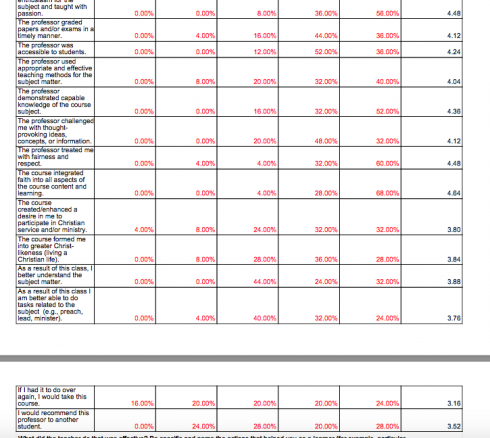 In the Fall of 2015 I sent an email to about twenty of my former students who were in BIBL 211 Message of the Old Testament (not necessarily at the same time or in the same section) to understand why that is so. Below are the responses I received in less than a day from the time I emailed them, while about the two-thirds of the students who received the email chose not to respond for whatever reasons. All the students whose responses are recorded below received an A in my classes. BIBL 211 Students’ Responses to My Email Inquiry According to these students’ responses, BIBL 211 works exactly the way I designed it to do. Is my class challenging to students? Yes, I do push my students to work hard to get a good grade on exams. I also provide more than enough ways to help them succeed in my classes, such as study guides, study sessions (not every time, but when it was offered those who needed it most did not come!), and various forms of extra points, which they have to earn. I don’t remember receiving a study guide for any exam when I was a student at Columbia Christian College, which had an open-enrollment policy. Hard working students agree with me on my attempt to help them again and again. Those who work hard are satisfied with the design of my course requirements. It is a different story for those who do not want to work hard because it is probably they who complain about the exams. I can always write a better exam, which I continually try in order to improve the quality of the exams, but students need to work hard too. I don’t plan to lower the bar. Students will have to earn their grade.
It is interesting to see who signs up for my class again. Out of sixty-four students who have signed up for my BIBL 211 Message of the Old Testament class in the Fall of 2015, twenty-seven students were my students in freshmen Bible classes. Chart 1 Student Composition of BIBL 211 Fall 2015 Out of the twenty-seven, seventeen students received a A in BIBL 102. One student received a C, while the rest of the students received a B. Out of the twenty-seven, twelve students did not miss any sessions for the semester, while five students missed only one session. That was a great accomplishment in itself. This whole information confirms that my classes are working exactly the way I designed them to do. For diligent and conscientious students my class is relatively not-so-stressful to get a A or a B. I think that is why they want to take my class again. They actually say my classes are easy – During this Summer’s mission trip George Wang, a Chinese student from Sahnghai, actually said, “Oh, your classes are EASY.” However, it is a different story for those students who don’t want to be in a Bible class, and who don’t want to do much work. I still have the responsibility to educate them.
As Chart 2 shows 19 students out of 51 responded indicated that they did not want to be in the course. Chart 2. Students Attitude and Behavior in BIBL 211 Fall 2015 This was shocking to me, especially given the fact that I thought this was one of my best classes ever, if not the best. Out of 59 students 22 were in my freshman Bible class in the previous semester and 14 of them were A students. They set the tone for the class in that it almost felt like walking into a fan-club gathering whenever I walked into the classroom. These students greeted me first and actively engaged in class discussions, both online and face-to-face. During the Christian Scholars Conference this past June, Doug Peters approached me and introduced himself to me and thanked me for teaching his daughter Alani Peters. He said my class was the best Bible class she enjoyed at ACU. I knew Alani’s father was a preacher because during class discussion I asked the class to raise their hand if anybody is a preacher’s kid, but I did not know who he was and never met him before. I didn’t know until today (September 3, 2016) that Doug Peters is new Professor of Preaching at Oklahoma Christian University. I also told him how I appreciated Alani as a person and as a hard working student who earned an A in the course. Below are some examples of student evaluations coming from this class
This was arguably one of my favorite courses to take this semester. Good number of people I knew were in it but more importantly, it was with one of my all-time favorite teachers. Twas a pleasure to be your student for 2 semesters Dr. Cha.
Dear Dr. Cha, I enjoyed this semester in your class just as much as I enjoyed it last year, maybe even more! Some people might say that your class is hard or that you are a hard teacher, but I believe that this class can be quite interesting while being only semi-difficult, if the student reads the chapters every night. I thoroughly enjoyed every class discussion we had and your input on the subjects. Thank you for being a funny, caring professor and I am really going to miss this class next year! P.s. Maybe your class can have tests that are a liiiittle bit easier. Other than that good job!
Dr. Cha is an amazing professor, his experience as a citizen from a different country has exposed him to various culture gaining the mentality of a global citizen and a citizen of the Kingdom of God who welcomes people from different part of the world. He does well to include this in his lectures to help his students also develop a similar thinking style.
Thank you for class! I’ve enjoyed having you as a professor and I appreciate the well-rounded theology you present, and I appreciate your humor and stories and how you open up your home to your students, and that you allow questions and different viewpoints.
What the second student wrote is interesting. This student thinks my class is only “semi-difficult if the student reads the chapters every night.” This student also indicated that s/he enjoyed “every class discussion.” Third and fourth student’s evaluation reveals their perception and appreciation of my approach to the task. Their appreciation is exactly what I try to achieve in all my classes.
As Chart 3 reveals one half of the students who responded didn’t want to be in that class regardless who taught it. Chart 3. Students Attitude and Behavior in BIBL 211 Fall 2015 Chart 4 shows that about thirty percent of the respondents wanted to take this class from me. I assume they were sort of my fan club, who did well in my freshman Bible classes in the previous semester. Chart 4. Students’ Attitudes and Behavior in BIBL 211 Fall 2015 Chart 5 indicates that only nine students don’t think I am an excellent instructor in spite of the fact that fifty percent of the respondents indicated that they “really did not want to take this course regardless who taught it.”Chart 5. Students’ Attitudes and Behavior in BIBL 211 Fall 2015 I consider this change of attitude to be a success. The nine students comprise fifteen percent of the class, while eighty-five percent of the class evaluates me as an excellent teacher. I know I am far from being a perfect teacher, and I will continue to improve my teaching skills. Yet I am grateful that I was successful in changing some of those students’ attitude toward the Old Testament and how I teach it. This is special to me because more than retaining some facts about the Old Testament, this change of attitude is the primary goal in my teaching. Once they realize the value of the Bible in its historical context and its fascinating transformative power, I believe everything else will follow sooner or later.
One way to improve the quality of education in my class is adopting the use of the Canvas Discussion function. In the Fall of 2015 I started using it in BIBL 211 for several reasons. It obviously helps students begin studying earlier and spend more hours studying. It is also designed to reduce quiz and study anxiety as each reading guide and discussion prompt is to guide my students and prepare them for daily quizzes. I assigned ten percent of the semester grade for the discussion. It is time consuming for me to respond to their posts. Yet I was willing to help them to alleviate their stress by adding this hands-on assignment and encourage especially shy students to engage in class discussions. As the link below shows many students participated each time, and I was satisfied with quality of some students’ postings. Unfortunately, a few students never participated in spite of the fact I mentioned it so many times and even attempted to bribe them to participate by adding some hints or answers to quiz questions in my responses. For an example of a full Canvas Discussion for BIBL 211 with Student Responses see: https://acu.instructure.com/courses/1653613/discussion_topics/11047271
Chart 6. Semester Grade BIBL 211 Fall 2015 Chart 6 shows students’ semester grade in BIBL 211 Fall 2015, and as it indicates their grade distribution is very impressive with 27 As, 18 Bs, and 9 Cs with only a couple of students failing the course out of 59 in class. This is better than usual BIBL classes. It is too early to tell whether the use of the Canvas Discussion function actually raised students’ performance or not, given the fact that I had many A students from the previous semester taking this course. I will have a better picture after this semester as I continue to use the Canvas Discussion for every session.
What have I learned about teaching over the past five years of teaching at ACU? I have learned, as it is often said, each class has its own personality, good or bad. I really enjoyed teaching BIBL 211 in the Fall of 2015, largely because of those diligent students who set the tone of the class. Yet I realized after the semester was over that so many students – many more than I was aware of during the semester – didn’t want to be there to begin with. I was successful in reaching out to some of those students, but I am also motivated to do better. I am grateful that our new system of Course Evaluation is more detailed than ever before and includes sections on students’ attitude and behavior in class, which helps me to know where my students are more accurately. I try very hard to catch the attention of even those who don’t want to be in class so that at least a little bit of learning takes place. Message of the Old Testament is a class that I can teach even in my dreams, but the unavoidable fact that each class having its own personality reminds me not to be complacent. One theologian compared the Christian walk to playing baseball. Realistically, baseball players know that if they hit .300, they are great. But that does not mean they try only 30 percent of their ability each time they get to the batting box. Each time they do their best, a perfect 100 percent, to make a hit. I would use the same analogy to teaching. Teaching is an art that can never be perfected. Who can say “I have perfected the art of teaching”? Realistically, I know I will never be able to perfect the art of teaching. Nevertheless, that does not deter me from trying my best each time I get to the batting box of teaching, so to speak.
I am always interested in becoming a better teacher. Ever since I started teaching at ACU there have been numerous opportunities at the Adams Center and Learning Studio for faculty development that I wanted to attend. Unfortunately, every semester I have a noon class, which forbids my attendance at these great opportunities. At least, I’ve managed to attend some sessions like Digital Story Telling, and other sessions include: Teaching like a Chrisitan (August 19, 2016); How Learning Works (August 18, 2015); How to Make it Stick in the First Week of Class (August 18, 2015); Canvas For Cornerstone (August 18, 2015); The Impact of Mobile Technology on Student Attitudes, Engagement and Learning (September 9, 2015); Master Teacher (2nd Year NF): Faculty Models for Christian Ministry (October 30, 2015); Reimagining: Envisioning the Future of Education (January 21, 2016); Getting Ready to Teach Online (January 25, 2016); Facilitating Online Interaction (March 24, 2016); Using Canvas to Manage Quizzes (March 2, 2015); Using Canvas Mobile Apps (March 20, 2015); Using Canvas to Facilitate in-depth Discussion (April 8, 2015); Organizing with the iPad: Using the iPad for personal productivity (March 26, 2014); Broom Colloquium (February 26, 2014); Table Conversation: Faculty Religious Identity (October 4, 2013); Summit Faculty Lunch with Peter Williams (September 17, 2013); Summer Teaching Institute (May 20-23, 2013); and International Studies Group (October 22, 2012) with other technology related sessions. Master Teacher Certificate; Adams Ct Participation12-13; Adams Ct. Attendance Record 2014-2016
Also I’ve been taking advantage of pedagogy sessions at annual Society of Biblical Literature meetings. They include: SBL Academic Teaching and Biblical Studies Section – Theme: Enhancing Teaching and Learning in Biblical Studies (November 22, 2014); Teaching Biblical Studies in an Undergraduate Liberal Arts Context (November 24, 2014); Academic Teaching and Biblical Studies (November 25, 2013); Academic Teaching and Biblical Studies (November 19, 2012); Academic Teaching and Biblical Studies (November 20, 2011); Teaching Biblical Studies in an Undergraduate Liberal Arts Context (November 20, 2011); and Wabash Center for Teaching and Learning in Theology and Religion (November 21, 2010). These sessions at the SBL and the Adams Center continue to challenge me to be a better teacher, and I am grateful for these opportunities.
Next Page: Course Evaluations Summary