
In Hebrew the terms “learn” and “teach” share the same consonants lmd, and how vowels are added to this Hebrew root word decides whether the term means “to learn” or “to teach.” The best example of this Hebrew root word appears in Deuteronomy 4:10 where it occurs twice, first as “to learn” and then “to teach.” “To teach” in Hebrew is to learn intensively. In other words, teaching in Hebrew is to cause someone to learn. This concept of teaching is foundational for my philosophy of teaching and learning as it implies that unless learning takes place teaching is not done! Typically, I have students who don’t want to be in a required general education Bible course. As the screen shot below indicates 8 out of 34 students did not want to be in the Freshman Bible class last semester. Yet it is still my responsibility that they learn not only the content of the Bible but also discover that it really matters. Thus I am concerned about how students experience their learning and constantly in search of the way that is most conducive to my students’ learning. This search involves understanding the subject, who I am as a teacher, and my students as best as I can.
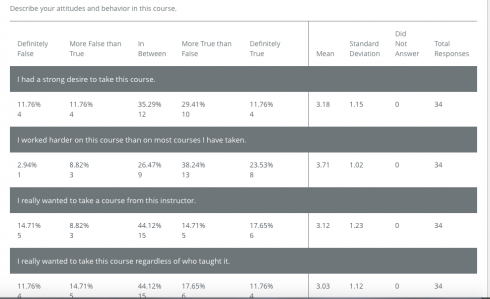
Students’ Attitude and Behavior in BIBL 102T03 Spring 2016
As I teach I am engaged in activity that has great value, and that entails tremendous responsibility. I am helping to create the future. Unfortunately, most Ph.D. programs do not include courses on how to teach, leaving their graduates to learn how to teach on their own. Thankfully, I was blessed with many great teachers who were influential in shaping me to become the kind of teacher I am today. They were masters in their specific fields, well-disciplined, servant-minded, and their courses were academically very demanding. Having never taken any courses on teaching other than the Adjunct Seminar at Baylor University, all I knew about teaching at first was learned through observation as I modeled my teaching after the best teachers I knew, those who taught me to find joy in learning and in biblical studies. Of course, that was not good enough so I began to attend pedagogy sessions at the Society of Biblical Literature national meetings and read books on the subject, which I continue to do in order to perfect the art of teaching as the Teaching Improvement menu demonstrates.
Biblical studies fascinates me. Learning from great minds something that I cannot come up with on my own is thrilling for me. Early in my teaching career, however, I quickly found out that the Bible was a boring subject to many of my students. While imitating my best teachers I also had to quickly learn a way to teach that is more integral to my own nature. The most fundamental element in this then-newly formulated teaching philosophy of mine that continues to be important now was a rather simple concept: Do whatever helps, i.e., cause, my students to learn the subject: knowledge of God, not mere objective knowledge on the Bible. I am concerned about more than transmitting mere objective knowledge about God. Knowledge of God transforms lives. Remembering how God transformed my life and how he continues to do that for others is at the heart of my teaching philosophy. It is awe-inspiring to teach students and witness their lives being transformed to be the people they were created to be.
Some of my students at Baylor University wrote about my teaching very positively on their evaluations. Of course, I have had my fair share of negative evaluations as well, some of which were also very helpful for me to be a better teacher. One student mentioned, “He gives great answers to some of my most difficult questions about theology.” Another remarked, “His class was ‘da bomb!’ Cha helped to bring many scholarly views to one idea! That was a great learning tool.” Another student added, “He actually cares that we learn it. I wish Baylor had more professors out there like Kilnam Cha. Best Instructor I’ve had.” Over all, their evaluations focused predominantly on my academic ability to teach the subject matter.
At Cascade College where I taught for five years before joining the ACU faculty my students responded somewhat differently. As Joseph Witzig graduated he wrote me a letter saying, “When I think of my most favorite teachers that I’ve had in the past your name came up in my mind.” What impressed him was not my knowledge in the subject matter even though he did mention it. What I did outside class mattered more to him, such as cooking for the members of Dignity Village, a community of former homeless people who built and reside in semi-permanent buildings on city of Portland property; meeting and talking to his father at the local Safeway; several visits students made to our home for barbeque and fellowship, etc. Landon Lynn also wrote, “Ashley and I are learning a lot from you in Exegesis and even more important your students always know you are there for them and that is huge.” Chad Martin’s letter reveals what matters to students especially in a small Christian college setting:
“I have learned a lot from your classes, but most of all I have learned most from your life. I watch you teach, I watch you converse, I watch you love what you do. The value lies in your life and not the subject you teach. You are a witness to Jesus Christ and you testify of his love. That is the true lesson, sermon, and example. You have moved my spirit and have encouraged me to continue the fight.”
Contrary to my Baylor students’ responses, the Cascade students valued my authenticity as a Christian teacher and role model. I am so grateful for my teaching experience at Cascade where I began to learn what it takes to be a great teacher at Christian universities. I still value and operate under this small school mentality as I now teach at ACU. By the very nature of the term, “professor” means the one who professes. As a professor I profess my faith in and commitment to Jesus Christ by what I say and do. Not only what I teach matters but also how I carry my conversations with my students, or even how I write my syllabi. Anything I do consciously or unconsciously professes my faith. As Chad mentioned, students closely observe what I say and do. They can see my passion for the subject and care and concern for my students. As I make myself more and more available to my students outside the classroom, I may become more vulnerable to an extent. Yet I also become more authentic and effective, not just as a teacher who conveys and transmits objective knowledge of the Bible but as a professor who professes my faith in Christ and commitment to Christian faith.
I consider learning to be mutual. First of all, as I prepare for classes it is I who learns the most. Just as I teach and challenge my students, I am also challenged by and learn from some insightful students. The first year of my full-time teaching was quite challenging in many ways. I had four new courses to prepare, and I often had to stay up until 2 or 3 AM to get ready for the following day’s lessons. By the first Spring break I was totally exhausted, and I crashed during the break by doing nothing but sleeping and resting. The following week, some of my students made a mission trip report in Acts class. Throughout the semester, I had talked about mission, but some of my own students went to Venezuela to do mission work during the break. Anna, Saryl, and Kenneth could not stop talking about their trip. Even after class, they talked to me about it for another hour. I could see the impact the trip made on them. Challenged by my own students, I began to contemplate what I could do to become a more effective teacher. The end result of the contemplation was to practice what I preach. That was how I began to take my students to Korea and China for month-long summer mission work. Using the Bible, my students taught English to college students and underprivileged kids, free of charge. In China they led Bible studies for Chinese college students, and we worshipped with Chinese house church members! Inspired by my own students, I was able to provide opportunities for my most mission-minded students to experience the world and serve God and his people in foreign countries where cultures and languages were so different from their own. This mutual aspect of learning is also apparent in our mission work in China, just as the Apostle Paul’s mission effort was mutually encouraging (Romans 1:12).
Jodi and Jessica, twin sisters, were my advisees. When I saw their transcripts, at first I honestly thought they had no business in being Bible majors. Their combined SAT scores were a little more than two-thirds of my son’s SAT score. I wondered how anyone can receive such low scores and come to college. They told me that their birth mother was a drug addict, and due to that they have a learning disability. Yet they were diligent students and wanted to serve God by serving the poor and needy. Spending their own money, they and other students provided food for members of the Dignity Village, almost on a weekly basis. In support of their ministry, when they became leaders of the student group visiting the Village, my wife and I cooked for the members of the Dignity Village. I had a chance to talk to the president of the Village. He said they were most appreciative of Jodi and Jessica’s accompaniment because they rarely have an opportunity to converse with young ladies like Jodi and Jessica. When Cascade closed its doors, Jodi and Jessica along with a few other students threw a farewell party. My wife and I were their honored guests. They were very appreciative of what I did for them both in and outside class. I also appreciate them very much because it is probably I who benefitted more in our relationship. They reminded me of what true knowledge of God is (Jeremiah 22:16) and rid me of my prejudice against those students with low academic ability.
A small Christian university setting provides opportunities to interact with students like Anna, Saryl, Kenneth, Jodi and Jessica, both in and outside classrooms. I am grateful for learning this important relational aspect of teaching at Cascade before I came to ACU. Even though ACU is much larger than Cascade, for many of our students this is a small school, where they value the relational aspect of teaching and learning. Apparently, it is more than academic interest we share with our students; we share life itself as students purposefully observe us as we profess our faith in Christ and commitment to Christian faith both in and outside class. It is a great privilege to share our Christian walk with students, and it is rewarding to see them, as well as us, grow and mature both intellectually and spiritually. Lives, both my students’ and mine, are being transformed. As I teach, I am helping to create the future. As I teach, I get to participate in what God does, that is, repairing this broken world. What a privilege and responsibility!
In Him,
Kilnam Cha
Next Page: Integration of Faith and Learning