A Reflection on Teaching and a Reflection on the Integration of Faith and Learning in an Archival Context
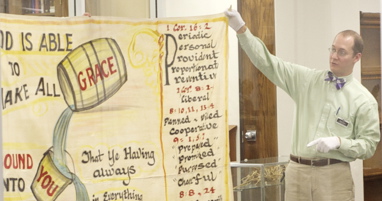
Mac teaching about sermon charts in the Special Collections Reading Room
Vocationally, I consider myself a teacher. Professionally I have for fifteen years earned a living as an archivist and librarian. Prior to that my vocation and my profession aligned in a more traditional classroom setting; for a dozen years they aligned in a congregational setting. But I have always considered myself a teacher, and my work teaching.
Library faculty, regrettably, are sometimes not perceived as teaching faculty and this misperception is often reinforced in subtle and unintentional ways. When understood on its own terms, however, librarianship is teaching and librarians are most surely teachers. My experience in library settings and training in library science leads me to the conviction that librarianship is a discipline concerned with a certain quality of pedagogy that manifests in the acquisition, preservation, accessibility, and dissemination of information objects across the breadth of all bodies of knowledge.
The quality of library pedagogy is less concerned with transmitting information, knowledge, training or expertise in a specific domain or discipline. Rather, it is concerned with the acquisition, preservation and accessibility of all seminal texts in every area of knowledge, suited of course to the particular needs, goals, and desires of each library’s community. In this sense librarians are meta-teachers who, in a university context such as ours, serve faculty and students from every discipline as they engage with the great tradition of their area.
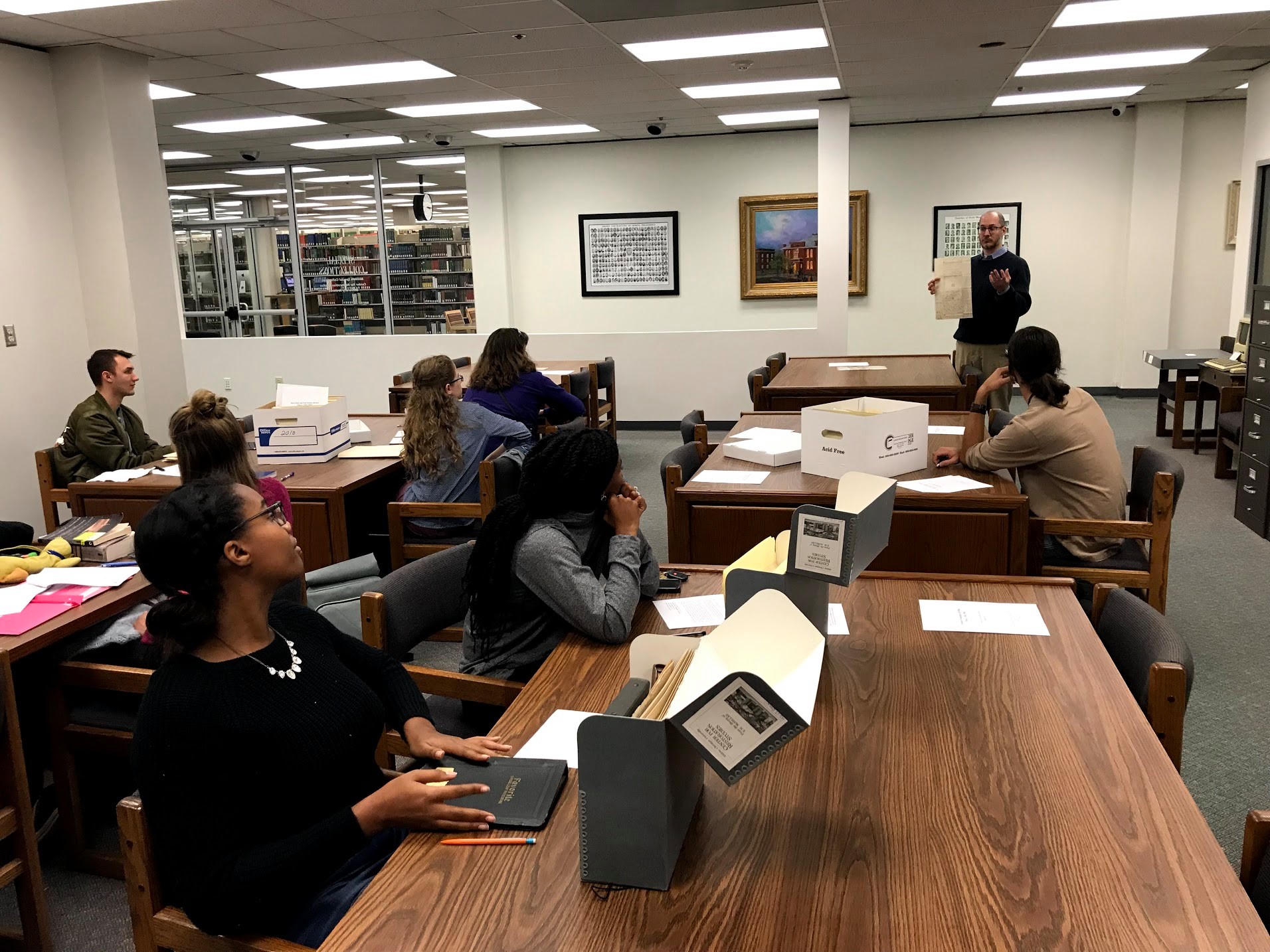
Library pedagogy is concerned with the acquisition, preservation and accessibility of all seminal texts in every area of knowledge, suited of course to the particular needs, goals, and desires of each library’s community. Mac guest teaching in Social and Ethnic History, 2020.
There is no other place, conceptually by philosophical design or physically by means of brick-and-mortar, on the university campus that is as inter- and intra-disciplinary and potentially transformative as its library. No other faculty or space, by intent, design, or accident, interfaces with every other by preserving their formative bodies of knowledge. Specifically, librarians at Abilene Christian University teach in the most immediate and visible way by means of reference instruction, guest lectures in formal course meetings, information literacy trainings, creation of catalog records, finding aids or similar points of access for information objects, through exhibits, and through bibliographic, historical, literary or other research publication. These activities, and others like them, are often and rightly seen as the proper modes and means of library instruction. I do not disagree.
However, it has become clearer and clearer to me, over this past decade at ACU, that by means of our teaching, librarians facilitate all other teaching, learning, and critical inquiry on the university campus.
I did not in 2013, or 2016, or in 2018, have the capacity to articulate this conviction in quite these terms. I certainly did not come to ACU with the kind of experience which could incubate such a conviction. I have grown into this conviction, and this growth has been a hallmark of my time at ACU. In large measure my convictions were formed as a result of serving the Abilene campus and I fully expect my understanding will develop and mature in years to come. Below I describe the many facets of my teaching.
Cornerstone
Looking back, I can identify my service to Cornerstone faculty and students as a deeply formative experience, and one which has been a highlight of my fall semesters. I approach my assignment there very self-consciously and transparently. I tell them I wish I had a similar opportunity as a first-year student. I tell them that hindsight suggests to me it is a liminal experience in which they can acquire skills, foundational understandings, and habits of mind and thought that will transfer to every subsequent course they take. The annotated bibliography assignment, with its basic informational literacy component, is just one piece of a larger formative experience…for them, and for me. Again, I tell them as much and mean it for I, too, am a learner and I utilize the same strategies for information retrieval and evaluation as they do.
Though the Library is still early in the formal evaluative process, my annual evaluations indicate students perceive my instruction is helpful and effective. Students are asked for feedback to this question:
If I attended a library workshop or my class librarian came to my class to do a library session, the information provided was helpful.1=Disagree Completely2=Disagree Generally3=Agree and Disagree in Equal Amounts4=Agree Generally5=Agree Completely
I highlighted my median feedback scores in the attachments below. Student response for one 2019 session was 4; my other three sessions were rated at 5. In 2020 students in two sections scored my instruction at 4, one at 4.5 and one at 3. The one lower score in 2020 could possibly be explained by the fact that of all the sessions I conducted, that one was by ZOOM at the professor’s request. It is possible that the quality of instruction we provide depends on the quality of interpersonal interaction. Might ZOOM mitigate the effectiveness of pathos? Since these evaluations do not appear to be, in our case, tied to grades in the perceptions of the students and since our role in the courses is not the same as an instructor of record, I take high scores as a generally reliable indicator of student perception. I would therefore have a higher tolerance for lower scores, in fact would generally prefer them, if this evaluation was more like other course evaluations.
This kind of evaluation, and that we have only in 2019 begun to ask for feedback, suggests to me that librarians are not generally thought of as teachers on par with ‘teaching faculty.’ If this assignment is as liminal and formative as I have argued it is to every Cornerstone section I have taught, and I believe it is for these courses and for every other course the University offers, then we should welcome the same kind of reflection for this assignment that faculty are required to ask of their general instruction. This evaluative tool consists of only one question and, to my knowledge, we do not ask qualitative or open-ended response questions about library instruction. Therefore I can only surmise what might lie behind scores of 4.5 to 5, or why a 3 in one section appears to be an outlier. My instruction could improve with that kind of feedback and over time I could perceive trends. Results from 2021 are about on par with 2019 and 2020 and again I see that for those students who gave me 4’s and 5’s there were still some who felt differently. I value this feedback, meager as it may be, because it makes me want to do better, to seek to make stronger connections, more impactful presentations, and generate a more meaningful first library encounter with my students. Such as it is, in time I hope we will have additional data to have a better handle on the effectiveness of our instruction.
While I celebrate what appears to be effective instruction, I take seriously that the data is incomplete. But more than that, I take seriously that I am always in need of improvement and that each class is a new class. Even on my best days I might not connect well with some students. No one is to blame in this scenario, rather it is a reality to acknowledge and address. Since I consider this assignment such a liminal and formative experience, I want to make sure I show up with my best attention: with substantive content, useful approach, appropriate energy, and helpful demeanor. I take student evaluation seriously and am very glad we have begun tracking this. In time we will see trends emerge and hopefully we can add an open-ended response question in order to gain substantive qualitative feedback from our students. Here are the results from the end-of-semester Cornerstone evaluation of library instruction. My sections are highlighted:
Cornerstone Evaluation Report Fall 2019
Cornerstone Evaluation Report Fall 2020
Cornerstone Evaluation Report Fall 2021
Beyond this question for Cornerstone, there is no formal procedure in place to capture student feedback on my work in other courses. I must therefore rely on conversations with colleagues, but occasionally a student will send a note of thanks that reflects on my work. This graduate student spent several hours in our collections and left this note on top of stack of books:
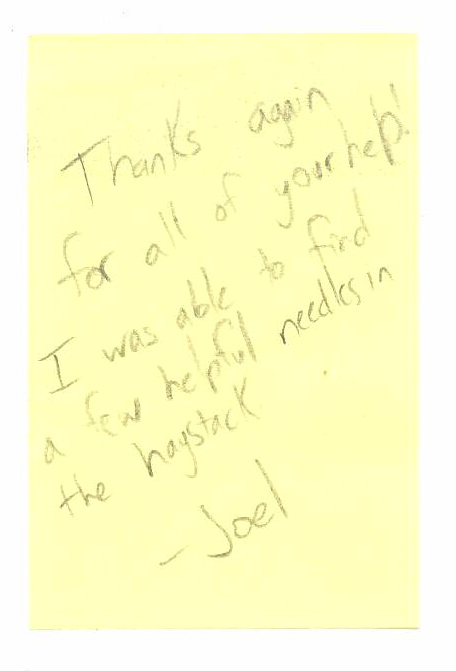
A post-it note from a graduate student in the midst of thesis research
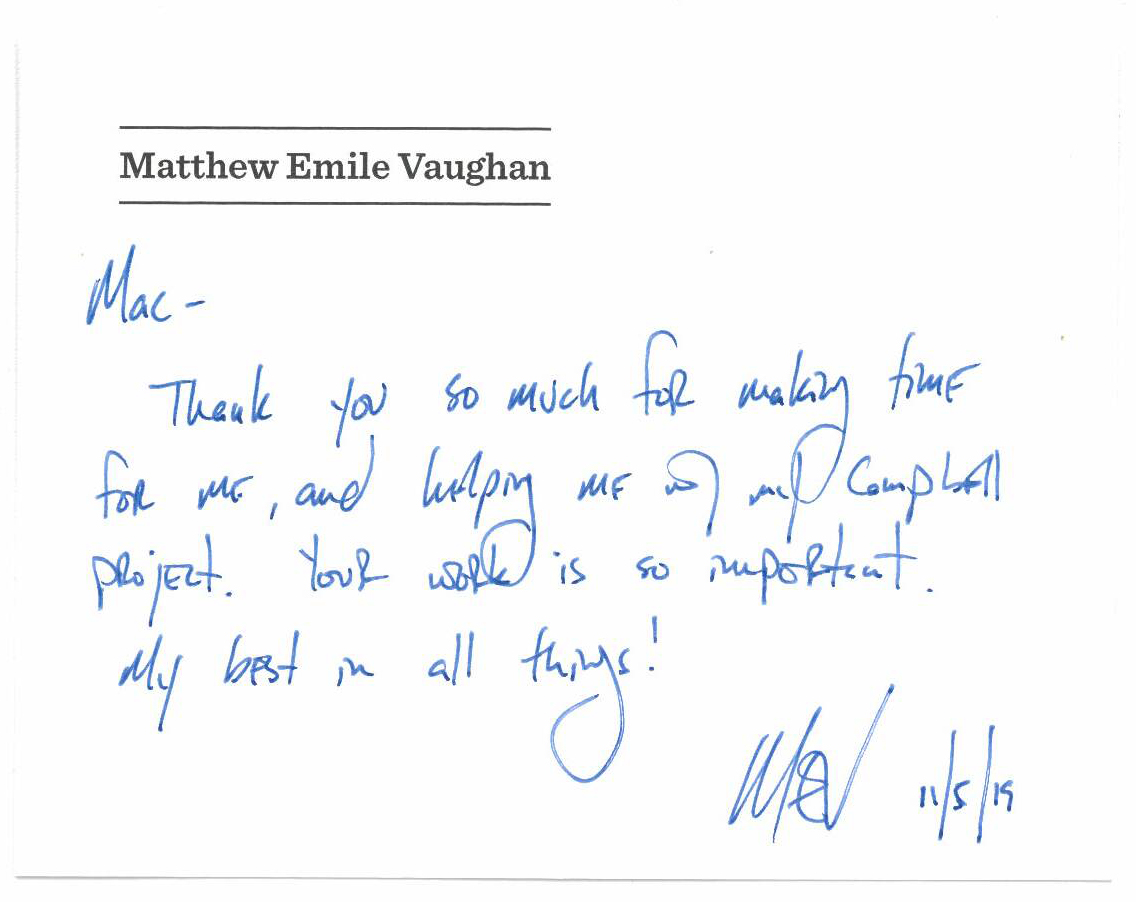
Thank-you note from an off-site researcher
Cross-disciplinary engagement
My conviction about the nature of library teaching has been reinforced yearly as I served faculty and students in history, political science, Bible and theology, and English. With each passing semester I stress to my students how the library gathers and holds in trust the great tradition into which they are being initiated. I stress that we are next in line, recipients of the knowledge and experience conveyed to us from our teachers. We are responsible to receive it, add to it, and carry it forward with faithfulness. It is a great joy to collaborate with my colleagues across the disciplines to introduce our students to these great texts, to showcase our unique archival materials, and to train them in the canons of practice that will help them use these materials in their own creative work.
Anecdotal reports of student comments such as this email from Dr. Perry Harrison (ACU alum who teaches at Fort Hays State University) and in this email from Drs. Kelly Elliott and Amanda Biles (along with Craig Fisher and Jama Cadle) indicate the quality of outcomes I strive for in all coursework I assist with.
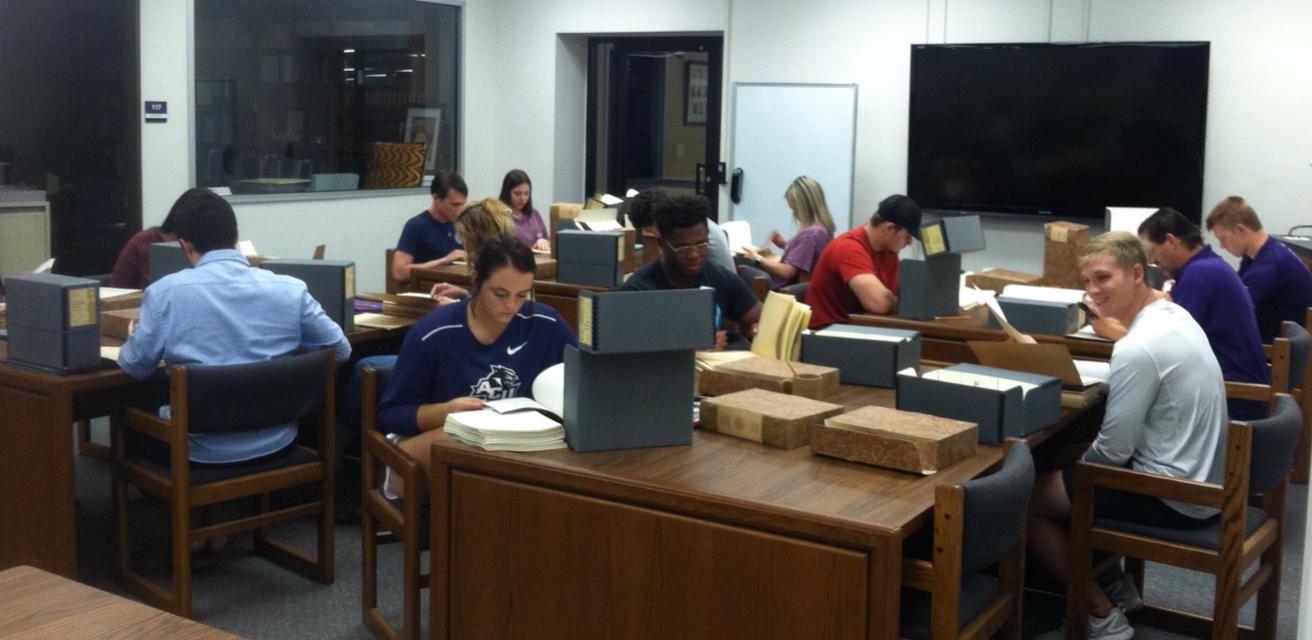
Historical Methods students discuss primary sources
Facilitating online access for a global body of users
My thoughts on this area of teaching was deepened through the experience of building, from the ground up, our institutional repository which now hosts over 26,000 unique items of ACU student- or faculty-generated scholarship, digitized holdings from our archival and print collections, and a host of institutional records in a variety of formats. To date users from 21,500 institutions in 227 countries have downloaded or viewed these items over 1,200,000 times. The stats for only the materials held by Special Collections reflect that users from 10,000 institutions in 223 countries have downloaded or viewed our 25,000 items some 600,000 times. Further, the overall download trend reflects sustained and increasing usage over time. We can now see that prior to the pandemic we were already well-poised to deliver web-based content to the a global user base who are increasingly relying on those kinds of assets available in that kind of way.
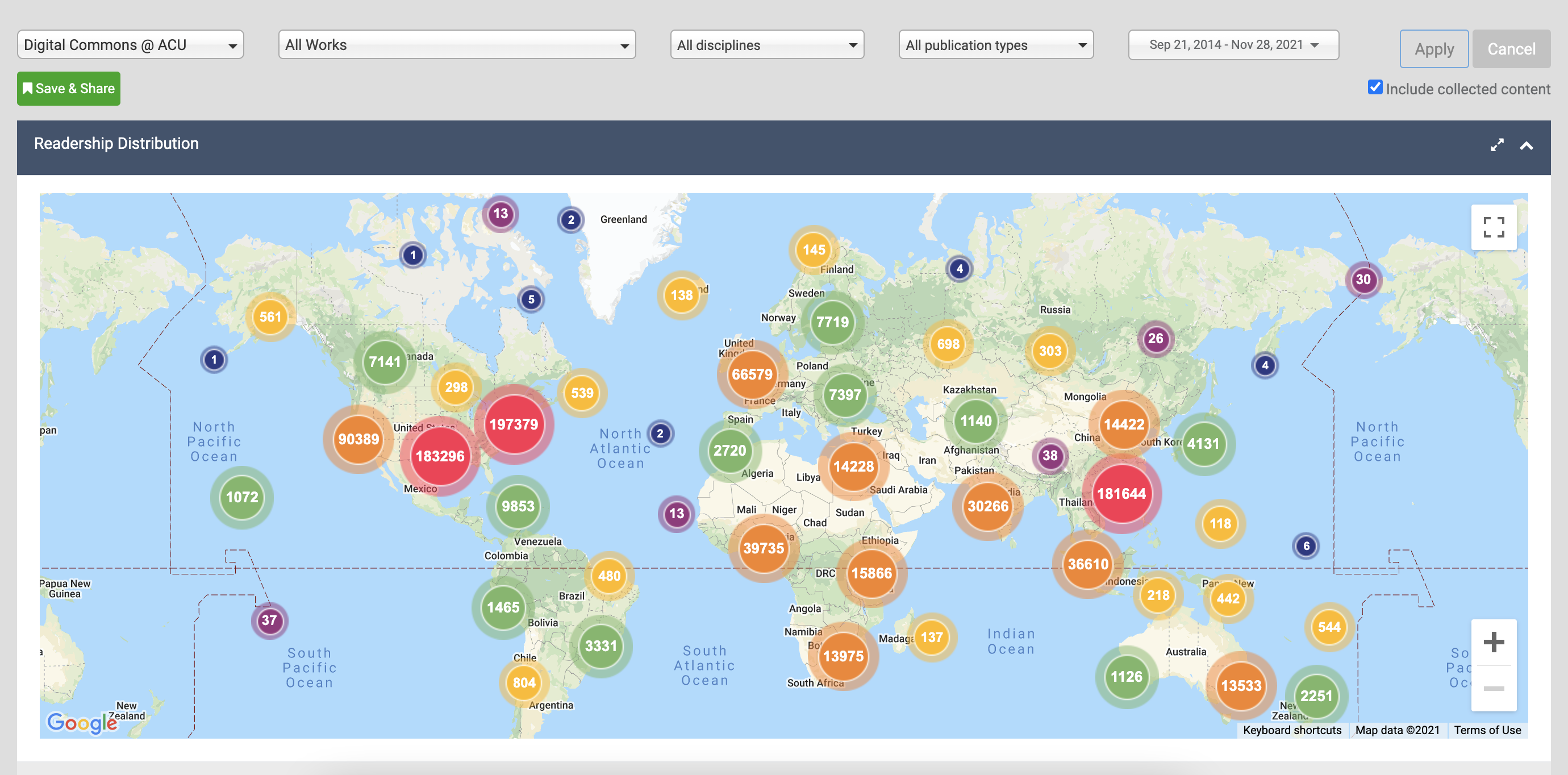
Data reveals users in 227 countries on every continent except Antartica have used or read our holdings. Download count is 1.2 million and climbing.
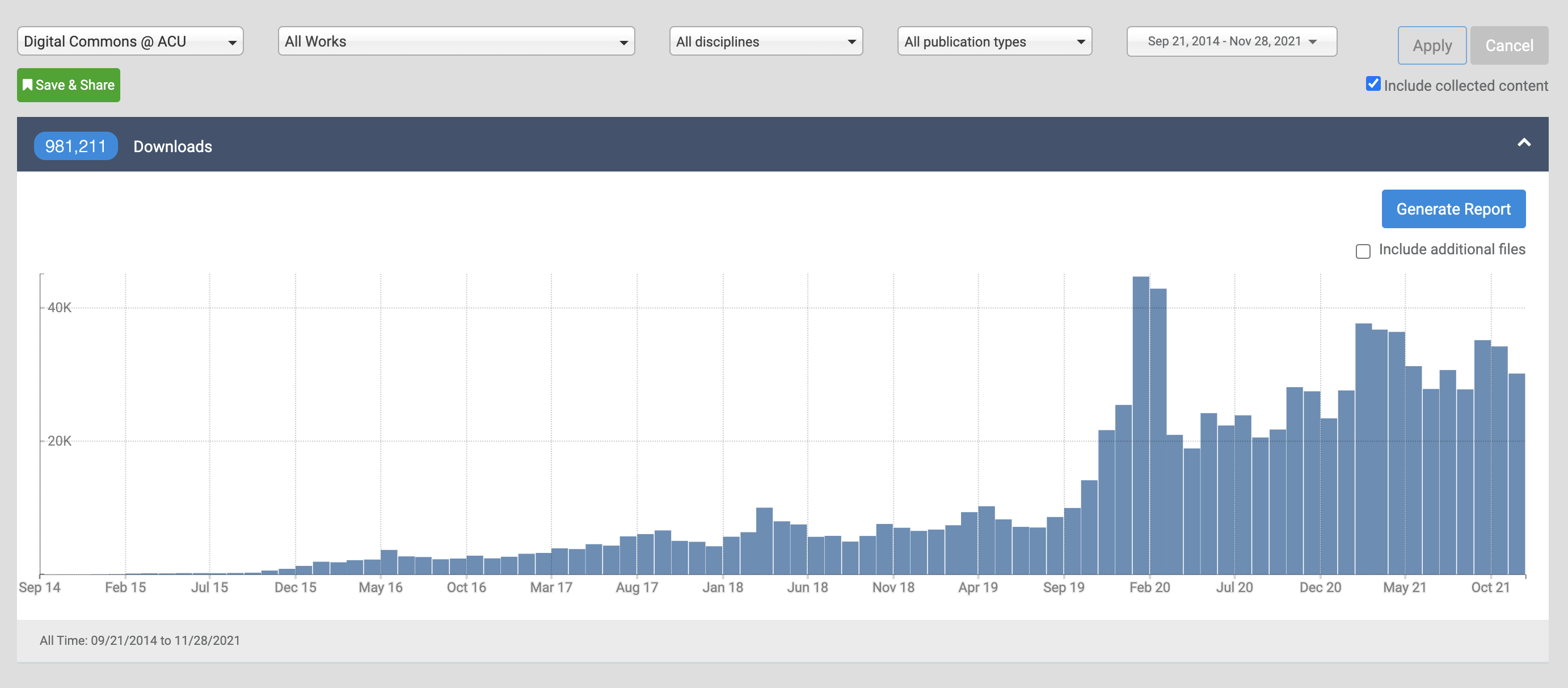
Usage stats reveal a steady and consistent upward trend. Users find our content and download it on a consistent basis. Most of the downloaded content is from our religious heritage. While the impact is demonstrably global in physical scope, we cannot foresee the transformative effect access to these materials will have.
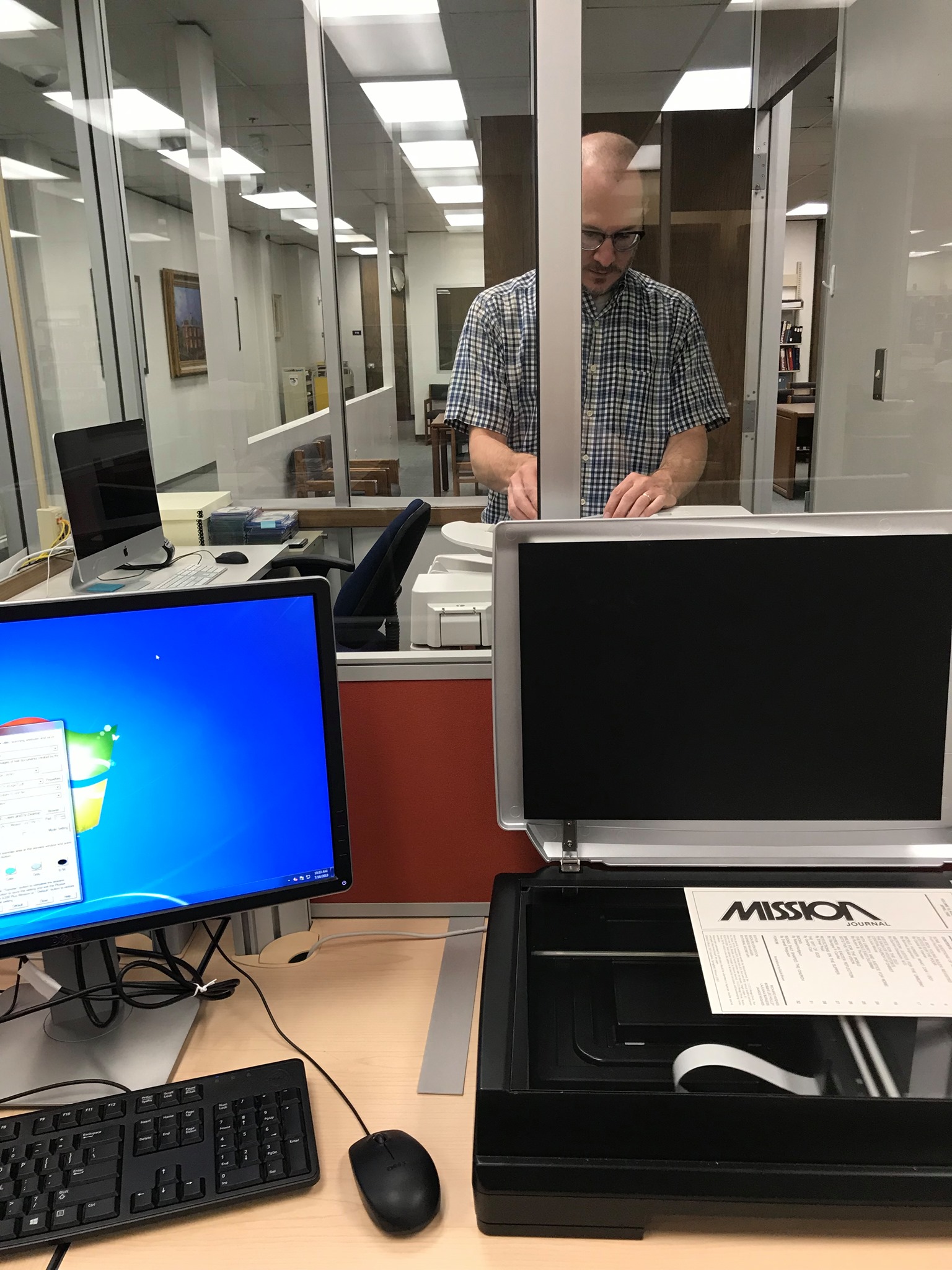
Mac puts the final touches on the Mission Journal digitization project.
My perspective has been refined and sharpened as I have built the holdings of Special Collections, ensured they are cataloged and described according to industry standards, and promoted their visibility and use through my writing and speaking. Specifically, I have come to see the latent potency of the web as a tool for global dissemination of information on a scale we could not have imagined even a few years ago. It enables us to take what is uniquely held in a library in Abilene to the farthest reaches of the planet.
Of the 25,000+ items I have shepherded through the upload process, several are clear standouts: primary founding documents such as Thomas Campbell’s Declaration and Address, Alexander Campbell’s Sermon on the Law, Rice Haggard’s Address on the Sacred Import of the Christian Name are now readily available in full text facsimile. Major periodicals such as Christian Chronicle, Mission, Horizons Chretiens, and much of Restoration Quarterly are now freely available. ACU lectureship recordings and Dr. Everett Ferguson’s teaching slide collection serve church leaders and teachers on a global scale. It is clear that thousands of these downloads are coming from academics, scholars, and researchers. It is equally clear that thousands more are coming from ordinary people serving and working in congregational settings, some of which are undoubtedly in ‘underground’ settings. I think specifically of Bible-study and Bible-teaching resources from past ACU Bible lectureships that are being downloaded by users in China and Africa. As gratifying as it is to receive a mention in the preface of a thesis or dissertation, or to be cited in a footnote in a journal article, it is far more satisfying–and far more important to me–to ponder that fellow believers somewhere around the world are being edified in their faith because of the work we do in Abilene, Texas.
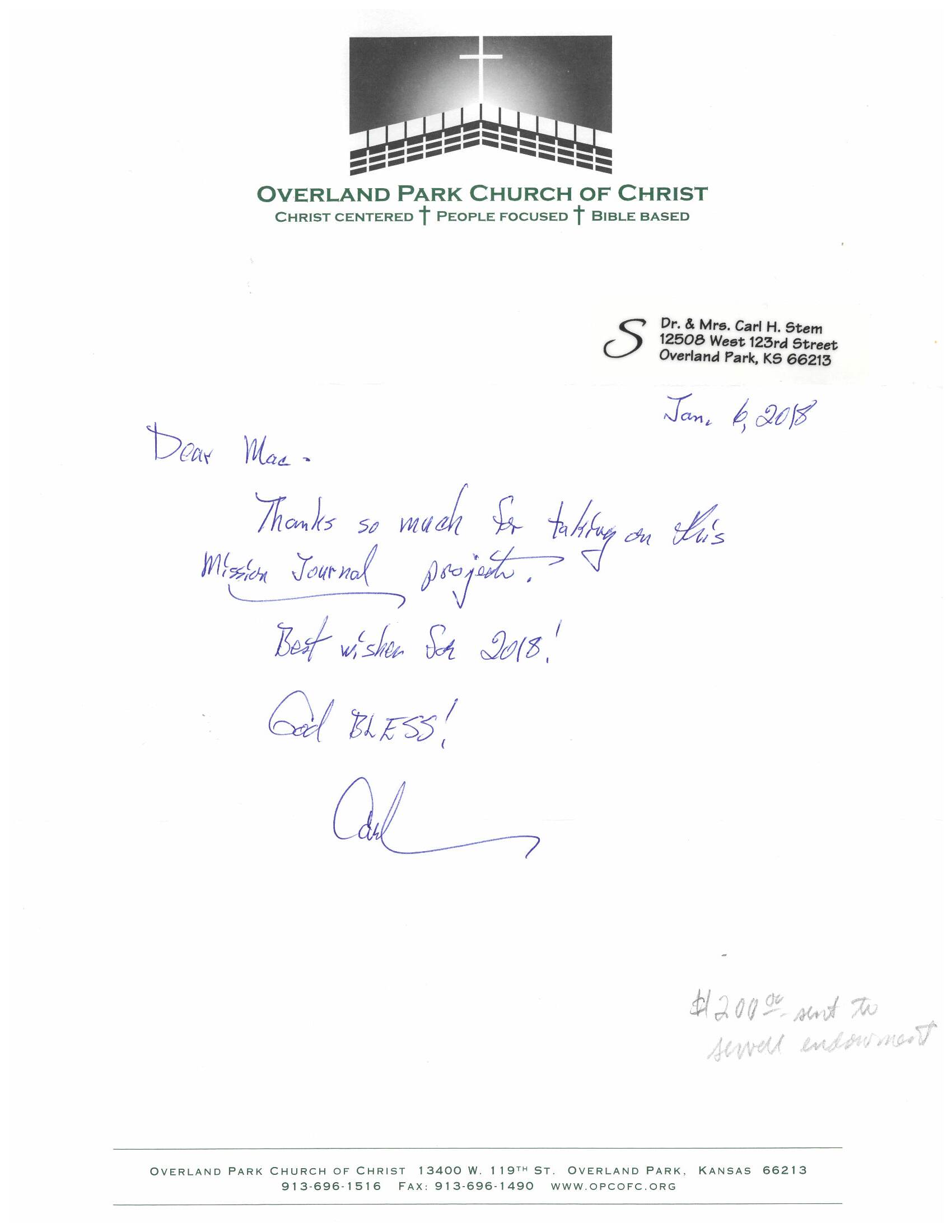
Note from Carl Stem, one of the leaders who published Mission Magazine, thanking me for my work in facilitating its full digitization.
Along the way I made mistakes and miscalculations about how best to present and describe these materials, how to leverage the functionality of the systems we have at our disposal, how we can improve outreach and promotion to foster awareness, and how we ought to prioritize which materials ought to be digitized. We could have made any number of changes to how information is structured, presented to the public, or described in our databases. There could have been better choices made about which materials to digitize, and we could have better leveraged the functionality of our digital platforms. But it is an iterative process, and I have come to realize the lessons learned from mistakes often can’t be learned any other way. I remain proud of the work we did, and usage stats bear out that many thousands of people can find them, and download them, and use them–in spite of my failings and frailties. There is a quality of improvement that comes by learning through iteration that just cannot be replicated or acquired through proxy. So the learning, growing, and adapting proceeds onward. I expect that will continue, and I hope I will be teachable and courageous to go where better information leads me.
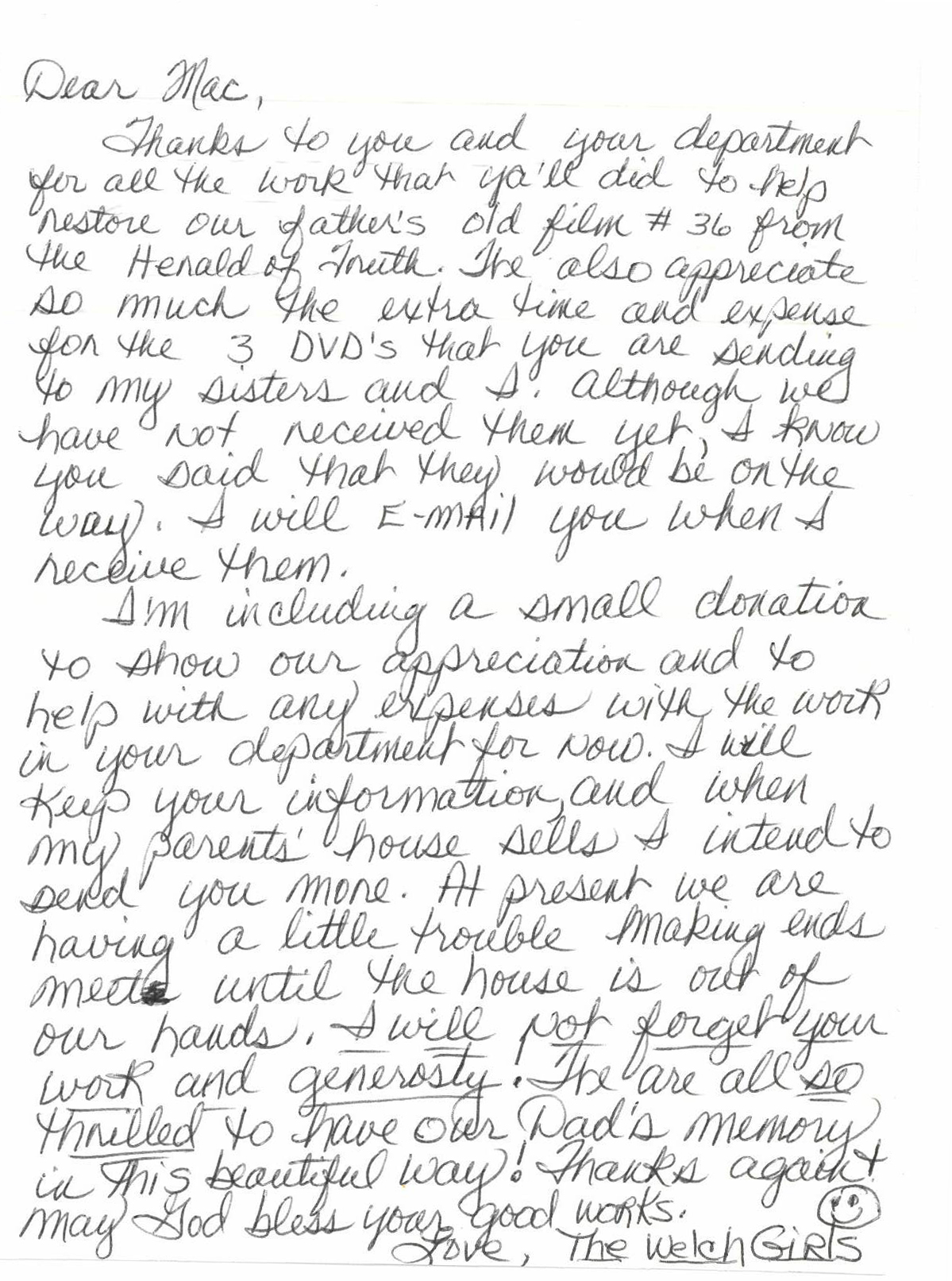
Thank-you note from the family of Alonzo Welch, who was the featured speaker in one of the Herald of Truth programs I digitized. They were able to see their father and grandfather preaching at the height of his career (late 1950s).
Facilitating user engagement through archival arrangement and description
When I came to ACU I realized our collection was in large measure unique among Stone-Campbell institutions and that it was also under-processed, under-described, and therefore under-used. I set a guiding principle for my leadership of Special Collections that our stewardship in teaching by acquiring, describing and facilitating use needed first to be of the highest caliber and every effort to that end should proceed from a strong foundation in traditional analog processing, description, and cataloging. In 2013 I led student workers in an initiative to align our physical and intellectual control of the collection with its conceptual and historical importance. Since then I have served as co-author, author, and supervisor for collection-level (or better) arrangement and description of 560 archival collections. The processes varied by collection, but each collection required some manner of appraisal and preliminary assessment. Many collections required accessioning. All collections received appropriate arrangement and description of analog materials in a variety of media; preparation, assembly, generation, and verification of MARC-ready metadata (shared with Technical Services Department); preparation and verification of expanded descriptive metadata for publication to a Finding Aids Series on the institutional repository. In some cases, the description, or intellectual control, was as granular as folder- or item-level. In many it was collection-level. In many more it was somewhere in between. In every case physical control was established through co-locating, labelling, and shelving all boxes and containers. By 2018 we achieved collection-level (or better) control over every collection with records in the library catalog and in digitalcommons.acu.edu. Since then I have maintained that as our minimal status quo, prevented the accumulation of any backlog, and ensured the timely processing of each new incoming collection or accrual.
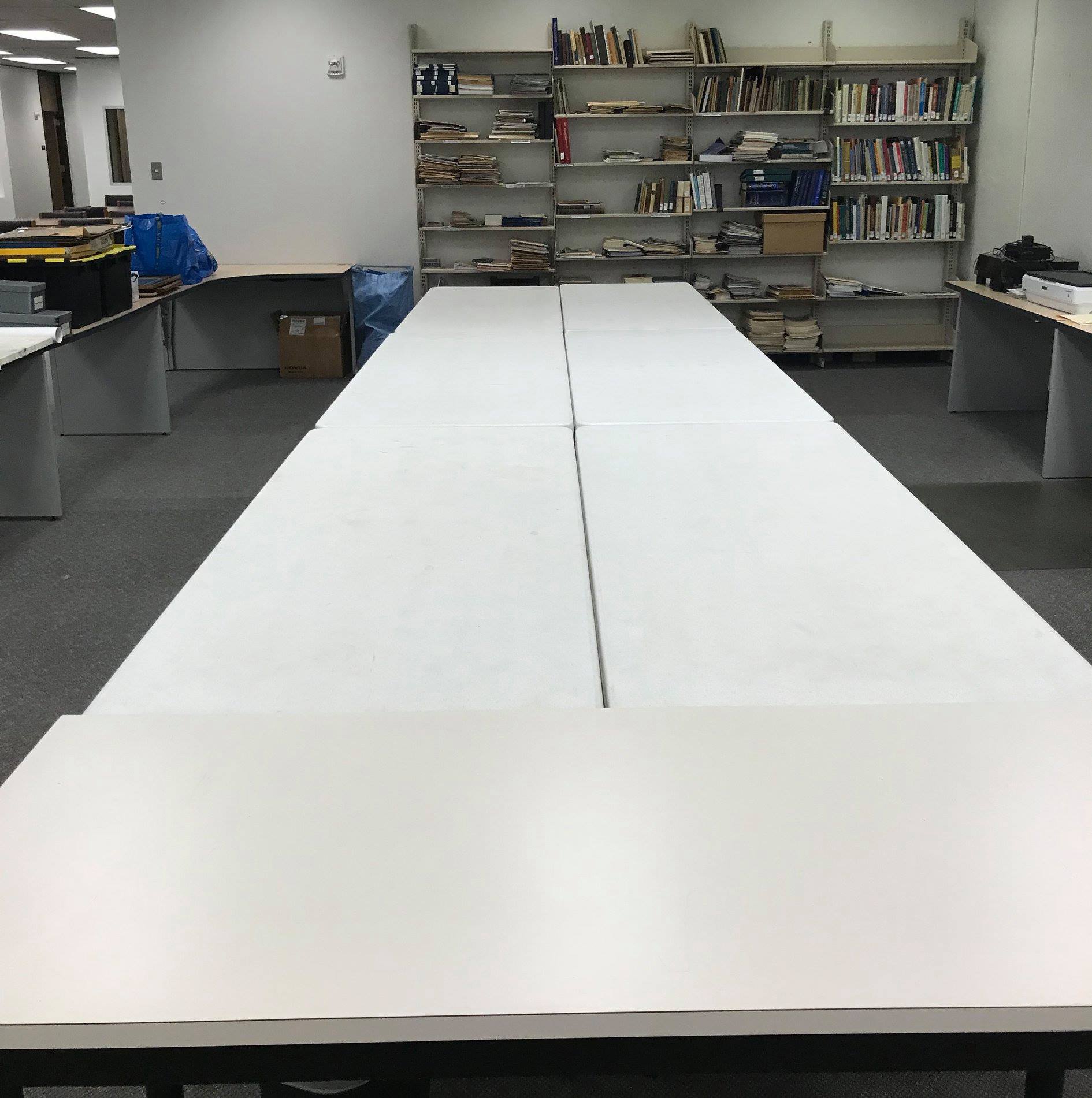
For an archivist, it doesn’t get much better than a set of freshly cleared tables primed for the next processing project. This is where I led a team of student workers to achieve intellectual and physical control for 560 collections.
Teaching by exhibit for local and global audiences
Since 2013 I have created, designed and described at least one new exhibit yearly (often two or more) of our unique holdings. For most of these exhibits I also created a digital surrogate which remains online. Two of my exhibits are among the top ten most-viewed pages on our blog: the Marshall Keeble exhibit (2018) with 1200 views and the Martin Luther exhibit (2017) with just over 800. The sustained interest in these digital exhibits demonstrates that users, who cannot travel to Abilene to see them in person, are finding and viewing them long after the analog exhibit was dismantled and returned to archival storage. I collaborated with Dr. Amanda Biles as she created and implemented a Public History course. Together we envisioned how we can provide her students with the awareness, skills, and blank canvasses needed to mount exhibits drawn from our collections. In this way I moved from being solely a creator of exhibits to co-creator and facilitator of student-led creative exhibit work.
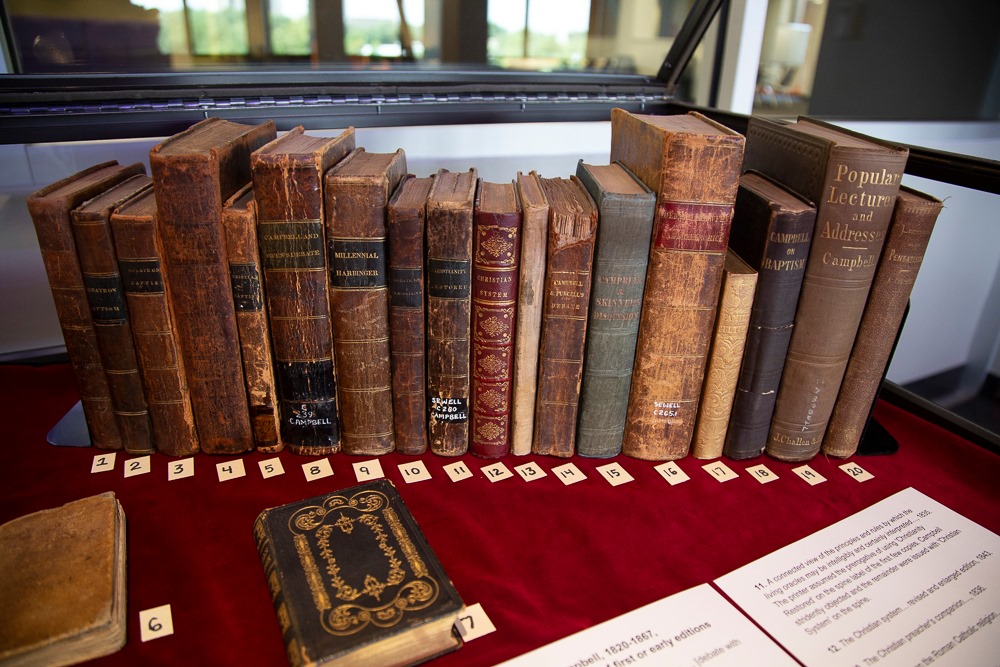
A pop-up one-day exhibit of scarce and beautiful Campbell first editions that Mac prepared for Restoration Day 2019 lives on the web for the world to enjoy. https://blogs.acu.edu/specialcollections/exhibits/for-the-good-of-mankind-thomas-and-alexander-campbells-enduring-print-legacy/#.XXqa85NKg3h
Teaching by mentoring student workers
To date I have supervised fifty-two students. Some semesters it was too much to handle (10-12 at once is not reasonable as I learned the hard way), but every semester it was productive. I am pleased that of this group of fifty, only three were very short-term employees. One realized she was over-committed, one received a better offer (and needed the funds), and only one turned out to be a poor fit. The remainder, I am most proud to say, worked with us at least a full semester and several worked with us for four full years. I consider it the greatest witness to my effectiveness in training and supervision that students could have left our department, but chose to stay. I also consider it a compliment to our department that several have entered the fields of public history, history education, or libraries and archives. In this way we were able to empower them with invaluable experience that was not just busy-work or mundane clerical work. I pride myself that our student workers work alongside me in almost everything I do. Nothing is too elementary for me, and within reason no task is too difficult for them. Most of our students work around 10-12 hours per week, some less, others more. In a very real sense it is like they are taking an additional course in supervised practice of archival science. I am also very proud that our hires have come from across the university spectrum: business and marketing majors to nursing majors to history and Bible majors to sociologists, thespians, artists, lawyers, historians, politicians, musicians and marriage therapists. Through the years it has been a pleasure to recommend them for graduate school and new jobs and to see them flourish in life after graduation.
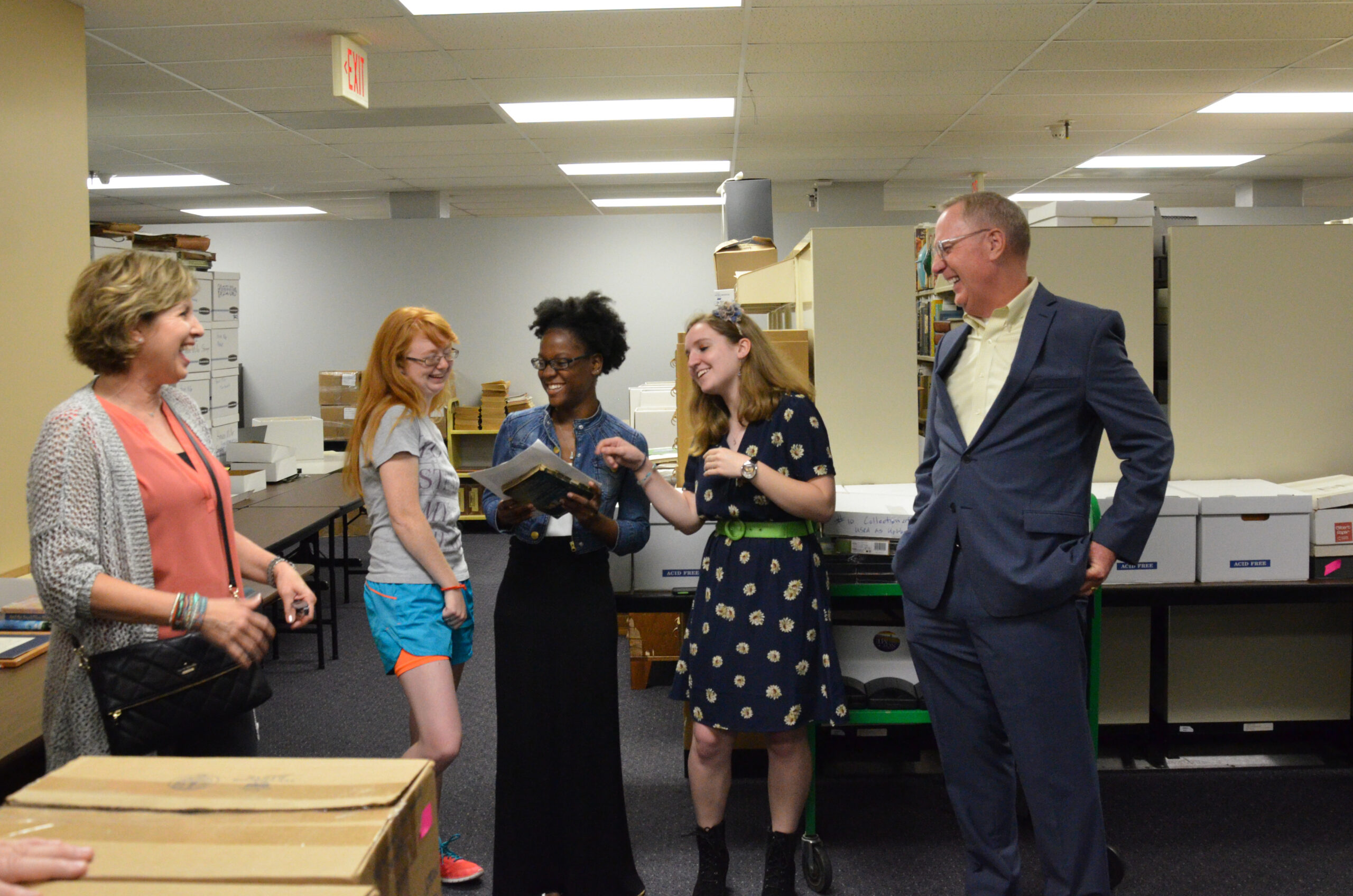
Max and Denalyn Lucado meet the students (l-r, Emily, Jeanniece, and Sarah) who helped Mac process their papers.
Reflection about Faith and Learning in an Archival Context
In my 2016 Restoration Quarterly article I suggested three spiritual disciplines by which Christian archivists might attend to the work of God and through which they serve their communities. I concluded the essay thusly:
Claude Spencer, pioneer archivist of the Stone-Campbell movement, remarked the Disciples were notorious for producing paper for the moment, consuming it, then casting it aside. It has fallen to later generations to follow behind and piece together the fragments. Undaunted in this challenge, Christian archives and archivists, by the nature of their work and the content of their collections, are poised to render to the church significant gifts. They can in fact redeem the rigorous canons of their chosen profession as spiritual disciplines, particularly the habits of observation and description, for the good of the church.
The disciplined application of inward meditation will bring before the church a wide array of voices, resulting in the gift of sensitivity. The disciplined application of outward service renders a hospitable and humble blessing. The disciplined application of corporate celebration holds high God’s work in our midst: from exemplars of the faith worthy of our imitation, to God’s far reaching grace and unfathomable love for us even in our worst 1non1ents. Pondering God’s gracious acts in this way, how can we not break forth in grateful doxology?
As I reflect five years since its publication, I would like to situate it briefly within a larger trajectory of my teaching career. In application the essay describes three spiritual disciplines (meditation, service, and celebration which enable or facilitate gifts to the church of sensitivity, blessing and doxology), but the substance of the article reflects some of my core values, particularly that God is at work in us and for us. I perceive my work, in a fundamental way, ought to orbit this central core. Again, modalities and methodologies may change but the core remains: that the loving work of God is central and therefore all of my efforts ought to mirror his love. In my classroom twenty years ago I made and hung two small posters on either side of the clock. Since students would look at that clock multiple times during their hour with me, I wanted them to see these quotes often:
“There are many who seek knowledge for the sake of knowledge: that is curiosity. There are some who desire to know in order that they themselves are known: that is vanity. Others seek knowledge in order to sell it: that is dishonorable. But there are those who seek knowledge in order to serve and edify others: that is love.”
–St. Bernard of Clairvaux
Bernard’s comment is well-put and ought to be by the clock in every classroom. What I tried to instill in my students is that we apply the very best of our thinking to our tasks because it deserves no less. I tell my students early on that they are not to check their brains at the door to Room 152: rather we check our assumptions, our traditions, our biases, our prejudices, our arrogance, our hard-headedness and hard-heartedness. We will explore, we will read, we will think, we will re-examine, we will learn, but we will do so to serve our churches and the world because we love God with our minds. My conception of the integration of Christian faith and archival practice is that we will know we are on the right track when our work self-consciously serves the good of the other rather than seeking prerogative for itself. We seek knowledge in order to serve. The same is true for librarianship. This might manifest in the created of original catalog records, finding aids, annotated bibliographies, reference instruction or any number of professional activities. But when the work bears the marks of selfless sacrifice in imitation of the life of Jesus Christ, when it seeks the good of the other for the sake of God’s glory, it begins to reveal how it has been formed by the gospel.
“Our life is full of brokenness: broken relationships, broken promises, broken expectations. How can we live with that brokenness without becoming bitter and resentful except by returning again and again to God’s faithful presence in our lives?”
–Henri Nouwen
Nouwen’s comment is well-put and ought to be in every Bible classroom. I tried to instill in my students that Scripture is more than mere recitation of historical events. Scripture is the drama of God’s pursuit of his much-beloved creation. We are part of that story and live in that story daily. God is present to us in ways beyond the sacred page; but my class is a text-based exegetical/theological academic class. I want my students to see that scripture gives us a lens through which to see God and his work in our lives and a grid in which we see meaning in our lives. So I wanted my students to see our academic investigation of the sacred page as one way in which we explore God’s marvelously sustaining and faithful presence. Now twenty years later, I remain convinced that Christian archives, like the materials they hold, bear witness in explicit ways to the fragility of human endeavor, to the brokenness of human experience, and yet also to the ever-present faithful work of God. Christian archives and Christian archival work is meaningless without the content of the Christian faith: the specific theological claims of the reality of God, his work in Jesus Christ, the presence of the Holy Spirit, and the nature of his church. Back of every finding aid or catalog record is the faithful work of God in the lives of those who preached, taught, written, or served before us. My task as a Christian archivist is to arrange, describe, and preserve these materials to exacting professional standards so that in them may be manifested the faithful presence of God. My task is to bring my gifts under discipline that they may bless the church for the sake of the world to the glory of God.
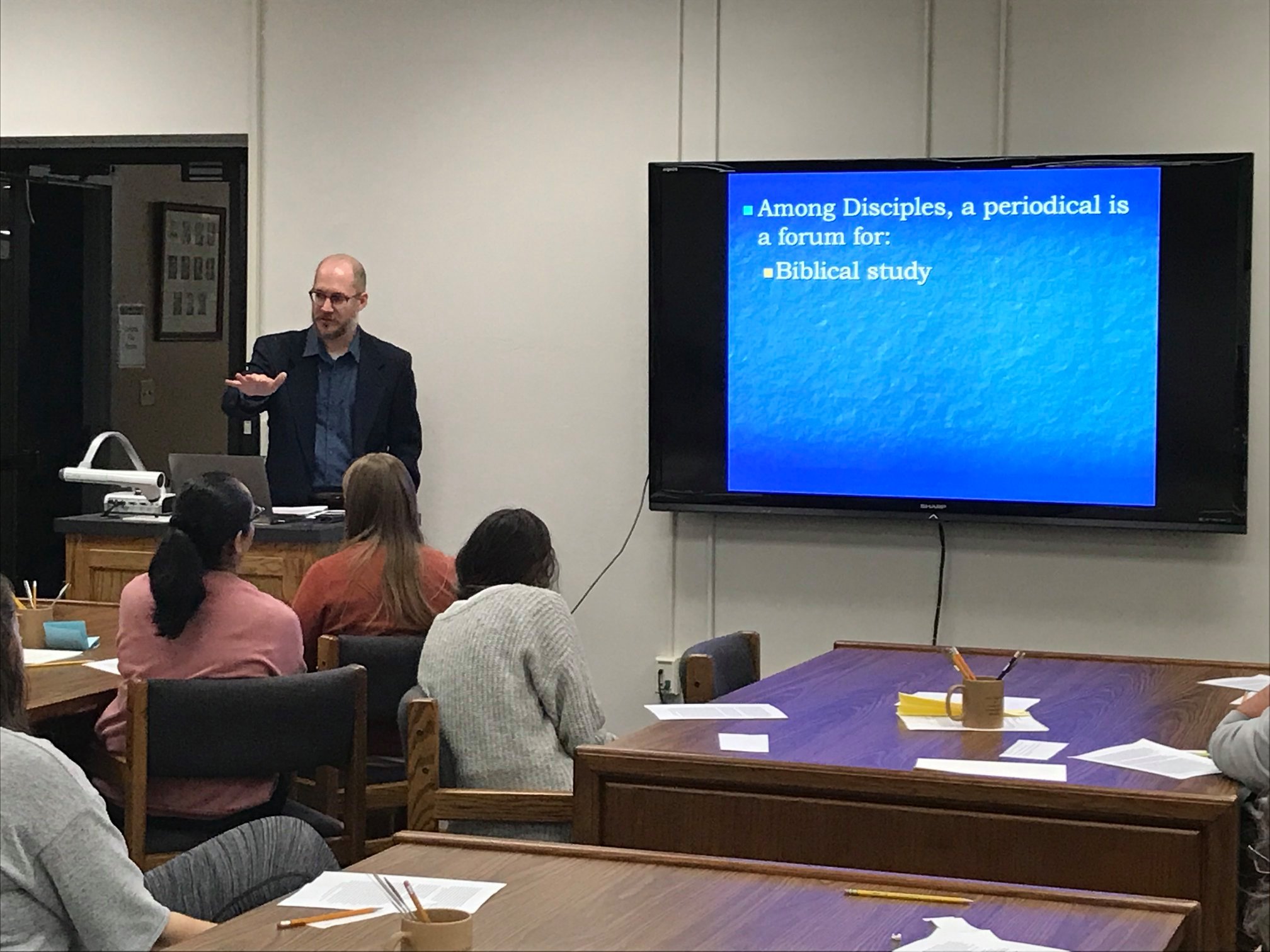
Mac guest lectures about BC Goodpasture and editor-bishops in the Stone-Campbell tradition for Dr. Tracy Shilcutt’s Social and Ethnic History course.
This trajectory began over twenty years ago in a secondary classroom and arcs forward on a university campus. My development over these years has come through traditional formation in the training of library school, through acquiring archival certification, and through near-constant engagement with the intellectual life of the university: interfacing with students and faculty on campus and with colleagues around the world by means of scholarly publication. The basic content, though, has remained the same: that the core function of my teaching is to apply the best of mind, time, energy, and devotion to my understanding of the Christian faith and then interpreting it through my work. It has grown and developed as I entered a new profession in a new setting and had to think through how faith and learning relate and are applied in an archival setting. My 2016 Restoration Quarterly article was an early formulation and re-contextualization of these commitments. I tried then to think very closely about how archival practice might intersect with traditional Christian spiritual disciplines. I tried to articulate how a person of Christian faith might also at the same time conduct an archival enterprise according to the best practices in the field. I tried to articulate how to bring the best gifts of mind and body to bear for the sake of serving the church and the world, to bear witness to the faithful presence of God. It gratifies me to see that this article has been cited in academic articles and theses about spirituality in library and archives contexts. My 2019 chapter on Claude Spencer, pioneering archivist of the Stone-Campbell tradition, further explored how he approached his task in his context. His attempt to wed archival rigor to hospitable churchmanship serves as an admirable model given the constraints in which he worked.
Finally, in retrospect I see that I have tried to work within the field of Stone-Campbell history, the domains of archival and library science, and within the broader Christian tradition of biblical studies, church history and theology. Where I see points of connection I have tried to tease out how they might intersect and interact and what all of that might mean. It has been an iterative process many years in the making and the end is not yet in sight.
Click here to read Dr. Tracy Shilcutt’s letter of support for my teaching, She has worked closest with me in Historical Methods, our most significant collaborative laboratory for cross-divisional collaboration, as well as several other courses.
Next section: Scholarship