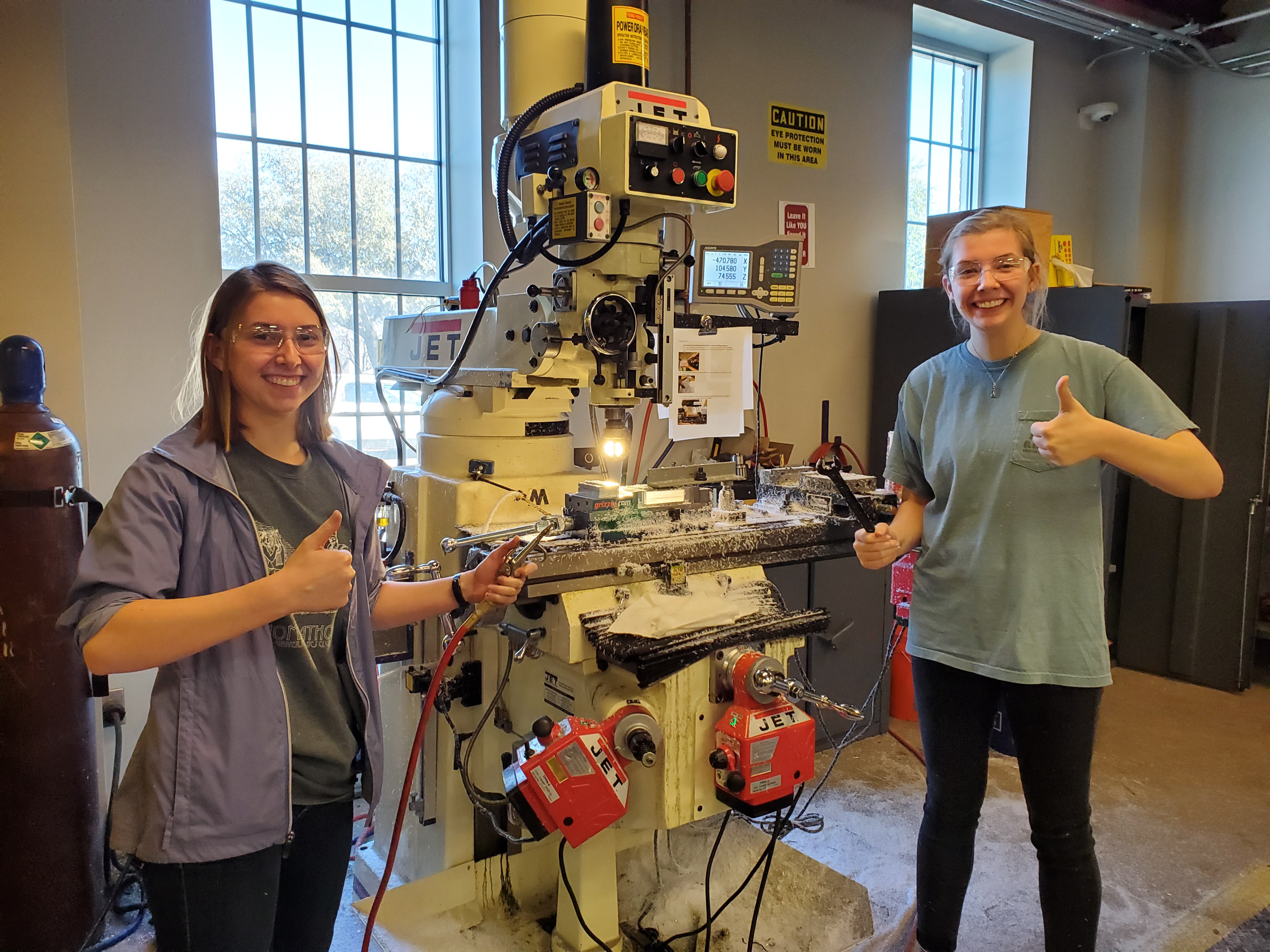
ACU undergraduates Emily Branson (left) and Lily McIntosh (right) machine tiles for the STAR forward upgrade in Bennett Engineering Labs.
In this section, I provide details on the STAR Forward Upgrade project. I describe, in particular, the roles ACU students have played throughout the effort. This project has prioritized student participation and leadership in a purposed attempt to provide opportunities for learning and development of valuable professional skills. It has also proven to be a perfect marriage of the two complementary elements of our department: Engineering and Physics. At the end, I reflect on some of my joys with this project, as well as a major mistake I made and how I’ve grown along the way.
Physics Motivation
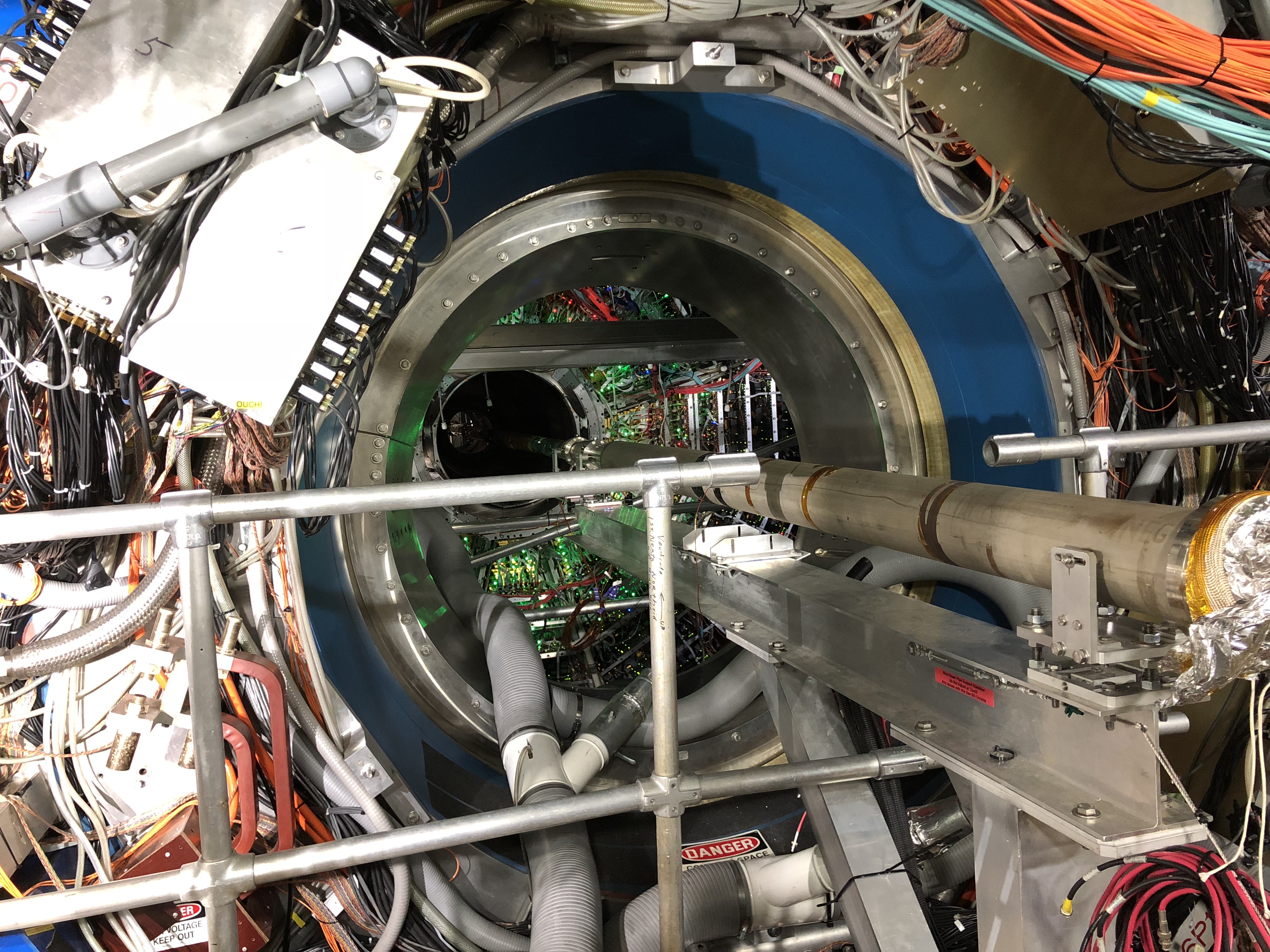
The hole in the STAR pole tip, looking toward the west side of the time projection chamber. The RHIC beam pipe runs through the center of the pole tip.
The STAR experiment studies such things as the underlying structure of protons and neutrons by measuring the particles that result from a highly energetic collisions of beams of protons. For a complete picture, one would need detectors that completely surround the location of the collision. This is obviously very difficult, e.g. one needs to leave enough of a hole for the incoming beams to pass through, but the more coverage one can get, the better. As one can see from the picture, STAR has a rather large hole surrounding the beam pipe. Because of this hole, many of the particles from the collision that are scattered “forward,” i.e. very close to the beam pipe, are lost. The STAR collaboration proposes to build a new suite of detectors that “fill in” much of this hole. This suite of detectors is colloquially called the “STAR forward upgrade.” The upgrade will consist of three general classes of detectors: “tracking” detectors that track the locations of electrically charged particles; “electromagnetic calorimeters” that measure the energy of particles that interact via the electromagnetic force, e.g. electrons and photons; and “hadronic calorimeters” that measure the energy of particles that interact via the strong nuclear force. These detectors will enable STAR to gather a far more complete set of information about these collisions. By doing this, physicists will be able to paint a clearer picture of the fundamental building blocks of the world around us.
Project Proposal
To fund construction of the hadronic calorimeter, a group of STAR collaborators submitted a Major Research Instrumentation (MRI) proposal to the National Science Foundation (NSF) entitled, “MRI Consortium: Development of a Forward Calorimetry Upgrade for the STAR Detector.” The five investigators of the consortium are as follows:
Investigators
- Principal Investigator (PI): Scott Wissink (Indiana University)
- Co-PI: Jim Drachenberg (ACU)
- Co-PI: Renee Fatemi (University of Kentucky)
- Co-PI: Carl Gagliardi (Texas A&M University)
- Co-PI: Michael Lisa (Ohio State University)
The MRI program is highly competitive. Each institution is only allowed three MRI submissions in each cycle. Before our proposal could be submitted to NSF, it had to pass through an internal competition at Indiana University. NSF historically funds around 20% of the MRI proposals it receives. Our proposal was successful and funded at the level of $1,950,000 (91% of the requested budget).
As Co-PI, I led ACU’s effort in drafting the proposal, including writing documents to serve as bio-sketches, ACU scope of work, ACU budget, and budget justification. I worked closely with the ACU Research Office to ensure all requisite forms and documentation were in order.
ACU plays a prominent role in this proposal. The hadronic calorimeter is constructed with alternating sheets of lead (20-mm thick) and a specially constructed plastic “scintillator” material (3-mm thick). I was responsible for purchasing all plastic scintillator for the project (a total of $333,900), receiving the shipments from Eljen Technology, and distributing scintillator plates to UCLA and Ohio State for machining. Additionally, ACU is responsible for machining one-third of the scintillator tiles and finishing the construction process by polishing and painting edges of the tiles, a process described below. ACU is the only institution in the consortium to perform all phases of the scintillator construction process. Furthermore, at every stage of the process, ACU’s effort is led by undergraduate students and performed on the ACU campus. To date, we have been able to employ over 20 student researchers from multiple departments, including Engineering and Physics, Math, Nursing, Bible, and Psychology, on this grant.
List of Student Team Members
| Name | Major |
|---|---|
| Emily Branson | Physics |
| Isla Casey | Physics |
| Trent Cavicchi | Engineering |
| Levi Chambers | Bible and Ministry |
| Kathryn Davis | Liberal Studies |
| Ben Edwards | Physics |
| Ziyu Gao | Engineering |
| Colton Gates | Engineering |
| Diana Hernandez | Engineering |
| Beth Jennings | Physics |
| Payton Kirk | Engineering |
| Denis Lagat | Nursing |
| Jared Mayfield | Physics |
| Lily McIntosh | Engineering |
| Madison Meador | Physics |
| Noah Mitchell | Physics |
| Amen Mugisha | Psychology |
| Diane Mukundwa | Engineering |
| Matthew Myers | Physics |
| Josh Nicholson | Physics |
| Winny Nkutu | Nursing |
| Irene Rono | Nursing |
| Roy Salinas | Physics |
| Yunxi Wei | Mathematics |
Construction Projects
The construction process can be broken down into four basic tasks:
- Each 3 mm × 203 mm × 203 mm sheet of plastic scintillator is (approximately) quartered into four “tiles” using a bandsaw
- The tiles are milled to precise dimensions of 3 mm × 95 mm × 97 mm
- The 97-mm-long edges are polished to a “glass” finish
- The 95-mm-long edges are painted with a white reflective paint
The first two steps are illustrated in the videos, below.
Cutting Scintillator
Note the (appropriately) purple “scintillation” glow from the tile edges
Milling Scintillator
These first two steps are carried out in the Bennett Engineering Labs and give each student valuable training and experience operating tools of the engineering trades. The polishing and painting are carried out in the basement labs in Onstead Science Center. It is worth noting that ACU’s ability to function as a leading institution on this project would not be possible without the investment made in these facilities. It would also not be possible without Donald Isenhower’s extraordinary 40 years of experience working with scintillator and building detectors and his eager willingness to share that expertise with our students.
Reflection
Seeing this project take-off is one of the more gratifying experiences I have had in my career. It is a tribute to my colleagues at ACU Engineering and Physics and the phenomenal students we have across this campus. Lamar has many excellent qualities, and I always felt free to pursue creative research efforts. However, I also found it difficult to sway colleagues to join me in the efforts. At ACU, my colleagues not only encourage my creativity but participate with me. At ACU, I have also been able to find a wide variety of students eager to work and take on challenges. While understandably the bulk of our student researchers have come from Engineering and Physics, our team has benefited from students all across campus, e.g. math, nursing, psychology, and Bible. We have had significant participation from our international student community. It has been extremely gratifying to bring a project like this to the ACU campus.
Our department at ACU is unique, and I believe this project highlights the ways this uniqueness is a strength. At Lamar University, many of our physics majors were dual-degree students, e.g. pursuing degrees in electrical or mechanical engineering as well as physics. While I had the opportunity to mentor these students, I did not have the opportunity to work alongside my engineering colleagues. At ACU, the situation is different. I believe this difference is an opportunity. Speaking for myself, working with my engineering colleagues, every day, I have been able to learn from and appreciate their often very different perspectives. One of the reasons I initially believed in this project was the opportunity for us to work together, to leverage the best of both perspectives. What I have observed, so far, is that all students involved, whether engineering or physics, have gained valuable hands-on experience with tools of the trade and also exposure to the deeper underlying concepts of physical phenomena. Going forward, my dream is that projects such as this will pave the way for future mutually beneficial collaborations between engineering and physics students and faculty.
There have been many challenges throughout this process. As an institution with a primary focus on teaching, we do not have the supporting infrastructure that many of our colleagues have. As a result, whereas most of my colleagues at IU, A&M, UCLA, OSU, and Kentucky are able to delegate minutiae to others, I am responsible for these tasks at ACU. As one example, I physically hand-deliver the packages of scintillator to the Campus Center for shipping to UCLA and OSU. These tasks are time-consuming and often wind up urgent, requiring me to drop whatever I am doing, e.g. to ensure packages make it out the door by the close of business. On the other hand, I am now far more acutely aware of the critical importance of these “details.” I also think it is a good lesson for students to watch their professors engage in these tasks, trying (imperfectly) to lead by example. Of necessity, it has also given me a deeper personal investment in the project.
The Lost Crate
It’s worth reflecting on one of my major mistakes. A bit of a story is in order…
One of my shipments to Columbus, OH, representing 10% of the scintillator for the project, was lost for a significant period of time. My contact from OSU was out of the country, and I had not thought ahead to communicate with the local shop manager. Consequently we did not realize the package was lost until the shop manager ran out of scintillator to machine. When it was confirmed the package was lost, I scrambled to ship another crate of 400 plates to OSU and worked with the company to locate the package. After weeks of searching, the company eventually declared it a loss and begin processing reimbursement. I worked with Eljen Technology to prepare manufacturing of another 400 plates of scintillator. Right before processing the check for reimbursement, the company finally located the package in a freight facility in Columbus, OH. At this point, the OSU campus was shut down due to COVID-19 and the crate could not be delivered to the shop. My colleague had to arrange for shipment to his own house and wait to deliver it to the shop when cleared by the university.
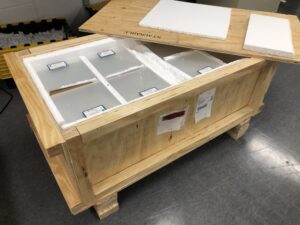
An 800-count crate of uncut scintillator plates from Eljen Technologies in the basement of Onstead Science Center.
While the loss of the package was not my fault, there are simple things I could have done to alert us sooner to the trouble. I assumed the shipping process would work (how hard is it to lose a 150-pound crate of scintillator?!). A good project manager, though, anticipates problems and communicates early and often with those on site to diagnose problems, as early as possible. In this respect, I dropped the ball and cost us valuable time and effort. I learned from it, though. For all shipments made after we discovered the crate was lost, I was far more proactive in tracking shipments, multiple times a day; communicating with the people at the destination; and not assuming “no news is good news.” I’m grateful for the learning experience, and I am relieved that it did not ultimately endanger the project!
<<< Undergraduate Research Presentations and Publications >>>