Explanation of Plots
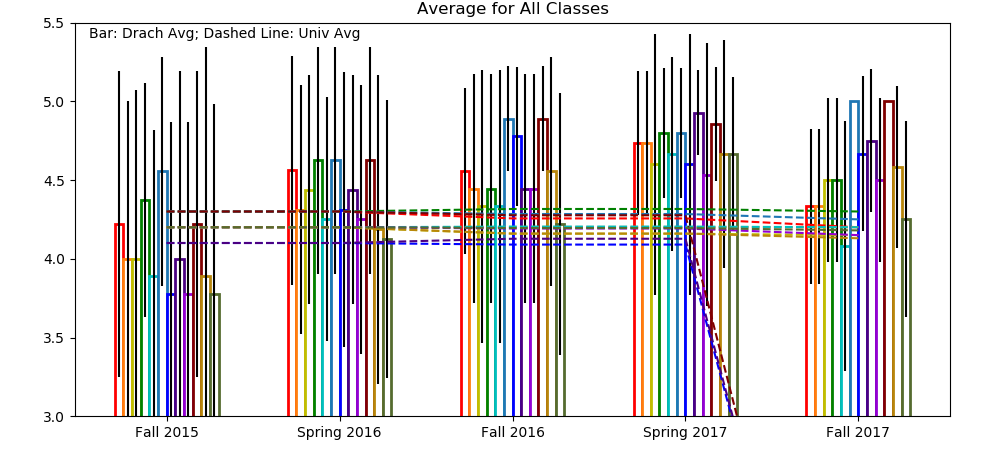
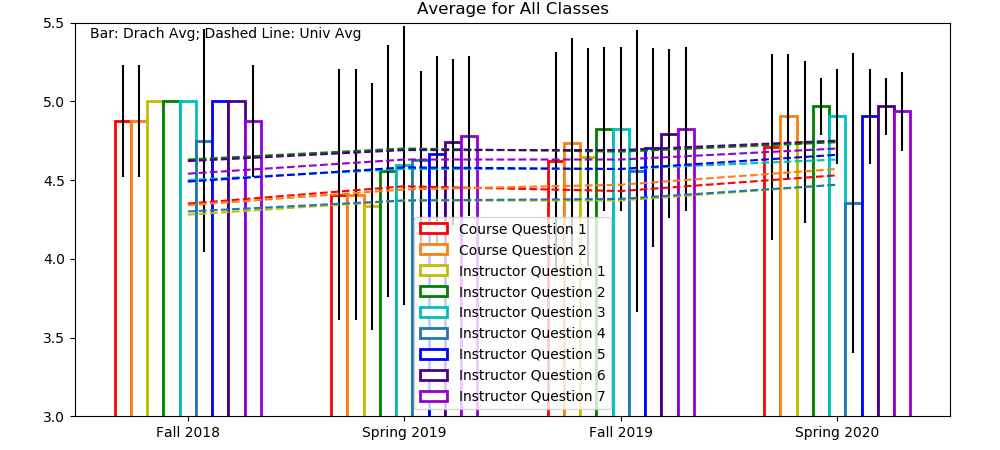
In the plots, below, I present the average score for each student evaluation question as a bar chart. The bars for each question have a different color, as explained in the legend, which applies to both plots. Overlaid with this, I present the university average for the questions as a line graph, where the line color, again, reflects the question. Note that typically the university average is higher than the average of my department and college. The averages are presented separately for each semester to show my progression over time. Since the set of questions changed when I moved from Lamar to ACU, I show separate graphs for my averages at Lamar and at ACU. You will also notice a systematic shift in the university averages for the two schools. Click on the image to view larger versions of the plots.
Average for All Courses
Reflections on Student Evaluations
My student evaluations have shown steady improvement over time. I believe this is due to a combination of factors including growing experience, reflection on student feedback, and implementation of improved methodology. In hindsight, I think the most relevant factor, early on, was simply experience, to which I attribute the significant jump between my scores in Fall 2015 and Spring 2016. I put together my Fall 2015 College Physics II course, largely from scratch. As a result, I learned significantly from missteps and trial-and-error, which paid dividends in subsequent semesters, either in delivering improved offerings of that course or building other courses more effectively. The steady improvement from Spring 2016 onward I attribute largely to listening to feedback and improved methodology. Below, I will reflect in more detail on some specific instances and enlightening pieces of student feedback.
Fall 2015
My lowest evaluation scores were given in Fall 2015, my first semester of teaching at Lamar; and, in hindsight, I believe this is completely fair. While my scores exceeded the acceptability requirements for annual review, they were consistently below the department and university averages.
Text responses from students were positive, overall, e.g. from College Physics II lecture:
Dr. Drachenberg is best at breaking down extremely difficult topics and problems in a way that helps them not be so intimidating. He relates things to real world examples and makes things easier to understand.
Good at engaging students in class discussions and participation, treats everyone fairly.
However, I certainly had critics! From the same lecture:
Since it’s his first year, he doesn’t really know what works best. Crams in lecture material, speeds through lecture, everyone is literally lost. Even the brightest students in our class were still lost and didn’t completely understand the material given. The homework were generally due the same day we learned most of the material for that homework even though he gives us about a week to complete.
Obviously, much of this comment is hyperbole, e.g. not “literally” everyone was lost and it was not “generally” the case that students had less than a day for their homework. However, it is more than fair to say that, at this point, I did not have a good feel for the appropriate pace or balance for the course. Also, since I was building assignments and lectures as I went, I was not always as organized, as I wished to be.
In responses to “Areas to improve”: HIS TESTS. They’re so hard. Normally, our class average is an F…
Again, there is some hyperbole, here, e.g. the average test score was not an F. However, in hindsight, the difficulty level for the Fall 2015 course was far too high. The gist of the critique was completely fair.
Between the Fall 2015 semester and the Spring 2016 semester, I made adjustments to the pace and balance of College Physics II. I did my best not to sacrifice content, but rather focus more attention on the demanding topics and spend less time on the less critical concepts. I also significantly adjusted the level of difficulty on the exams, in particular, reducing the length of the tests. Those adjustments aside, the simple fact that College Physics II was no longer a “new prep” in Spring 2016 was significantly helpful. As a result, my scores significantly improved between Fall 2015 and Spring 2016. From this point forward, I began to score above the department and university averages, a trend that continued throughout my time at Lamar.
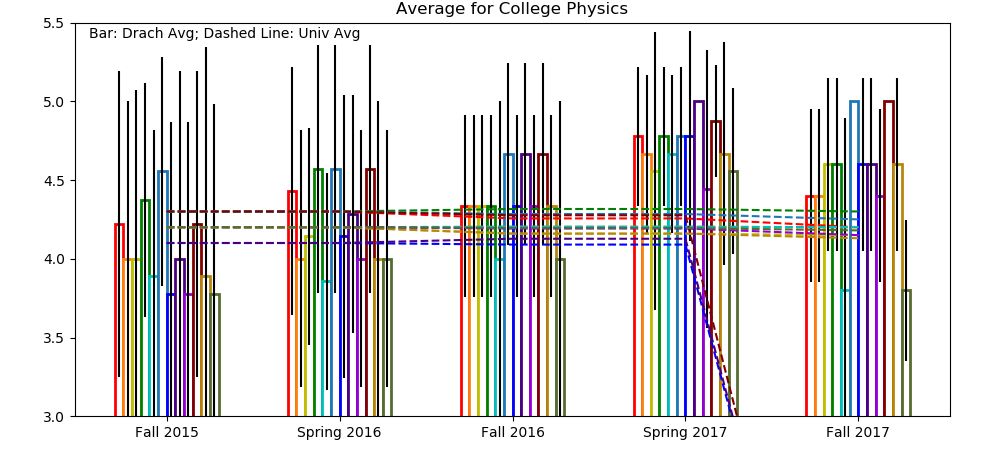
Note: In the plot above, my Spring 2016 evaluations include four very positive student responses from an upper-level course. For a direct comparison isolating College Physics II, see the dedicated plot below.
Fall 2017
You will notice a slight dip for some questions in the Fall 2017 semester. The start of this semester was significantly disrupted by historic flooding in the Golden Triangle related to Hurricane Harvey. Frankly, I was simply grateful that my averages continued to meet or outpace the university averages! This was a difficult semester for everyone: faculty and students, alike.
Student comments did not offer anything revealing pertaining to the dip in my average. Under “Instructor Weakness,” one comment requested more visual aides, one mentioned the use of Mastering Physics, and one regretted my not providing review sheets for exams. Under “Areas to improve,” the same three items were reiterated along with an additional suggestion of offering multiple chances to on-line quiz responses. While I do incorporate visual aides in lecture, I understand that some students will prefer more; and that is okay. I also understand the request to drop Mastering Physics, which is by no means perfect; however, I had to disagree respectfully with this student. The only realistic way I could teach College Physics II was with assistance grading homework. We did not have room in the department budget at Lamar to hire student graders for my courses, so an on-line homework tool was more or less required. I also found that for College Physics II, it provided several advantages overall, including immediate feedback, a bank of built-in hints if they got stuck on a problem, “tutorial” problems that would deliberately step them through a solution, and expanded portability. I will also note that having an on-line tool during the Hurricane Harvey disruption became a significant unexpected advantage. While I did not provide exam review sheets, I would provide the exam equation sheets upon request as well as hold review sessions. Finally, the on-line quizzes in question were multiple choice, therefore it did not seem a good idea to provide multiple attempts at a question.
Spring 2018
My Spring 2018 evaluations are not shown, since my access to the Lamar internal network was disconnected prior to those results being provided.
Fall 2018 and Spring 2019
Fall 2018 was my first semester at ACU. With that change comes a change to the particulars of the student evaluations. Along with changes to the evaluation questions, I also switched to teaching a different mix of classes. Finally, it is worth noting that the average professor score on student evaluations is higher at ACU than at Lamar. So, while it is difficult to extrapolate trends from my time at Lamar into my time at ACU, I have tried to reflect on my performance in general.
The scores from my first semester at ACU in Fall 2018 were abnormally high. I attribute this to a relatively small number of student responses that were all overly kind. I believe I was not a disaster, but I also think those scores are unfairly high.
My Spring 2019 semester averages were far more realistic. I received a number of comments from my Engineering Physics I course, the largest class I taught that semester. On “improving effectiveness,” I received the following suggestions (paraphrased) that I will reflect on in some detail.
- End on time
- Grade homework more quickly
- Do more demonstrations earlier in the semester
- Spend less time on the earlier chapters
- Reduce number of exam questions
- Improved exam reviews and study guides
- Reduce course workload
- Work problems on the marker board rather than PowerPoint
- Do more “lecture” in class
- Use numbers rather than variables in example problems
- Improve the functionality of the classroom
I agree that suggestions 1-4 are fair, and I have tried to improve in these areas. In the Spring 2019 semester, I did occasionally run long in EPI. Almost always, it stemmed from trying to finish an example problem; and the types of problems we work in EP are difficult to stop and restart without simply reworking the problem from scratch. I have tried to improve my time management in this respect, but I will admit that stopping-and-restarting efficiently remains a work in progress for me. The comment on homework grading is completely fair. In contrast to the situation at Lamar, we have sufficient department funds for student graders for Engineering Physics. In our introductory courses, the department has also prioritized teaching problem-solving approaches, e.g. stating givens, articulating an approach, evaluation of the answer, etc. Consequently, I decided paper homework for Engineering Physics I and II was necessary, in contrast with the on-line homework I used for College Physics at Lamar. The amount of homework to grade is substantial in Engineering Physics, and I have had difficulty with student graders not returning graded homework efficiently. I have addressed this in a few ways, e.g. being more careful with whom I hire and hiring multiple graders for particularly large sections. I shared the students’ desire for more in-class demonstrations earlier in the semester in EPI. I devised a few new demos for the Fall 2019 semester and response has been positive. Finally, I agreed with the sentiment that too much time was spent on the more mundane sections of the first few chapters in EPI. On the other hand, these concepts are foundational; and I did not want to skip them entirely. I compromised by moving some of the easier material into the laboratory, where I thought a hands-on approach would be more engaging. I used the additional time in lecture to focus on the more difficult concepts from these earlier chapters. Response has been positive, so far.
I have considered suggestions 5-6 about exam questions and reviews; but I have decided not to make radical changes, so far. I closely monitor exam scores, each semester. My goal is to see class averages around 75%, and generally this has been the case. Consequently, I have not felt the need for major overhauls to exams, preferring to make incremental changes where appropriate. I also experiment with ways to improve exam reviews and study guides, but this is honestly a continuous and on-going effort.
Concerning suggestion 7, the workload in EPI and EPII is substantial; and, while I sympathize with this particular student, I believe the workload is appropriate and necessary. For our majors, EPI and EPII are foundational, laying a framework for the rest of their courses. Many of the concepts are challenging and require substantial practice outside of class. While I cannot change the reality of this, I am concerned that the course not become what it is at many other universities, specifically a “weed-out” course. To this end, I believe I have been successful. Out of 57 EPI students from Fall 2018-Fall 2019, I only had to fail 1 student (I will address the Spring 2020 semester in detail, below). I am constantly looking for ways to improve, but I do believe that on the whole we have been able to find balance in challenging students and setting them up for success in both the short term and long term. I am humbled and encouraged that each semester, in addition to negative comments about workload, I also receive comments such as the following:
EPI Fall 2018: His classes are very hard because of the subject but somehow he manage to made the hardest class of the semester the best class because every time I left class I learned something new. His presentations were well explained, his classes were great and he was always available to help us.
EPI Spring 2019: Although it was my hardest class, it was definitely the most interesting. Thank you for everything.
EPII Spring 2018: The best class I have taken, it was a very, very hard but the professor made sure that everyone was doing good and he was willing to help you if you asked. Althought he demands a lot of work (3 quizzes and 3 homeworks per week), plus the tests, he will help you and it is his interest that you learn the material and comprehend it in order to use it in real life.
EPI Fall 2019: This course was by far my favorite course I have ever taken, and it was an absolute blast to be a part of. Keep it up.
EPII Fall 2019: Loved this class! It was difficult but not unreasonably so, and very interesting. I also thought it was really cool how Dr. Drach would do a short devo at the start of every class: that was always a really cool way to start my day!
EPI Spring 2020: This was a tough class, but I learned a lot and I look forward to having Dr. Drach for EP 2.
EPII Spring 2020: My hardest course I ever took, but quite possibly the best professor to back it up. I loved this course and will remember the lessons I learned regarding Physics, and those above aspects of life.
To some degree, suggestions 8-10 are matters of taste. As described elsewhere, I am sensitive to varying student preferences, and I try to use multiple forms of media for working example problems, including PowerPoint, the marker board, and a document camera. I have continued to utilize pre-lecture “reading quizzes” to gauge the need for further in-class “lecture” on a particular topic, and I believe this has been effective to addressing this particular request. The use of symbols rather than numbers is an interesting topic! In my experience, it is common for introductory physics students–whether in College Physics or Engineering Physics–to have difficulty transitioning from numbers to symbols. However, it is a critically important skill to learn, especially for engineering and physics majors. I appreciate the student comment as a reminder that this is difficult for them, and I have tried to be more direct in explaining my reasoning for that particular exercise.
While the final comment on utility of the classroom was out of my control, I did pass this along to our leadership. I am grateful that the powers-that-be were responsive. As of the Spring 2020 semester, classroom functionality was significantly improved; and students benefited because of it.
Spring 2020
I am humbled that my Spring 2020 evaluations are among my best, and I believe it says something significant about our school that university averages are up across the board from the previous semester. I am grateful to work around colleagues that challenge me to be at my best when the times are most difficult.
I began the Spring 2020 semester with 42 students enrolled in EPI and 18 in EPII. After the move on-line, two EPI students and one EPII student dropped. Of those left in class, I had to fail three EPI students and one EPII student, based on semester performance. These are higher percentages than my usual, and I believe reflect the extreme challenges of the Spring 2020 semester. What a challenge it was! I was gratified that students seemed to respond well to the effort we made to continue through the disruptions:
EPI: Out of all my courses, I think Dr. Drachenberg did the best job transitioning to online classes. It definitely relieved some stress on me because I knew he was taking into account these unusual times.
EPII: The instructor did very well at adapting to the changes and challenges of this semester. Thank you for this!
Averages for Specific Courses
It is useful to look at general trends for specific courses, where possible. Many of my classes have relatively small enrollment numbers, thus, it is not always easy to evaluate trends. However, for the sake of transparency, I provide separate results for College Physics II, Engineering Physics I, and Engineering Physics II with some brief qualitative reflection. Upper-level classes simply do not have sufficient data for this type of presentation. Nevertheless, I provide full evaluation reports for all classes, below, for further reference.
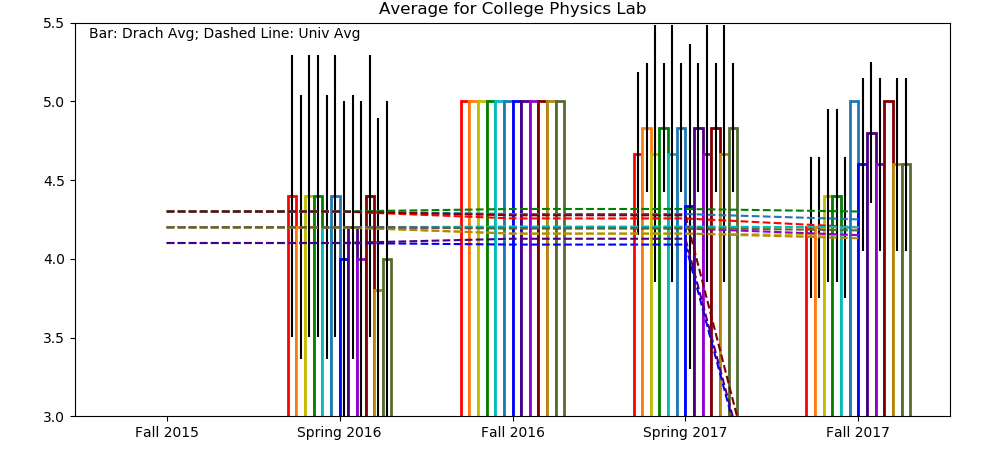
Average for College Physics II
Reflection
There is a clear positive trend, which I believe reflects my general improvement as a teacher, improved teaching methods, and effective response to student feedback.
Reflection
College Physics II was designated as 4-hour course at Lamar, including the laboratory as part of the lecture course. In Fall 2015, they did not provide separate evaluation for the lecture in the lab. In subsequent semesters, they did; so I have presented these separately for more effective reflection. There is general improvement from Spring 2016 to Fall 2016 and onward. After experimenting in Fall 2015 and Spring 2016, I created a new, dedicated set of experiments and manual for College Physics II laboratory. I believe the positive student response reflects the effort to improve lab exercises and sync the topics more effectively with lecture discussions.
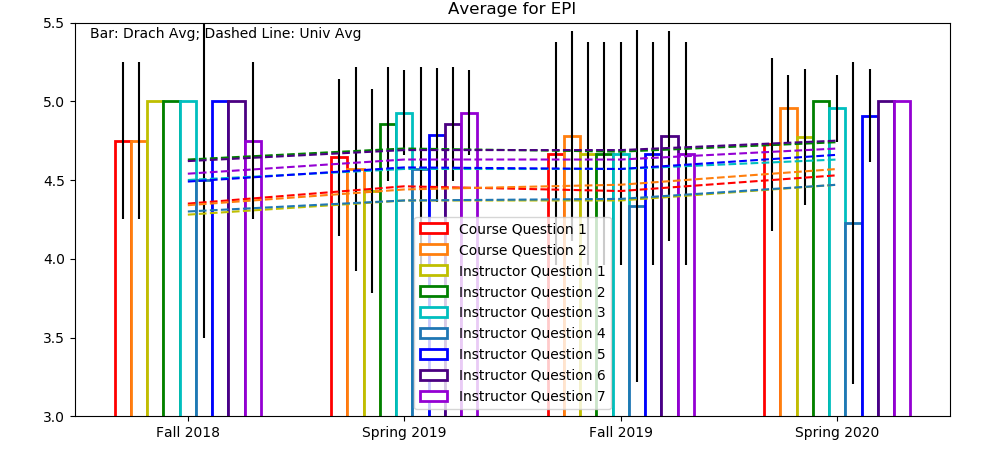
Average for Engineering Physics I
Reflection
As discussed above, Fall 2018 responses are appreciated but probably unrealistic. Spring 2019 responses are likely more fair. My scores in EPI lecture are more or less stable. At first glance, there appears to be something of a dip in Fall 2019, however, a deeper look reveals this is not statistically significant and largely due to a single student scoring “3” on every question. Because the Fall section of EPI is “off-sequence,” enrollment is lower; and a single student can have a larger effect on the average. Note: the “uncertainties” reflecting the number of respondents and variation in response are much larger for Fall 2019 than Spring 2019.
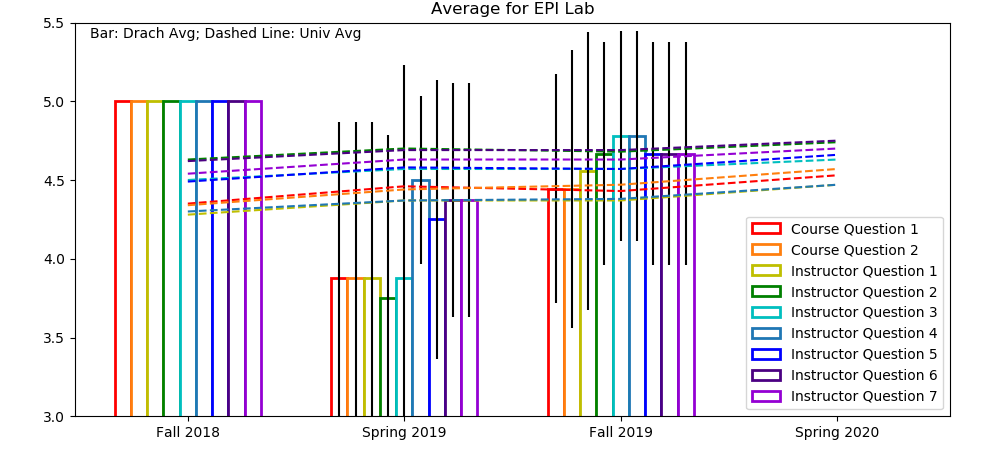
Average for Engineering Physics I Lab
Reflection
Again, I’m flattered; but I cannot take the Fall 2018 responses seriously (small number of responses, all overly kind). Spring 2019 is much more fair. No one was satisfied with the state of EPI lab, at that point. As a part of my service, I agreed to overhaul EPI lab, when I was hired. I spent the Fall 2018 and Spring 2019 semesters observing the current status and developing exercises. The inaugural launch occurred in Fall 2019. As you can see, every question saw significant improvement from Spring 2019 to Fall 2019, which I believe speaks to the effort to improve the lab.
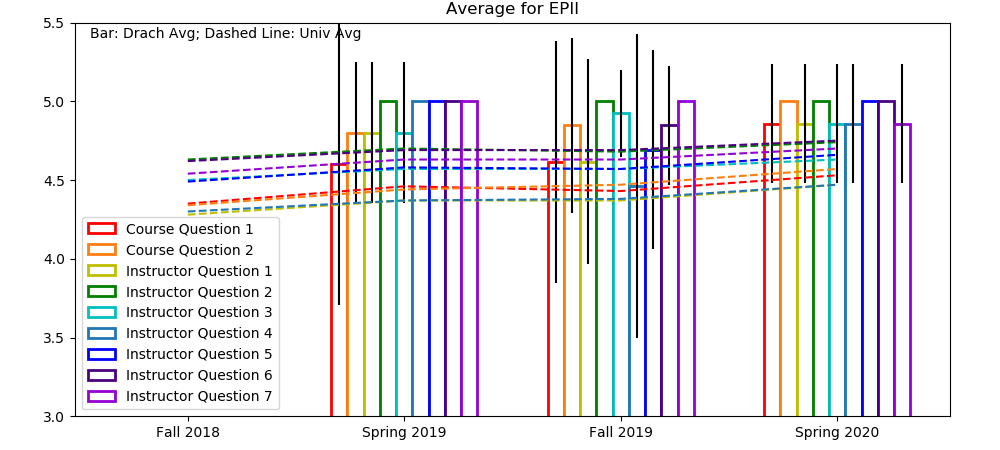
Average for Engineering Physics II
Reflection
It is difficult to divine trends in EPII. I would characterize the state of these responses, overall, as “stable” with perhaps some improvement over time in some of the questions.
Spring 2020 (ACU)
- Engineering Physics I
- Engineering Physics II
- Electricity and Magnetism (cross-listed as PHYS 360 and ENGR 360)
Fall 2019 (ACU)
Spring 2019 (ACU)
Fall 2018 (ACU)
Spring 2018 (Lamar)
Due to accepting the job at ACU, my access to Lamar computing services was disconnected before I was able to download my teaching evaluations for the Spring 2018 semester.
Fall 2017 (Lamar)
- College Physics II
- College Physics II Lab
- Quantum Mechanics
Spring 2017 (Lamar)
- College Physics II
- College Physics II Lab
Fall 2016 (Lamar)
- College Physics II
- College Physics II Lab
- Quantum Mechanics
Spring 2016 (Lamar)
Fall 2015 (Lamar)
<<< Department Criteria for Teaching Engineering Physics I Laboratory >>>