At Lamar University, one of my main courses was College Physics II (second semester of algebra-based physics, e.g. for pre-health professionals). When I first taught the course in Fall 2015, the laboratory was not satisfactory in my opinion. The lab manual was significantly out-of-date, pieced together from old exercises developed by various professors over the years. In my semester as a visiting assistant professor at Valparaiso University, I taught the calculus-based version of this course along with the lab. I found the “Valpo version” of the lab to be of much higher quality than what we had at Lamar. Drawing from that experience, I developed a new set of lab exercises appropriate for the algebra-based course and compiled a new, modern lab manual. Because of this experience, one of the specific requests the ACU Engineering and Physics faculty made when I was hired was that I overhaul Engineering Physics (EP) I lab. I taught EPI Lab using the status quo for the Fall 2018 and Spring 2019 semesters to understand the positive aspects of the curriculum and investigate specific areas for improvement. During the summer of 2019, I rewrote the EPI Lab curriculum and introduced the new course in Fall 2019. In the following paragraphs, I detail my approach and thought process, as well as reflect on the initial delivery and where we might improve, going forward.
The Status Quo
The EPI curriculum in use going into the Fall 2018 semester was “RealTime Physics: Active Learning Laboratories, Module 1: Mechanics” by David R. Sokoloff. Exercises typically involve the use of motion sensors and computer software that enable precise measurement of position, velocity, and acceleration, while automatically creating graphs of object motion. I appreciated the graphical component of the labs, as well as occasional “kinesthetic” exercises, e.g. having students generate graphs of themselves walking at constant velocity, acceleration, etc. However, I generally thought the lab was too elementary for the calculus-based course. Students typically found the lab report questions to be more tedious than enlightening. While the data collected were of very high quality, the apparatus was pre-packaged and typically set up and working before students arrived. I appreciated the qualitative reflection afforded by the lab reports, however, there was very little quantitative element to the exercises. Finally, while the material largely dealt with relevant foundational concepts, I found it frustrating that so many of these concepts derived from the less challenging course topics. In these respects, the curriculum seemed to me quite useful for an introductory course for non-majors; but not quite at the level we prefer for our majors. My goal for the new curriculum was to preserve the graphical and kinesthetic elements of the existing curriculum, while adding transparency, opportunities for creativity, concepts from the more difficult topics of the semester, and quantitative elements of the lab.
The New Curriculum
The rhythm of the new exercises is as follows: Each lab focuses on a major concept drawn from that week’s lecture. In this way, I have the opportunity to sample topics from across the semester, including those topics that students find particularly challenging, e.g. angular momentum and torque. The writeup for each week begins with a brief summary of the concept and a concise statement of the learning objectives to set up the week’s exercise. The next section describes the exercise in general terms, e.g. “Set up an (approximately) isolated system of two objects that can collide in one dimension.” Rather than providing students with the exact setup, already in working order, students are asked to discuss with their lab partners to design and carry out their own experiment. They are given access to everything in the lab stockrooms and may even bring with them useful items from home. The instructor is there for oversight and consultation, but in this way students are given space to think and create for themselves. As a part of each exercise, they will collect and analyze their data and present the data in graphical form, e.g. using Excel. Each student, then, fills out a concise, one-page lab report, focusing on key concepts they will need for their upper-level lab courses, e.g.
- Expressing theoretical formula in linearized form
- Discussion of the experimental setup they designed
- Expressing the experimental result to appropriate precision with appropriately estimated uncertainty
- Interpreting the result quantitatively, e.g. comparing the experimental result to the expected result in terms of the number of standard deviations
- Discussing systematic uncertainties
Students are graded on completing the required elements of the exercises, presenting results appropriately, and interpreting results with appropriate quantitative justification. They are not graded on “getting the right answer,” as in cases such as these, there often is not a “right answer.” There may be an “expected” result; but, so long as the experiment is appropriate and the results discussed honestly, agreement with expectation is not required for full credit.
I tried to keep the objectives of each lab simple enough that they could reasonably be carried out in the allotted time without overly sophisticated (and typically opaque) equipment. The write-ups give students a few ideas, here and there, based upon my own trial and error; but ultimately they are encouraged to think creatively and for themselves. Because this approach to lab is likely very different than any they have yet experienced, I designed the curriculum to ease in students gradually. The first week’s meeting is an introduction to the ideas behind the lab, the expectations, and an overview of the data analysis tools in Excel. The first lab exercise (in the second week) is student-driven but done together with the instructor. The second exercise (in the third week) is then entirely driven by the students.
Reflection on the Inaugural Offering
I must admit, such a radical change from the status quo is not my usual modus operandi. As such, I was pretty nervous about the initial offering in Fall 2019. In the end, I was quite happy with the maiden voyage. One of my main concerns was the time constraint. There was one group of students that tended to run long, otherwise, the other groups consistently finished exercises well within the time limit. While I was not concerned that they get incredibly precise and accurate results, I did want the results to be of sufficient quality as to illustrate the relevant concepts. While results varied week-to-week, I found that the quality was generally sufficient. On the whole, I believe this is improvement over the previous curriculum. While the RealTime Physics labs give excellent results, students often lost the concept in the monotony of the exercise. By designing the exercise, themselves, students generally seemed more engaged throughout.
There were certainly challenges and room for improvement. In the very first week, it became apparent that one of the graphs I intended students to make was simply not realistic, given the way they collected the data. As a result, I decided to abandon that particular element of the exercise and all such similar elements in subsequent weeks. Ultimately, I think it was a positive to make this change early, as it improved the focus of the exercises and helped to keep labs from running too long. It also showed the students that I was serious about providing them a quality curriculum. Another area that did not go as well as I would have liked pertains to their use of Excel. I was surprised at how many of the students seemed to have no experience with spreadsheets. While this is not necessarily a problem–on the contrary it emphasizes the need for such an element in the lab–students seemed to slide into the practice of passing off the Excel work to whichever student in the group already had experience. Going forward, I am going to ensure that the data-entry and spreadsheet operation rotate through the various members of the lab groups.
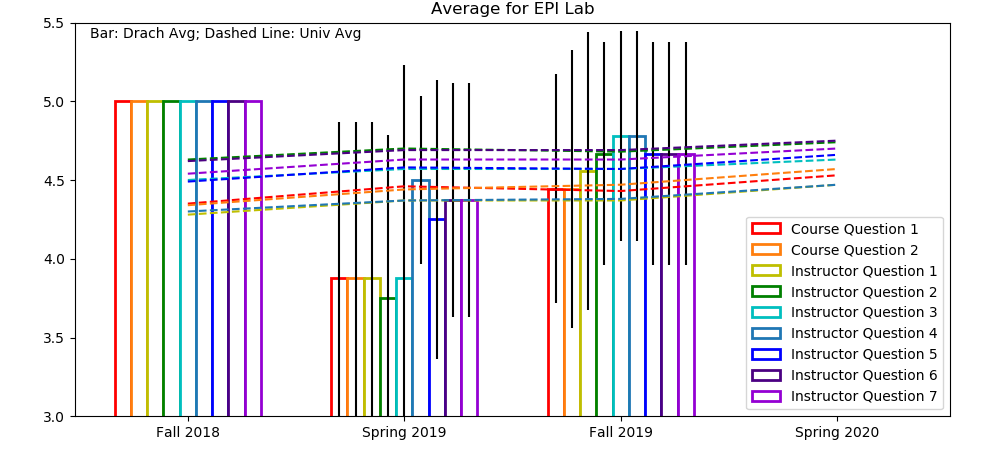
Student reception to the lab was rather positive. In the figure above I show the student evaluations for EPI Lab for each semester I have taught it. As discussed earlier, Fall 2018 student responses are quite positive but unrealistic. On the other hand, Spring 2019 is far more realistic. The improvement from Spring 2019 to Fall 2019 is fairly obvious. I take this as another indication that, while there is obvious room for improvement, the initial implementation of the course was ultimately a success.