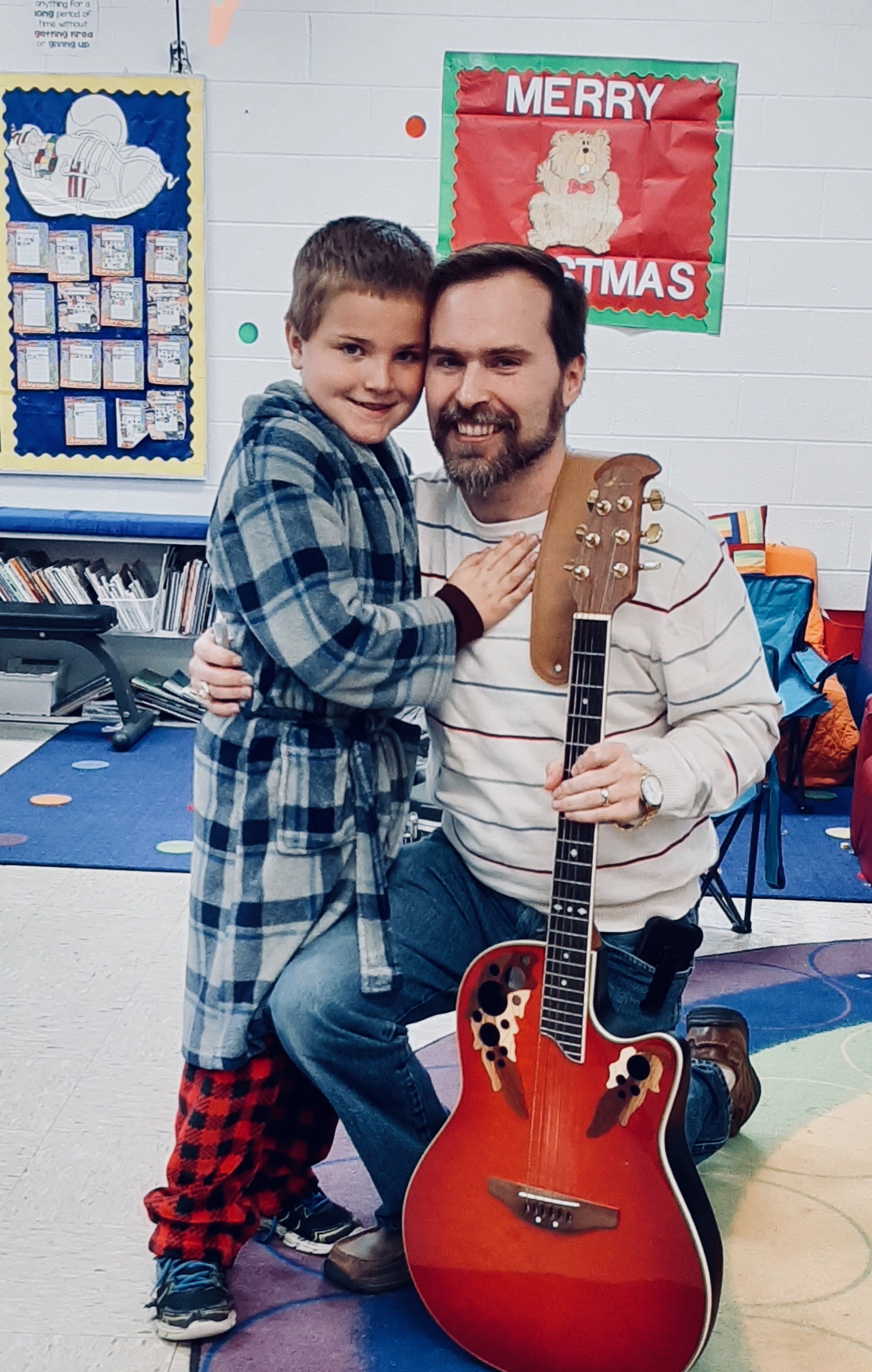
Leading Christmas Carols at Daniel’s 2nd grade Christmas Party (Mrs. Awbrey’s class, ACS)
In this section, I provide some details and artifacts of my service to the church and to my community. From 2015 until 2018 my family and I worshipped with the Meadows church of Christ in Beaumont. After my move to ACU in 2018, we settled in the Wiley area and have worshipped with the Oldham Lane church of Christ. I have appreciated opportunities for service through my interactions within these wonderful congregations. Many of my community service opportunities have grown from interactions with my family. I am the father of two children, Daniel and Lydia, and have enjoyed opportunities to serve through interactions with their school (Abilene Christian School). My wife is a family physician in Abilene, and I have appreciated opportunities for my professional expertise to be a tool for serving the community through interactions with her colleagues in the health care community, in particular during the COVID-19 pandemic. Throughout this section, I will provide reflections on how these activities have shaped me and influenced the ways I serve as a faculty member.
Meadows church of Christ
When I joined the faculty at Lamar, my family and I placed membership with what was then the Ridgewood church of Christ in Beaumont. A short time later, the congregation moved from the Ridgewood neighborhood to the Meadows neighborhood on Beaumont’s west side, taking on the current designation as the Meadows church of Christ. During our time with this family, I served as a deacon with education as my primary area of service. I coordinated all Bible classes and periodic classroom work days. My wife and I organized Meadows’s first VBS at the new location in Summer 2017. I served as one of the regular Sunday morning adult Bible class teachers during our three years with the congregation and taught high-school and university classes on Wednesday evenings. I had the honor of covering the Sunday sermons for our normal preaching minister, Rick Walker, on a couple of occasions, when he was on travel. I was also in the regular Sunday/Wednesday song leader rotation.
Oldham Lane church of Christ
After joining the faculty at ACU, my family and I settled near the Wiley area. We placed membership with the Oldham Lane church of Christ on the south side of Abilene. I have served as a teacher for adult Bible classes and worked with Rob Forkner and James Tebow who lead the university ministry, including teaching the university Bible class (see, for example, Rob’s letter). I am in the regular song leading rotation and assist in other areas, where I can, including leading prayer, reading Scripture, delivering announcements, and serving communion. More recently, I have also begun serving on the missions committee and hope to serve with the medical mission team in Guatemala, when our ability to navigate the COVID-19 situation allows.
Long Island Churches
My trips to Brookhaven over the last 17 years have given me the chance to form relationships with the churches in Long Island, in particular the churches of Christ in Patchogue and East End. I have benefitted tremendously from opportunities to learn from ministers like John Moore of East End and serve where I can, e.g. as a song leader and Bible class teacher.
Reflections
Having grown up in the church, it is difficult to imagine life without it. In the immediate context of this portfolio, it is difficult to describe all the ways that life in the church influences my role as a faculty member. My hope is that my life in the church leaves an indelible mark on all aspects of my life, as an organic outgrowth of my identity as a child of God. As I reflect on specific aspects of my role as faculty, I see clear ties back to my growth in the church. My very first teaching and public speaking experiences were with the church, learning them as service roles rather than roles for ambition. In this respect, perhaps it is easy to say that I would not be who I am as a faculty member without my growth in the church.
In the development stages of my career, i.e. graduate school and postdoctoral work, my community of faith took on another level of meaning for me. Finding commonality of faith with others who were grinding through graduate coursework, writing theses, and defending dissertations was immensely important in graduate school. Finding a church home in Long Island helped to strengthen me spiritually during extended stays at Brookhaven amidst a work environment often hostile to people of faith. Finding a community of faith in Valpo, when we initially knew literally no one in the entire state of Indiana, helped us to learn how to grow spiritually without the safety net of immediate family. There are so many lessons, here, I struggle to chose something specific. Two particularly important lessons from these experiences that shaped me for my roles on the faculty at Lamar and ACU. Through Christ’s church, I have been able to find deep and profound commonality with people in a way that the world–in particular the world of today–would say is impossible. As a faculty member, especially at ACU where we are encouraged to embrace our identity in Christ, this is a liberating realization. If I can tap into that reality in my work with students, imagine the life-changing experiences we can have together. If I can reach that commonality with my colleagues, imagine the differences we can make in our roles as teachers and scholars. The second lesson I have learned is the importance of forming relationships outside of academia. I have learned “the hard way” that the academy often functions as an echo chamber. Whereas early in my career, I expected the academy would widen my perspective, I fear that at times in certain respects it actually narrows it. For example, coffee breaks at STAR often have a comical feel to them with hundreds of people from a variety of places all sharing peculiarly similar opinions! My church families, however, often bring me face-to-face with profoundly different perspectives. Their interests, concerns, and needs are all different–and different from mine–and frankly all closer to where my students are, when they arrive in my classroom or laboratory. They give me a constant and beautiful reminder of how very little academic credentials matter to my Father and how very little they should matter in the grand scheme to me.
I cannot help but close this subsection with a statement that I hope is obvious from my reflection. I need the church far more than it needs my service. I hope that I have left a positive impact on my church homes, over the years. Without question, the impact they leave on me is far beyond what I could leave on them.
Outreach at Abilene Christian School
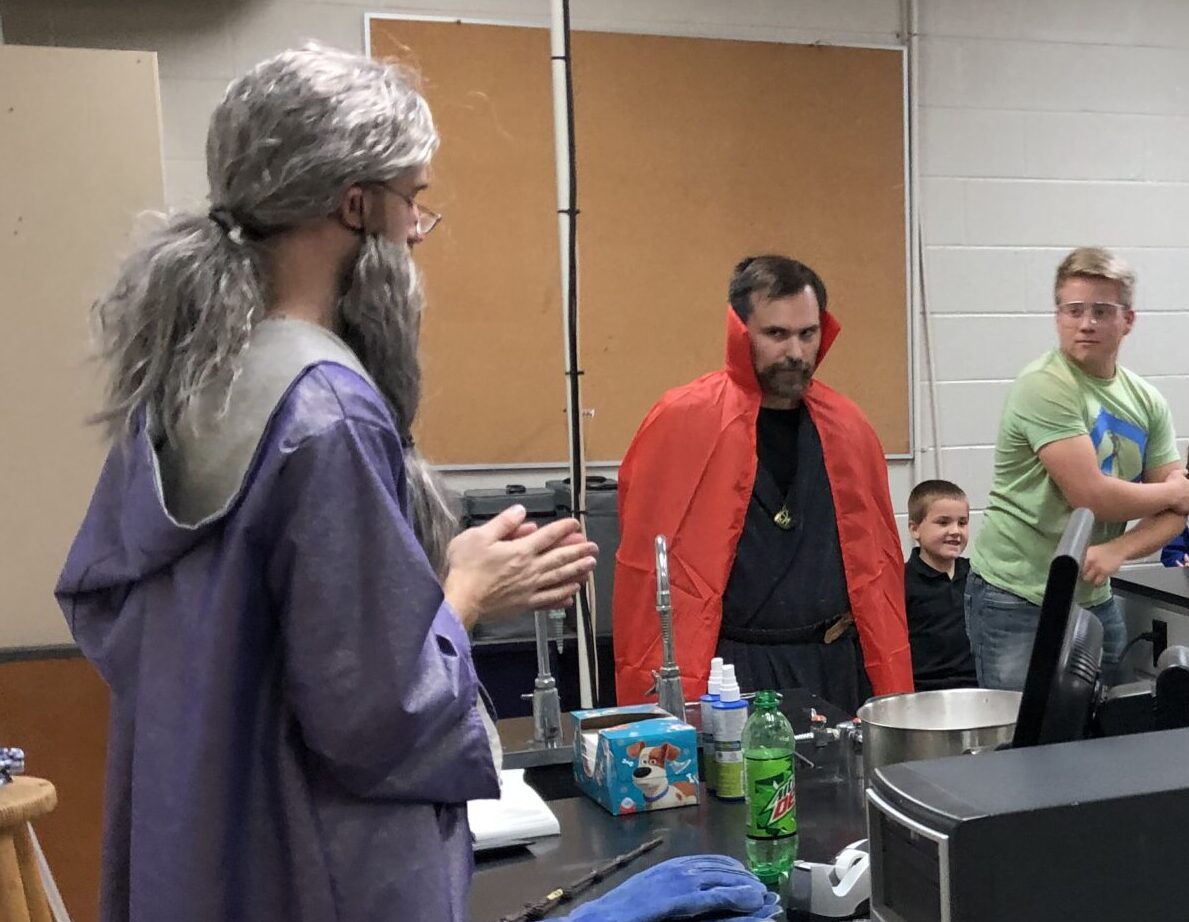
Spooky Physics show at ACS on Halloween 2019. (L to R) Larry Isenhower, aka Dumbledore; Jim Drachenberg, aka Dr. Strange; Daniel Drachenberg (lurking); and Keaton Brewster.
One of the hallmarks of SPS under Dr. Larry Isenhower’s leadership has been community outreach in the form of outstanding physics demonstration shows. In Fall 2019, my son entered 2nd grade at ACS. The 2nd grade teachers, Mrs. Awbrey and Mrs. Seffek, do a wonderful job of introducing their classes to concepts of science and experiments. I worked with these teachers to arrange for the ACU SPS chapter to perform a special physics show on Halloween for the 2nd grade classes at Abilene Christian School (ACS). We dubbed the show “Spooky Physics” and enjoyed performing demonstrations while dressed as some of our favorite characters from children’s fiction. Our students, as usual, did a phenomenal job; and the 2nd grade classes thoroughly enjoyed the experience. They provided us some wonderful thank you notes, which I post below for your enjoyment.
In Fall 2019, my daughter’s Pre-K teacher invited parents to share in a “Community Helpers” unit by talking briefly with the class about our various professions. I enjoyed participating in a short visit with the children where we talked about light and some of the neat things we can see with prisms and “special glasses” (diffraction gratings). I also could not help but make a quick connection with the rainbow spectrum and the story of Noah and how in each beam of light we saw a hidden reminder of God’s promise to care for us.
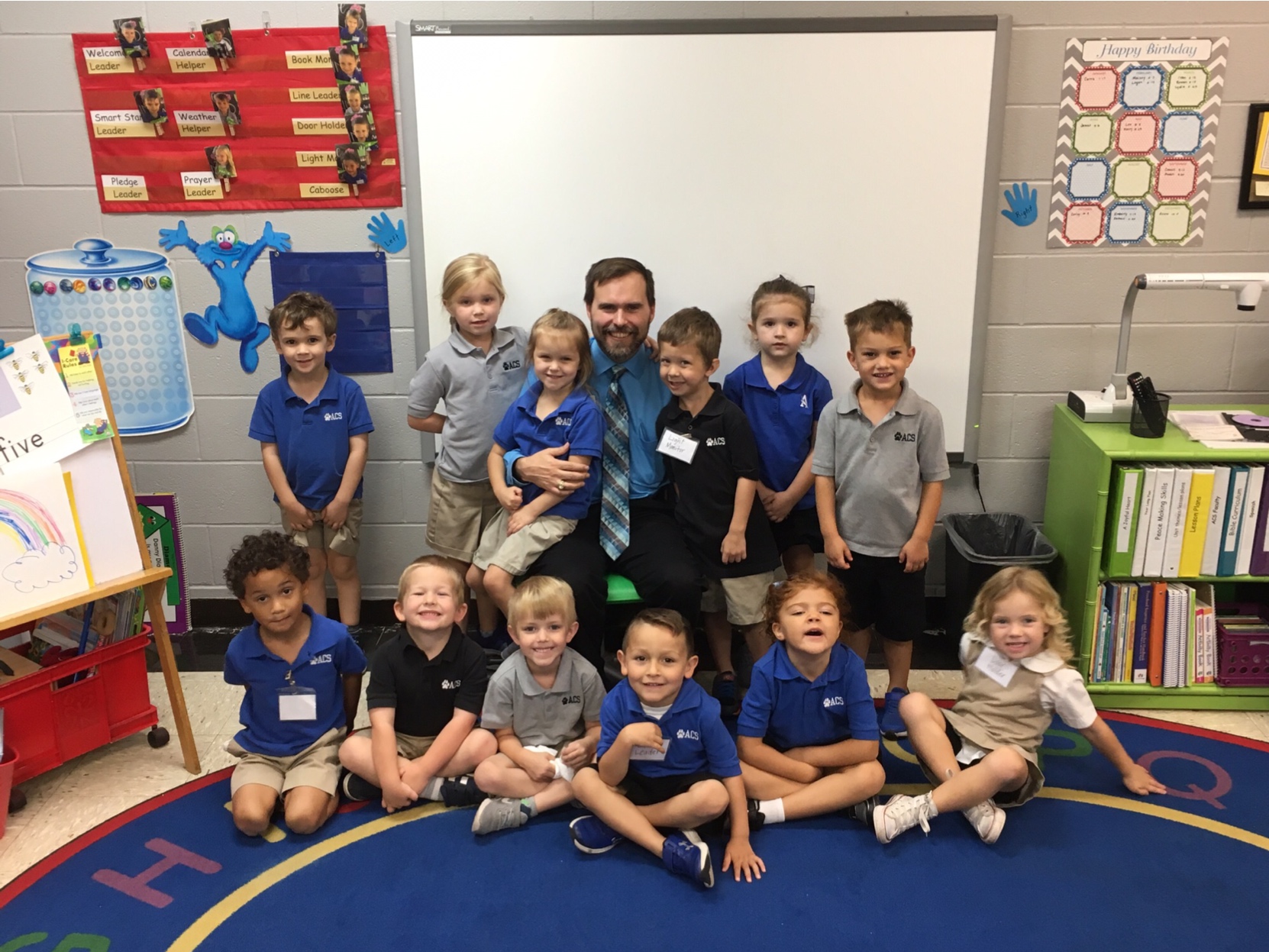
Visiting with Lydia’s (seated in my lap) Pre-K class about light.
Reflections
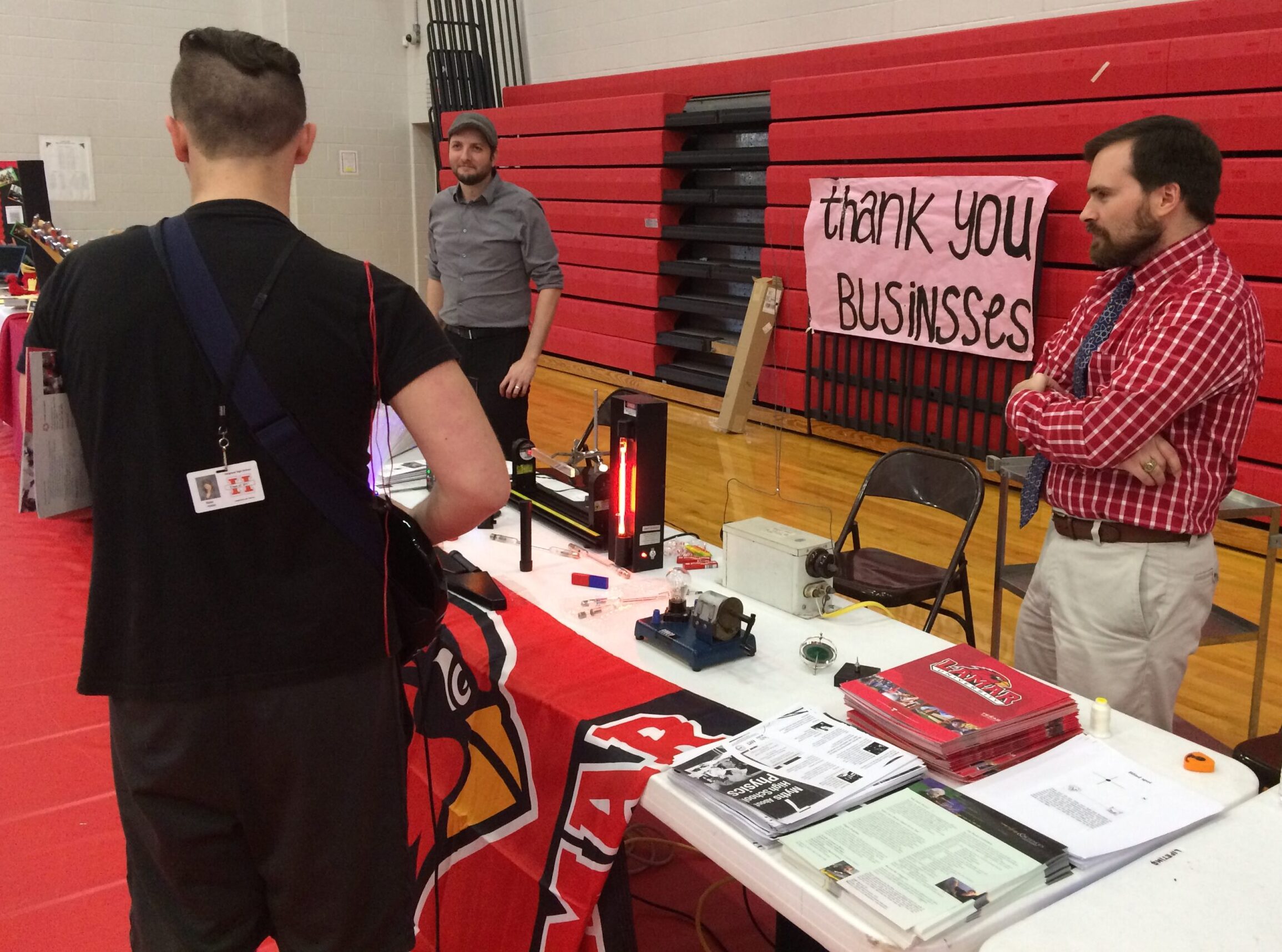
Visiting with a Hargrave High School student at the College and Career Fair in Spring 2016.
In many ways, my approach to outreach has been shaped by an early experience in my faculty career. In 2016, while with Lamar, I participated in a college and career fair at Hargrave High School in Huffman, TX. We set up tables to advertise our department and some of the student activities. The fair was attended by both high school and middle school students. I was struck by the difference in responses between the two groups of students. In contrast to the high school students, who showed general ambivalence (“…physics? Yeah, no thanks…”), the middle school students were far more excited by the demos and activities. Reflection on this experience has shaped me and the way I approach community outreach in a few important ways:
-
- We often wait to introduce students to physics in a serious way, e.g. as an actual career or as a potential subject of higher study, until later in high school, when they have more advanced mathematical tools. I believe this is far too late. By that point, many of the students have already decided the subject is “not for them.” Reasons are myriad, e.g. peer pressure in not wanting to stand out or appear “nerdy,” a reputation for the subject being “hard,” misunderstanding what the field is about, etc. For the long term, I have come to believe that we need to reach students much, much earlier, i.e. in elementary school and middle school, when they have not yet decided to hate it. Since I am currently the father of two younger children, I have embraced opportunities their teachers have given me to share some of my love for the subject.
- To reach younger students, I have to do a much better job of communicating. Younger students do not let me get away with hiding behind the pretense of jargon. Few are as effective at calling me out on this than my own children. They challenge me to approach things from the basic concepts and relate those concepts to their experiences. It turns out to be a pretty difficult exercise, at times! Frankly one of the biggest hurdles is in grappling with my own incomplete understanding.
- Studying physics gives me greatest joy when I connect it with a deeper understanding of the Creator. It becomes an exercise in wonder. There are times where it seems the experts have the least appreciation for the wonder of our field. We get too bogged down in the details that we lose sight of the very things that first drew us to it. Doing outreach to younger students helps me reconnect with those things. I hope it helps them. It certainly helps me.
Cosmic Cafe and the Rotary Club
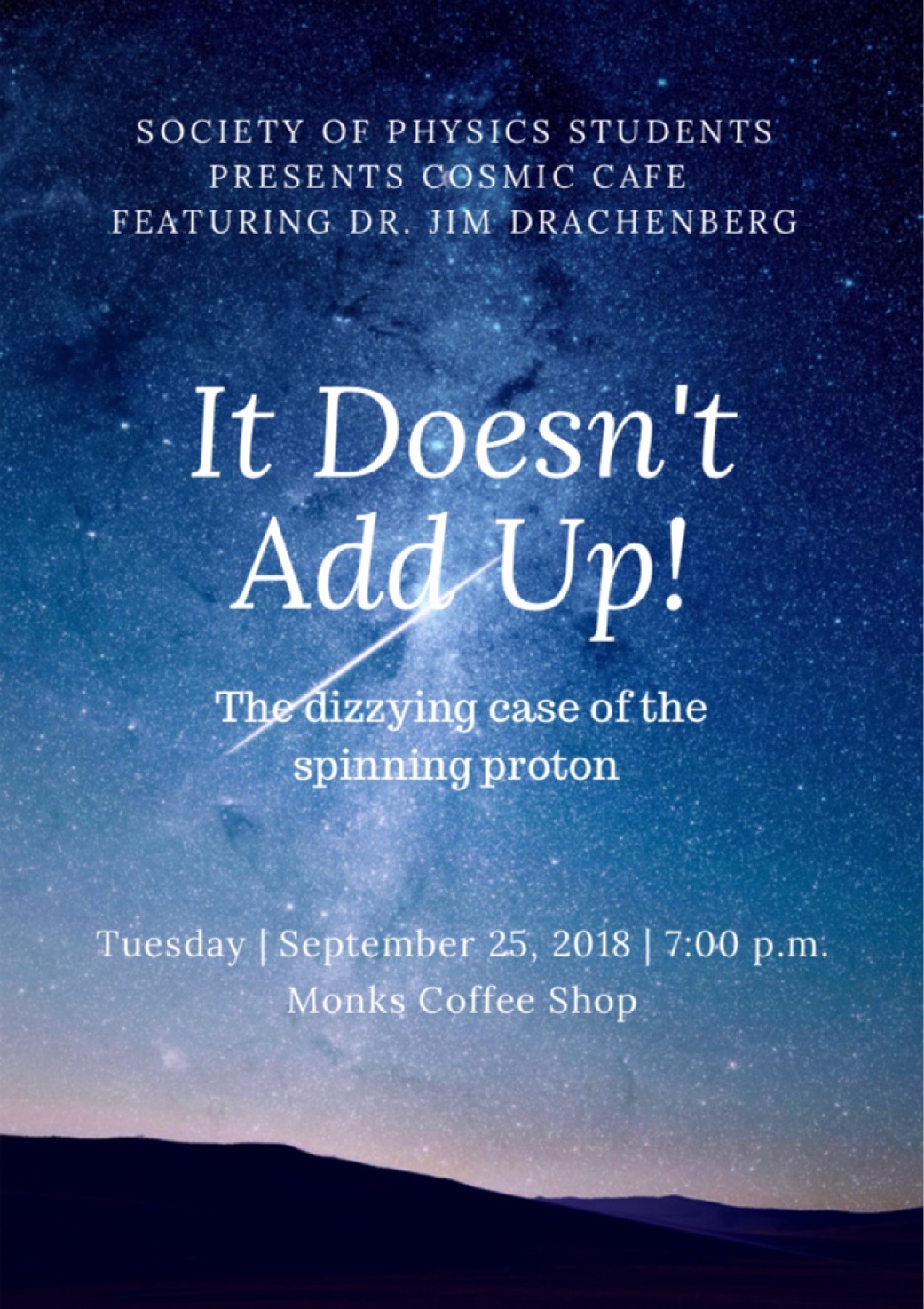
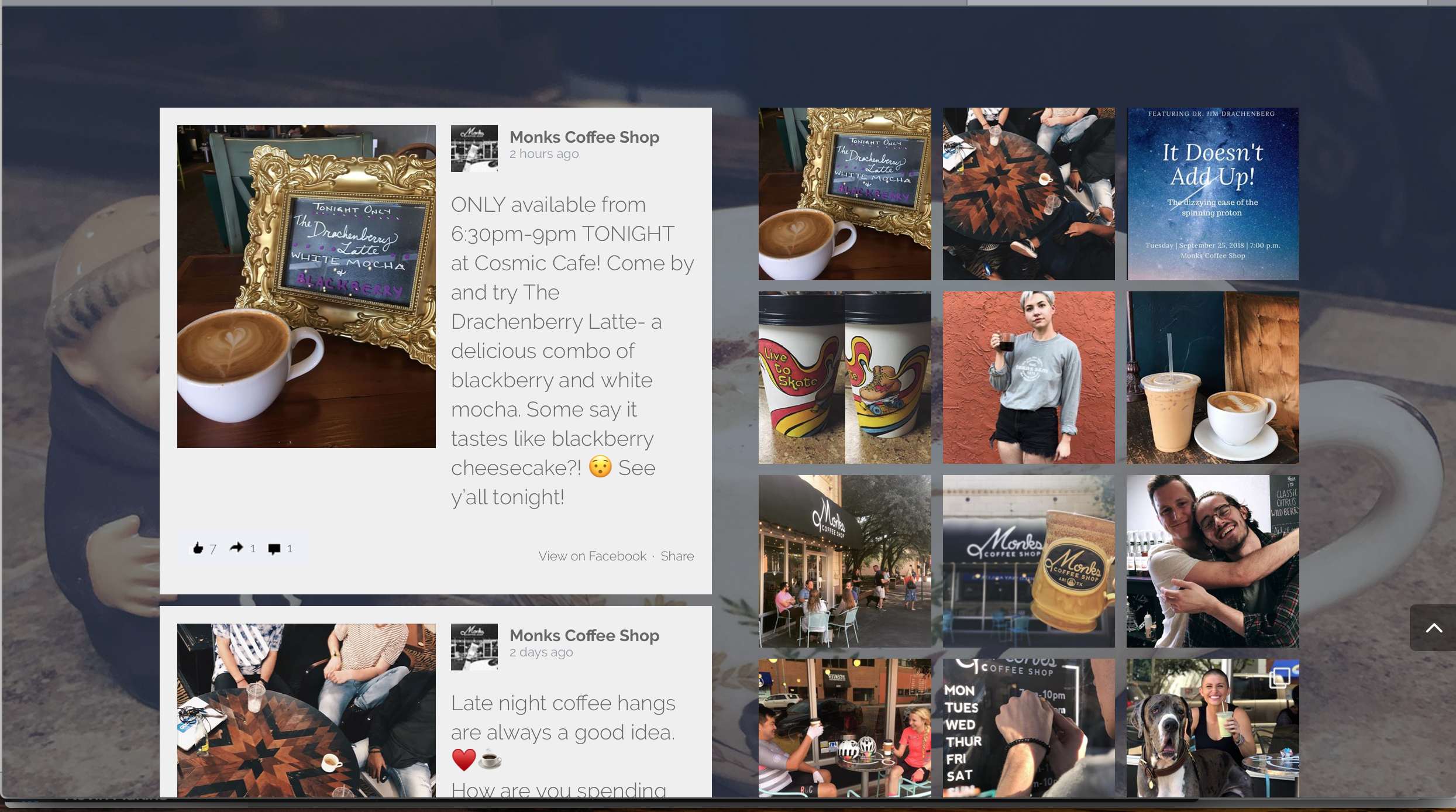
In addition to outreach to local schools, I have also enjoyed public outreach through the Cosmic Cafe public lecture series hosted by ACU Society of Physics Students (SPS) and the Abilene Southwest Rotary Club. In Cosmic Cafe, a professor or industry professional is invited to give a presentation and field Q/A on their work or interests to the general public at a local coffee house. I have been honored to give two such presentations: on September 25, 2018, at Monks and on February 27, 2020, at Maslow. In each, I gave a presentation on my spin physics research with STAR. At the first, I received the highest honor a physicist can receive: a coffee beverage bearing my name, the “Drachenberry Latte” (it was even pretty good!). In the second presentation, I was delighted to brag publicly on our students working on the STAR forward upgrade. On June 9, 2020, I was invited to give a presentation to the Abilene Southwest Rotary Club. The meeting was held via Zoom with a brief presentation and what turned into a rather fun Q/A with the Rotarians afterward.
Reflection
I gave my second Cosmic Cafe talk the subtitle, “Spin physics? Sounds fun, but can I eat it?” When I talk about my work with people outside the field, one of the common questions I get is, “So what’s the application?” or “What is this actually going to do for us?” Early in my career, receiving this question bothered me. Really, though, it is a fair question. I think it also reveal one of the challenges for those of us in basic research. The honest answer is that we have no idea what practical application will come from a better understanding of proton spin structure. However, history has shown us time and again that the very search for answers pays dividends. That answer is perhaps well and good for a university campus, where basic research is not uncommon. For the general public, though, they may not take my word for it. And, really, they shouldn’t! I should be able to make my case; and, if I am not willing to do so, I need to question whether I really understand what I am doing. Having grappled with this, struggling early, but ultimately embracing it, I have come to love opportunities like the Cosmic Cafe series and the Rotary Meetings. I have developed a stronger conviction for the worthwhile nature of our research and the benefit of greater public awareness of our work on campus. The challenge of speaking simply but not insultingly for the public has certainly made me a better teacher in the university classroom, as well. The experience has really been fun; and I hope to repeat the experience, once the COVID-19 restrictions are able to lift safely.
Taylor County Grand Jury
In late 2018 I received a grand jury summons for the 104th District Court, Judge Lee Hamilton presiding. I responded to the summons in January 2019 and was selected to serve on the grand jury. Judge Hamilton asked if I would be willing to serve as the alternate foreman, and I accepted to serve in this role. We met on the second Tuesday of each month from January until June 2019. In each session, we reviewed a rather large docket of cases, listened to testimony from arresting officers, asked questions of the officers and the district attorney, deliberated with each other, and voted on wether to no-bill or indict. We begun deliberations at 9 AM and were typically released around 2 PM. In May, our foreman was out of town; and, as the alternate, I served as the grand jury foreman. In that role, I chaired the deliberations and signed all indictments.
Reflection
I had never served on a jury, before; and, to be honest, had a very wrong idea about the way a grand jury functioned. It was an enlightening experience. I am glad to have had it, but it was heartbreaking in many ways. As a faculty member at ACU, I deeply appreciate that we are expected to serve our community not just as a means to an end but as a part of who we are in Christ. It is easy to serve a community, when you can pretend that your community has no problems. Of course, in reality, no such community exists. Once the ugly side is laid bare, community service is tough. However, I am learning that is also when love for community is most evidently real. On the grand jury, I heard stories I never wanted to hear and can never forget. At times testimonies and deliberations were maddening. As a child of God, though, I had to decide to love, anyway. If I truly loved my neighbor, I would do justly by them, wether they were the victim or the accused. I disagreed very strongly at times with other members of the grand jury; but, as a child of God, I had to learn to love my neighbor, anyway. I also saw a need for grace in a way that I had not before. As I put my own signature on each indictment, I could not help but feel the weight of it. In no way could I try to pretend that I had executed my job with perfect understanding or perfect judgement. Could I answer to God for this? Certainly not on my own. Could I ask God for grace in this moment and then not give grace to others, as I imperfectly live out my life?
I do not believe Abilene will ever be perfect, and I do not believe the ways of humanity are remotely capable of achieving such thing. I wonder if, sometimes, as ACU faculty, we think ACU can be insulated from it’s first name. I have come to believe it cannot. Consider that ACU may always reflect Abilene, even if subtly. I am not sure we can love ACU without loving Abilene; and, mind you, I speak of real, Biblical love rather than simply emotive infatuation. As hard as this experience was for me, I do believe I learned to love Abilene–and by extension ACU–in a way more closely to what God intends for me to love. I love Abilene because Abilene is people made in His image. Broken, needy people. In that respect, I fit in perfectly.
Data Analysis for the Public Health Department
When the pandemic began, out of my own curiosity, I began tracking public COVID-19 data from the state via the Texas Department of State Heath Services dashboard and from Taylor County via the Health Department website. When Taylor County began to see its first positive cases, I discovered the Abilene-Taylor County Public Health District did not have a data analyst on staff. In light of this, I volunteered to create a Google spreadsheet version of my “COVID tracker” to share with the Health Department and update it daily with the latest public numbers (I did not request access to confidential information and have never received such information). Over time, I added new plots and comparisons as requested by the Health Department. Using the spreadsheet, we were able to track the County’s number of positive cases, hospitalization and mortality rates, the testing positivity rate, and the age distributions for positive cases, among other things, in comparison to the “expected” rates based upon the state numbers scaled for the population. It helped highlight the extent of some early troubling trends, e.g. outbreaks within the food-packing industry, and also some early positive trends, e.g. outpacing the state in testing. The tracker also highlighted ways Taylor County’s caseload was significantly different from the rest of the state, e.g. a wildly disproportionate amount of cases in the young-adult population (20-30) that may in part explain the comparatively low hospitalization rate for Taylor County.
Reflections
First of all, it was gratifying for my expertise to prove useful to the community in such an unusual and challenging time. Between classroom obligations, figuring out how to adapt research to the distancing necessities, and helping my kids navigate their challenging school circumstances, it was difficult to see how I could otherwise help my community. In that respect, this outlet, simple as it was, helped me from an emotional and psychological standpoint. That recognition guided me to help my students in their challenging circumstances. If I felt helpless at times, it seemed reasonable to assume they must also be feeling some helplessness. I tried to be open about this, e.g. in my morning devotionals, to reassure the students they were not alone. The experience volunteering also gave me some concrete examples to show students how the tools we were developing in class and in the lab could help in a time of crisis. I was grateful for the opportunity to show them the value of helping in “small” and “creative” ways. While we like the idea of being “heroes,” the truth is, if we are truly serving, we will see the blessing of simply having a role to play in the larger story of the solution.