
“Why would people build a city in a place unfit for human habitation?” my English husband demanded to know while dodging from shady spot to shady spot. We were walking in the mid-August heat during our first week in Abilene, the city we now call home. The early cattle and railroad days are a distant memory now, so I have to confess that I couldn’t answer his question. (Good thing it was rhetorical!) But I do know from experience why people are attracted to Abilene today, to ACU in particular, and why they return, as I have, after years away. My goodness of fit at ACU has in part to do with my past—family, religious tradition, and education. It is also due to my desire to support and contribute to the vision of the university.
My History with ACU
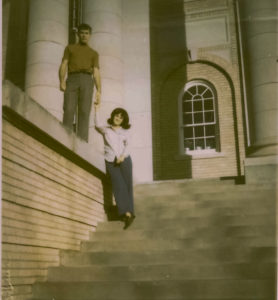
My first contact with ACU was through my family. My paternal grandparents met at ACU, and so did my parents; the chances that I’d even exist without this institution are slim! My father grew up in Abilene, and my grandmother still lived in town when I started my undergraduate degree in 2000. I came to ACU to study Missions, and before I knew it I was completely enthralled with studying the Bible, ancient languages, and the history of Christianity. I’d grown up in Churches of Christ, and parts of my extended family have been a part of the Stone-Campbell Movement for at least five generations, but I only had an inchoate sense of our heritage. My classes and professors at ACU helped me to make sense of our collective story, revealed how deeply our tradition had shaped me, and instilled in me deep gratitude for the gifts of our tradition even as I became more aware of our shortcomings.
I had decided to pursue a missions degree because I knew I wanted to work in and for the church, and at the time this seemed to be the only viable path open to me as a young woman. Graduate work at ACU opened my eyes to emerging possibilities, one of which was academia. I have always loved to learn and study, and soon I also had opportunities to teach. These experiences confirmed for me an inner calling to this kind of ministry—that of the professoriate—and members of the CBS faculty affirmed my vocation. When I was accepted at the University of Oxford, ACU offered me financial support if I would return and teach for the GST when I finished my degree.
By the end of my DPhil six years later, many things had changed in my life: I’d learned to flourish as “a stranger in a strange land” (which I suspect has just made me strange anywhere!) and met and married Ian. What hadn’t changed was my sense of calling to research, teach, and form students for ministry. Holding this conviction closely, I somehow convinced my spouse to leave his homeland and move to Texas, oppressive heat and all. (Thankfully, he has now “warmed” to the place and the people!)
When I returned to ACU in the fall of 2015, almost all of my colleagues were my former professors, and I wondered whether that would be awkward. It wasn’t. My colleagues welcomed me warmly and made my move back to Abilene feel like a homecoming, not just a relocation.
How do I fit at ACU?
As significant as this past experience with ACU has been in my life, it doesn’t guarantee a good fit now. When I returned after several years in another country and at a different institution, I wondered whether I’d still feel at home at ACU. Would ACU’s mission and ethos still be a good fit for me? My years at ACU have confirmed for me that my answer to this question is still “yes.”
ACU’s mission “to educate students for Christian service and leadership throughout the world” continues to motivate the work that I do. The second pillar of the university’s latest strategic plan emphasizes spiritual formation permeating our undergraduate students’ four-year experience at ACU. This resonates strongly with me. In my undergraduate classes, the students I teach represent virtually all of ACU’s colleges and departments. Whether we’re talking about the complex connections between Christianity and human cultures or the history of Christian spiritualities, I hope that my undergraduates leave the course better able to love God and love their neighbor, ground their identities in Christ, and live with integrity of heart, mind, word, and deed.
Our undergraduate student body is also increasingly denominationally diverse. If a person has only our contemporary moment in view, it can seem that the Christian faith is fractured beyond repair. The polarization that characterizes so much of our culture right now affects our churches too. Division is, of course, nothing new in the history of the church. But if we want to see where the center holds in the Christian faith, the history of how the central teachings of Christian faith have developed is absolutely essential. As I teach, I draw on central elements of the Christian tradition to help my students see that, in the midst of many variations and disagreements, there is still a lot that most Christians have in common. It’s usually the things that matter the most. I try to make my classroom (physical or virtual) a place where all of my students feel welcome to contribute, no matter what their religious affliation is, including those who do not profess a faith at all.
I also have expertise in the history of interfaith relations, particularly among the Abrahamic religions, Christianity, Judaism, and Islam. I was able to draw on this expertise when I taught the junior-level Bible core curriculum but less so since we discontinued that curriculum. I would love to draw on this strength more in my undergraduate teaching in the future. Our graduates will be better equipped for servant leadership throughout the world if they have basic knowledge of and empathy for the other monotheistic religions of their neighbors. This kind of work, when done well, doesn’t lead to relativistic apathy on the one hand or to dogmatic closed-mindedness on the other. Recognizing and and respecting religious differences while remaining steadfast in one’s own convictions are valuable skills for Christians to cultivate in a pluralistic world.
How do I fit in the GST?
I believe that I contribute in valuable ways to our GST faculty, and I talked about specific evidence of this in my reflection post on collegiality. In my teaching section, I indicated how the discipline of historical theology fits with the other theological disciplines. These contributions certainly have to do with goodness of fit too. However, I haven’t talked much about how I fit with the GST in terms of mission and vision, so I will focus on those aspects here.
The Graduate School of Theology’s mission is “to equip men and women for effective missional leadership for ministry in all its forms and to provide strong academic foundations for theological inquiry.” In the years that I have been a part of the faculty, we have revisited our mission statement multiple times as we have talked about our own strategic plan for the future. I have felt more invested in our mission and more confident about my fit with our faculty because I have been a part of these thoughtful conversations about who we are and who we want to be. I feel confident that my own vocation as a minister-in-the-academy fits the GST mission well.
I’m also excited about being a part of the GST’s leadership team as we think about how best to navigate the rapid changes taking place in theological education. We have been thinking carefully about how to maintain the strengths of our program as we do more online and hybrid teaching in partnership with ACU Dallas. I have been trying new approaches to my teaching, and this semester I’m trying to encourage my distance students to participate in hybrid opportunities. We’ve talked to colleagues at other seminaries who are excelling in distance education, and I think that increasing our hybrid offerings would increase our attractiveness to many potential distance students.
This semester I’m also attending a conference on another trend that is increasing in seminaries: competency-based education. I’m still uncertain how the insights of competency-based education might play out in the GST, but I’m eager to learn more and share what I learn with my colleagues.
Next page: CV