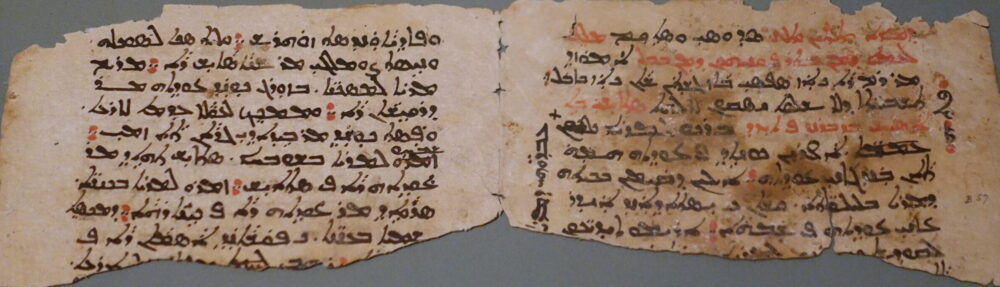
Some day, I would like to write a monograph on ninth-century Syriac theologians, but most of the primary sources are still only accessible in manuscripts. One step toward that larger goal is to publish the works of these Syriac authors in modern editions and translations and make them accessible to a wider range of scholars. So far, I have focused my attention on the works of John of Dara († 860 CE).
The Works and Legacy of John of Dara
John was a Syriac Orthodox metropolitan bishop of Dara, a fortress city that once guarded the frontier between the Byzantine and Persia Empires. In John’s day, Dara was no longer a border town. It was in the heartland of the early Abbasid Caliphate, an Arab dynasty that ruled a sprawling empire from the capital city of Baghdad between 750-1258 CE. John lived in a time of frequent interreligious contact between Muslims, Jews, and Christians. It was an age of religious conversions, theological debate, and philosophical exchange. Interreligious and philosophical debates were often hosted in the court of the caliph himself. John’s writings never directly address his Muslim counterparts, but some themes in his works overlap with the content of apologetic works that address theological differences between Muslims and Christians. Above all, John was a dedicated churchman: the topics that most interested him were Christian worship and sound doctrine, and many of the issues that he addressed continue to be relevant for Christians today, if in different ways. Below I list three research projects on John of Dara or inspired by and related to him that I am currently working on. I also indicate how far along these projects are.
- Introduction, edition, and translation of John of Dara’s discourses On the Feast of the Discovery of the Cross and On the Divine Economy.
I have drafted full Syriac editions and English translations of both discourses, which I would like to publish together in a single volume. On my first faculty renewal leave, I plan to polish these draft editions and translations, write an introduction, and submit them to a publisher (either Gorgias Press or Peeters). Though John wrote these treatises for a Christian audience, they both treat topics of resonance with early Muslim-Christian religious debate: the incarnation and crucifixion of Jesus Christ.
- A journal article on interreligious debate in the works of John of Dara.
I have presented on interreligious polemic in the above treatises at conferences (2019 and 2021), and I am combining these presentations into a single journal article, which I will submit to Hugoye: Journal of Syriac Studies. I expect to submit the article in early 2023.
- A journal article on a fragment of Muslim-Christian dialogue.
As I was preparing the edition of John of Dara’s discourse On the Divine Economy, I stumbled upon three pages of Muslim-Christian debate at the end of the manuscript which were not mentioned in the catalog description of the manuscript. I have not been able to find another text like it in Syriac. The paper I presented on this discovery at the 13th Symposium Syriacum (Paris, 2022) was very well received. I plan to submit the Syriac text and English translation with a substantive introduction for publication in Medieval Encounters, a peer-reviewed journal devoted to the history of Muslim, Christian, and Jewish cultural interactions between the 4th and 16th centuries.
My edition and translation are almost ready for submission, but I am collaborating with a colleague to determine if there might also be an Arabic version. If there is, we will work together on the Arabic and Syriac versions, which will enhance the project enormously.
For future study:
While I had a 3-hour course release in the spring of 2019, I came across a commentary on the Nicene Creed attributed to John of Dara, of which I made a rough edition and translation. (The Nicene Creed is a summary of the Christian faith that many Christians have recited every Sunday in worship since the late fourth century.) I’m interested in how Christian theologians in the early Abbasid era explained the basics of Christianity to ordinary believers, so I was intrigued by this work. After translating the treatise, I realized that it is a part of John’s longer commentary on the liturgy. That raised new questions in my mind about the circulation of this text, and I decided to pause my research and give it more thought later. Since then, I have come across additional commentaries on the Nicene Creed by other Syriac Orthodox writers, most of them later than John. I’m now collecting digital images of manuscripts containing Syriac commentaries on the Nicene Creed for future study.
Next page: Reflections on Scholarship