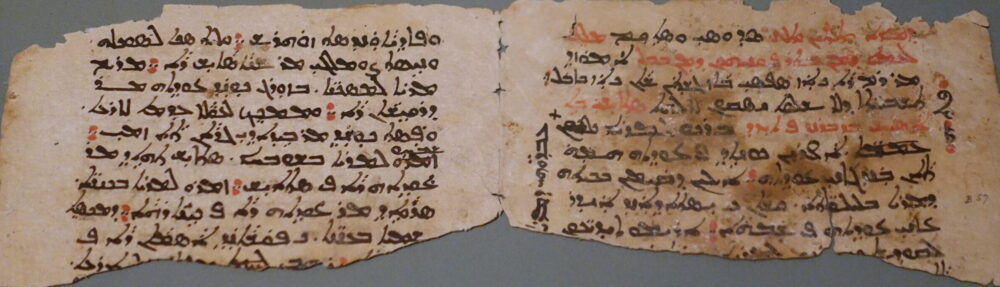
My area of research is the history of Christianity in the Middle East, especially the history of Christians who spoke Syriac, a dialect of Aramaic. Christians have studied scripture and worshipped in Syriac from the second century to the present day. Syriac was the lingua franca in the eastern Byzantine Empire and among the Christians of Persia; its influence stretched from the Levant into the Arabian peninsula, along the Silk Road into China and Mongolia, and down the Malabar Coast in India. Many of the places where Syriac-speakers lived changed hands between different world powers: Byzantium, Persia, and the Arabs. In the year 640 CE, a 40-year-old Syriac speaker living in the city of Edessa (Urfa in modern Turkey) would have experienced the rule of all three of these empires in fairly quick succession.
Much of my research, though not all, is devoted to the experience of Syriac Christians under the rule of the first two Muslim caliphates (from about the 7th century to the 13th century). How did these Christians respond to their changed position in the world under Muslim rule? How did they equip their churches to be faithful under new circumstances? In what ways did they deepen their understanding of Christian faith and discipleship even as they adapted their theological discourse to respond to a new situation? As I teach seminary students and upper-level undergraduates, I reflect: what can Christians today, particularly Christian ministers, living in a rapidly changing world, learn from the spirituality, biblical scholarship, and theology, and the successes and failures, of Christians of the past?
I’m interested in the development of theology over time, so I also study the period prior to the arrival of Islam and Muslim rulers. The fourth to sixth centuries were critical periods of doctrinal solidification—and schism—in the Church. Fundamental beliefs that most Christians now take for granted were debated and formulated during this time, most prominently the doctrines of the Trinity and the Incarnation. These are precisely the most theologically problematic issues between Christians and Muslims from their first encounters until the present. The story of Christian churches under the aegis of the Abbasid Caliphate—the Arab dynasty that ruled broad swaths of the Middle East from Baghdad between 750-1258 CE—has yet to be told on its own terms. I hope my research contributes to a better understanding of this subject.
It can be hard to evaluate the value of scholarship in fields that are unfamiliar, and I realize that mine probably sounds niche to someone who is unfamiliar with it. It may also be hard to determine what other scholars in my field think about the quality of my work. For that reason, I asked Professor David G. K. Taylor, my master’s and doctoral supervisor at the University of Oxford, to write a letter in support of my application for tenure. Flattery and unearned praise are not part of British academic culture, so I am doubly honored by the confidence he expresses here in my scholarship. Click here to see his letter.
The following pages document the research I’ve completed since my arrival at ACU in the fall of 2015, as well as some projects that I’ve begun but not yet published.
Next page: Conferences, Presentations, and Publications