
Because the departmental requirements for scholarship are specific and yet provide a number of options for accomplishment, I feel it is appropriate and helpful to note them below and then denote clearly how I have satisfied the requirements.
The specific departmental requirements for publications are stated as follows:
Evidence of at least 5 products within 6 years of application:
1. At least 2 of the 5 are publications in refereed journals, a book, or an invited book chapter.
2. Or 2 national invited presentations or an accepted international presentation and 1 publication in a refereed journal, a book, or a book chapter where the writing or the individual’s contribution is related to the field of CSD.
Below is a portion of my CV listing the three articles in refereed publications that I have published since 2007 (within six years of the present application). These three publications satisfy requirement one. Following the list is a brief discussion of each article.
publications
Austin, L. (2007). Consideration of native language service provision in speech therapy for students with severe impairments from Spanish-speaking homes. Texas Journal of Audiology and Speech-Pathology, 30, 41-45.
Austin, L. (2010). Dynamic assessment: Whys and hows. Perspectives on School-Based Issues, 11, 80 – 87.
Austin, L. (in press, for publication November 2013). Scaffolding early clinical learning for students in communication sciences and disorders. Perspectives on Administration and Supervision.
*********************************************************************************************
The first article (click link to view), entitled Consideration of Native Language Service Provision in Speech Therapy for Students with Severe Impairments from Spanish-speaking Homes (Austin, 2007) was published in a peer-reviewed journal, Texas Journal of Audiology and Speech Pathology. This article was written in response to a significant need that I saw within the field to provide first language (L1) communication therapy to nonverbal clients with severe impairments, particularly cognitive impairments. In the article I observed from data I had collected in my role as a contractor to more than six school districts that the fallback position for school-based SLPs in these cases appears to be to provide services in English because of the perception that the language of intervention is not significant in such cases. The limited evidence available does not support this practice but rather supports home or native language service delivery. In concluding the article I summarized the likely benefits for children with severe impairment and their families when the home language is supported. I received follow-up communication from two professionals regarding this publication, and in March 2011 I was honored to have this work cited in a presentation by three colleagues from Texas Christian University with specialization in cultural/linguistic diversity. This experience was significant to me because through it I realized that my thoughts and work could actually impact my discipline.
In May 2010 I was contacted by the editor of the peer-reviewed ASHA publication Perspectives on School-Based Issues and invited to submit a manuscript on the topic of dynamic assessment; the manuscript was accepted after review. (The editorial board of this quarterly publication is housed within the organization of Special Interest Group 16–School-Based Issues, which has a membership of approximately 5000). Articles in this publication are focused on topics which impact service delivery in school settings by promoting the highest quality services in that setting. Articles address clinical, educational, and administrative concerns. The manuscript, entitled Dynamic Assessment: Whys and Hows, was a tutorial which reviewed the theoretical basis of the methodology, then provided guidelines for practitioners wishing to design and implement dynamic assessments (Dynamic Assessment_perspectives ). I felt at the time of the invitation that the opportunity to write the article was an affirmation of my efforts to develop expertise in this area (this was after I had presented a paper on the topic at the annual ASHA convention).
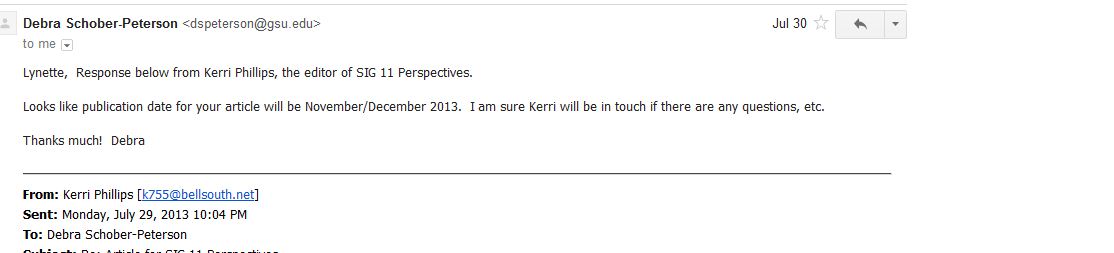
In summer 2013, after reflecting for some time on Cognitive Learning Theory (discussed in my Teaching reflections) and its implications for instruction in CSD, and after presenting on the topic at the annual convention of the Council for Academic Programs in Communication Sciences and Disorders, I submitted a manuscript on the subject to the publication Perspectives on Administration and Supervision. This publication is a significant resource for clinical educators and program and clinical directors as it focuses on the promotion of best practices in administration and supervision. The manuscript, entitled Scaffolding Early Clinical Learning for Students in Communication Sciences and Disorders, was a review of CLT literature and application of that information to the field of CSD. As far as I was able to determine through various database searches, this was the first treatment of the subject specific to our discipline. In it I provided explanation of the theory, linked it to CSD, and reviewed specific learning strategies that I have employed based on the theory that are designed to increase clinical learning. After the review process, the editor communicated to me that the article would be published in November 2013 (see image below for confirmation of publication). Click on the link to view the draft of the manuscript: Lynette Austin_Scaffolding early clinical learning for students in CSD_article with abstract
Next. . .Presentations