
Advocacy and volunteer service to the profession
I have been fortunate to be able to serve my profession in areas in which I have clinical expertise and personal interest. Much of that service has been through the state professional organization, the Texas Speech-Language-Hearing Association (TSHA). In 2003 I joined a group of bilingual speech-language pathologists in re-forming the TSHA Task Force on Cultural and Linguistic Diversity Issues, under the leadership of Rebecca Gonzalez. I served on the CLD Task Force from 2003 – 2011, and was co-chair for three years (2005 – 2008). As a task force we provided (and the current TF still provides) resources to the membership to support evidence-based practice in the area of service delivery to CLD populations. We did this via publication of articles, workshop presentations, advertising of resources, and through mentoring events such as student and faculty luncheons at the annual convention (those outreach events occurred during my co-chairmanship period). Below are images of two sample articles/announcements from TSHA’s bimonthly newsmagazine, The Communicologist (2008, 2009). (Click on the images to view).
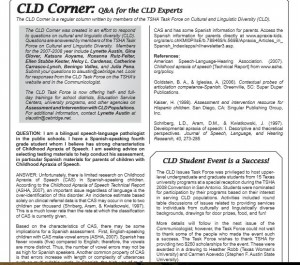
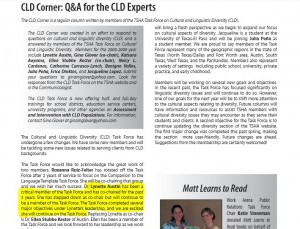
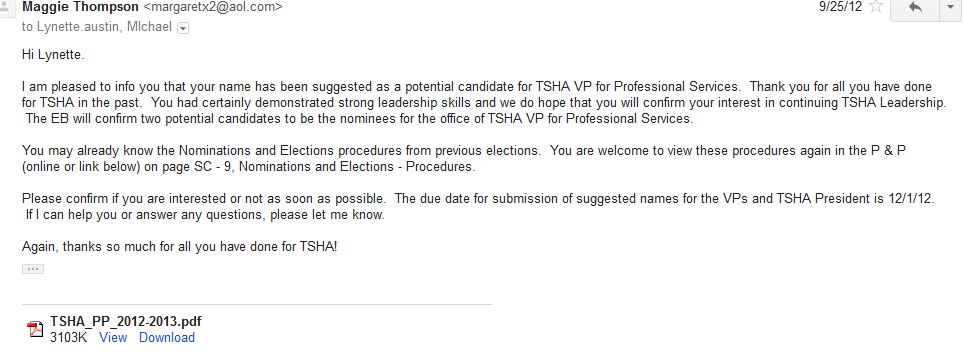
During my tenure on the TF we worked to address a broad range of relevant issues, including such topics as appropriate diagnosis and treatment of CLD populations, and challenges to the success of CLD students within undergraduate and graduate programs. The lessons learned during that time directly impact my current work with CLD/multilingual students at ACU. My work on the CLD Task Force was recognized by the awarding of three Certificates of Appreciation from the leadership of the association, in 2006, 2007,and 2008. In 2012 I was asked to consider becoming a candidate for the position of vice president of professional services, an invitation I was honored to receive but regretfully declined. I really feel that I want to continue to focus the time I have for service to the discipline on the area of CLD service delivery.
In 2005 I became involved in a related task force which had as its mission the creation of a “CLD version” of the TSHA eligibility guidelines (utilized in school-based practice) for determining a child’s eligibility for therapy in the area of articulation (a 2-year process); this work and related efforts have continued into my years of service at ACU. For some time, the association has worked to bring cohesion and consistency to assessment practices within the public schools of Texas, so that a child who is found to be eligible for speech and language services in one school district would meet criteria for services in the next. There are currently seven sets of TSHA-approved guidelines which are implemented by many school districts throughout the state; the eligibility areas included are articulation, articulation for CLD populations, fluency, voice, language, language and learning disabilities, and language impairments with autism or intellectual disability.
After the original articulation eligibility guidelines were created it was necessary to significantly adapt/modify/rewrite the recommended procedures to meet the needs of culturally and linguistically diverse children. I was co-author, along with several other members, of the “CLD Companion to the TSHA Articulation Template” and also became one of the original trainers for these guidelines. In 2010, the guidelines required updating and I was a co-author for this version of the guidelines as well. In 2010, I also became a member of the Continuation of Guidelines Task Force, charged with supporting eligibility guideline implementation throughout the state. Part of my efforts within this new group have been to promote instruction on the guidelines in graduate CSD programs in the state of Texas, so that new graduates preparing to practice in Texas schools are familiar with the procedures. My work on this task force continues today. An eighth set of guidelines is due to be released this fall; these are the guidelines for language eligibility for CLD students. I have been a reviewer for these particular guidelines.
Letter from Rebecca Gonzalez_service to the discipline_profession_TSHA
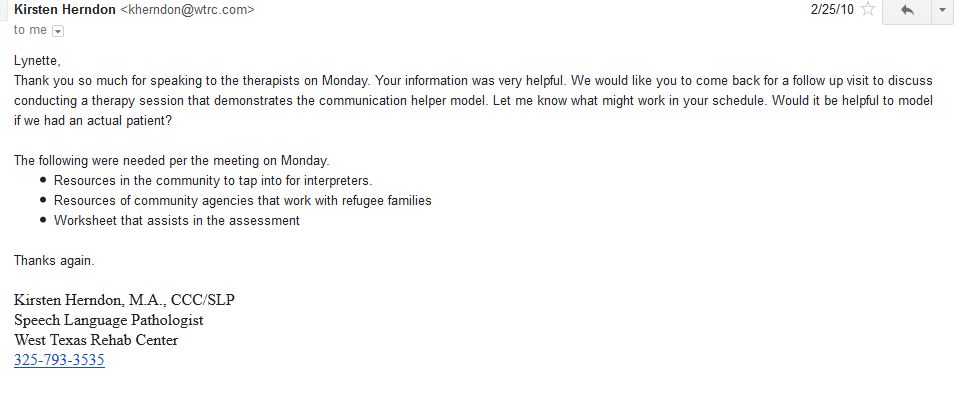
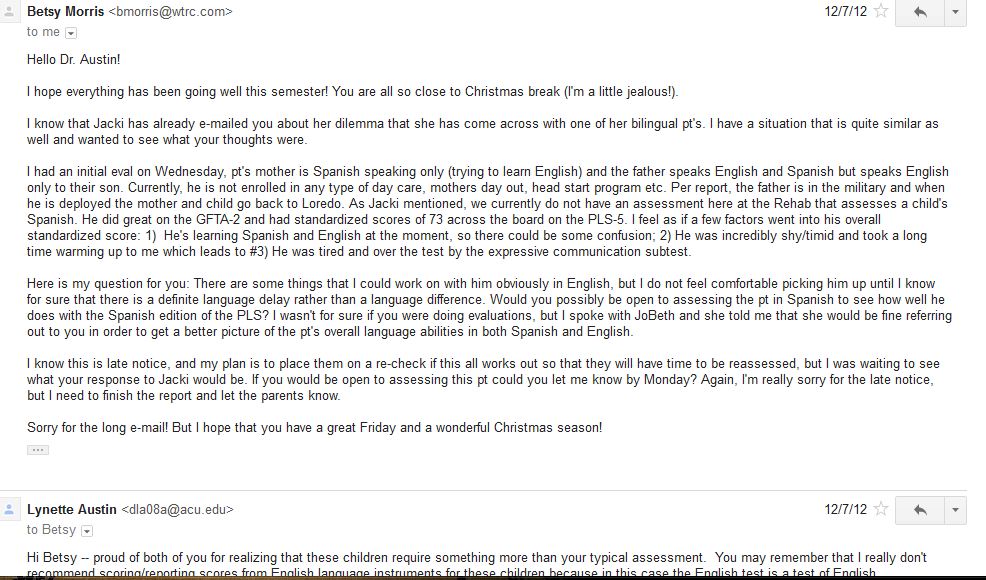
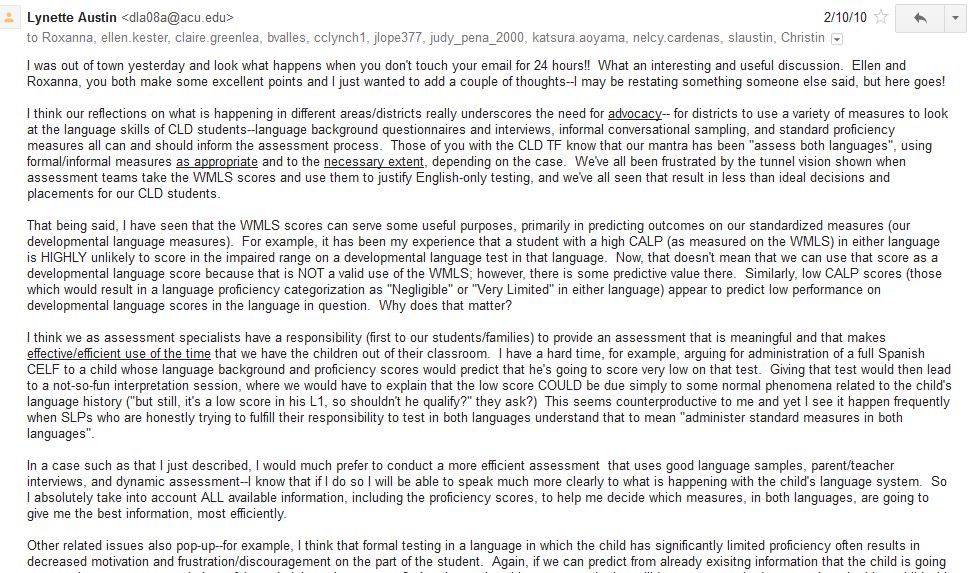
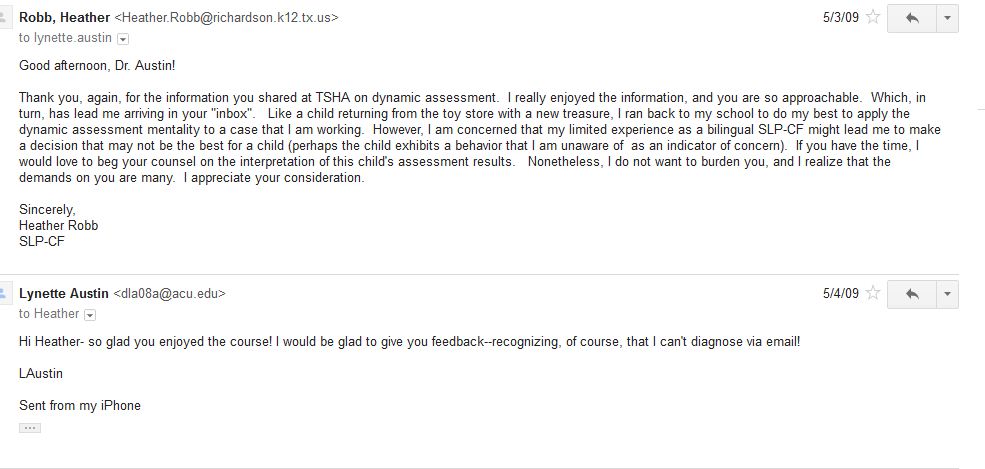
Locally I have also had opportunities to serve the profession by providing inservices and periodic consultation to personnel in local agencies (such as the West Texas Rehabilitation Center, local school districts and region service centers) free of charge to help them problem solve issues related to serving clients/students from diverse language backgrounds. These presentations and consults have included speech-language pathologists, psychologists, special education directors, lead therapists, interpreters, and counselors. I feel that this is actually a service of advocacy for CLD individuals, as communities of non- or limited English speakers are generally significantly underserved in the area of communication disorders (see related correspondence below.)
Letter from Terry Wyatt_special education director_service
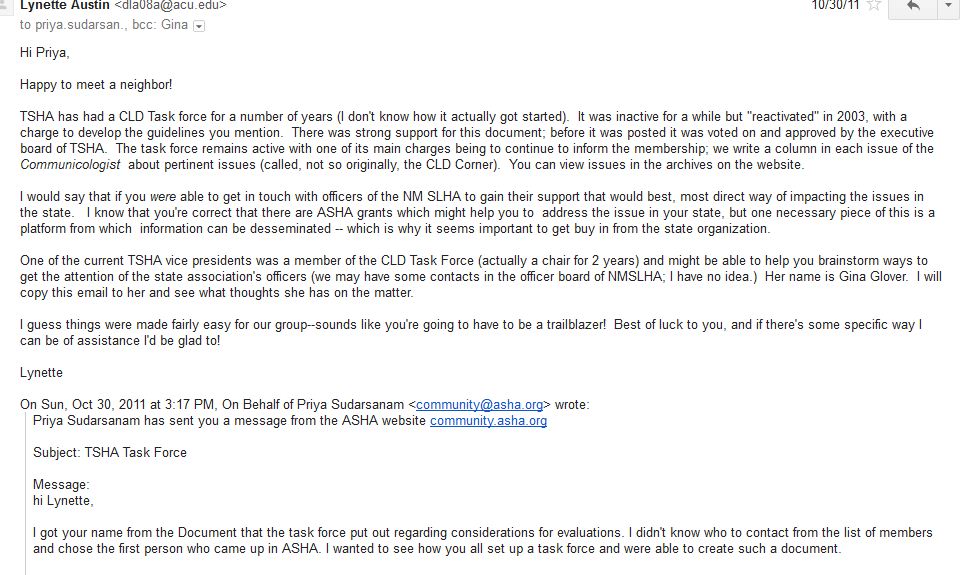
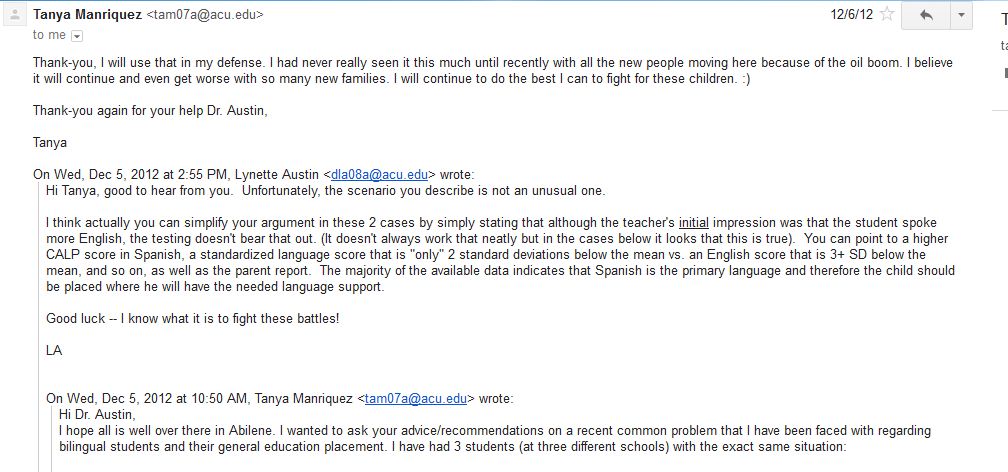
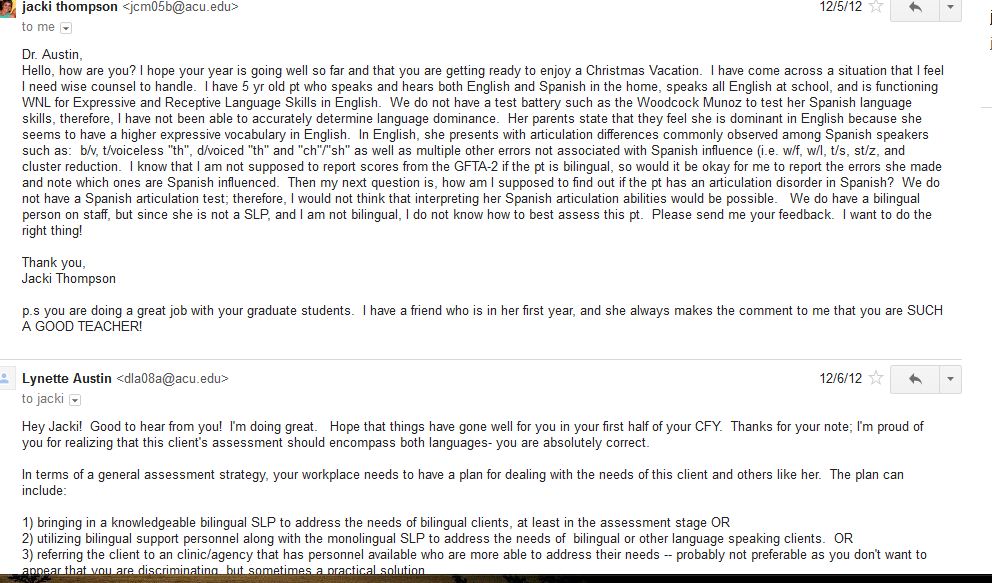
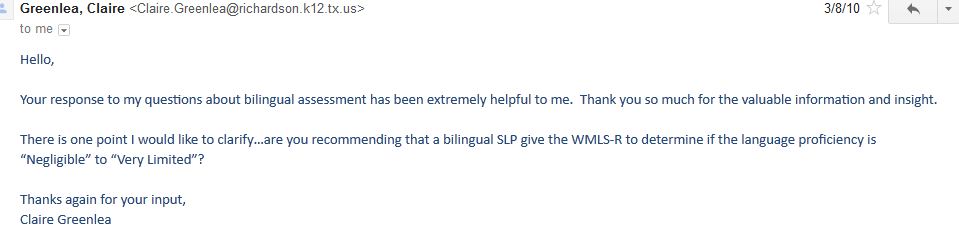
I also receive periodic questions and correspond on CLD issues with SLPs from around Texas and other states (previous students, ASHA members in my special interest groups, colleagues in academia,etc.) I believe that educating service providers about the needs of CLD populations is the first step toward alleviating inequities in healthcare and related services, and so I am delighted to share with and learn from other professionals who also have that concern (see related correspondence, below).
Workshops and consultations
By virtue of my work within the state organization in the area of CLD issues, I have been fortunate to become connected to a passionate, enthusiastic group of like-minded professionals. These contacts have resulted in many invitations and opportunities to provide workshops and inservice trainings across the state. Since 2008 I have been invited to present 15 workshops to school districts and region service centers. Topics have ranged from overviews of assessment and treatment issues for CLD populations, to use of interpreters in treatment settings, to ethics in treatment of CLD populations, to use of dynamic assessment as an evidence-based practice for CLD populations (an area of particular expertise of mine), to the implementation of RtI theory with English language learners (in both academic and speech/language contexts). The audience for these workshops is typically comprised of monolingual and bilingual speech-language pathologists, but I have also spoken to groups comprised of licensed specialists in school psychology, educational diagnosticians, special education directors, directors of English-as-a-second-language programs, ESL teachers, and interpreters. Below is a sampling of correspondence regarding this area of service.
Pasadena ISD_Comments from Course Evaluations_Lynette Austin_ RtI and the SLP
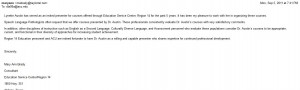
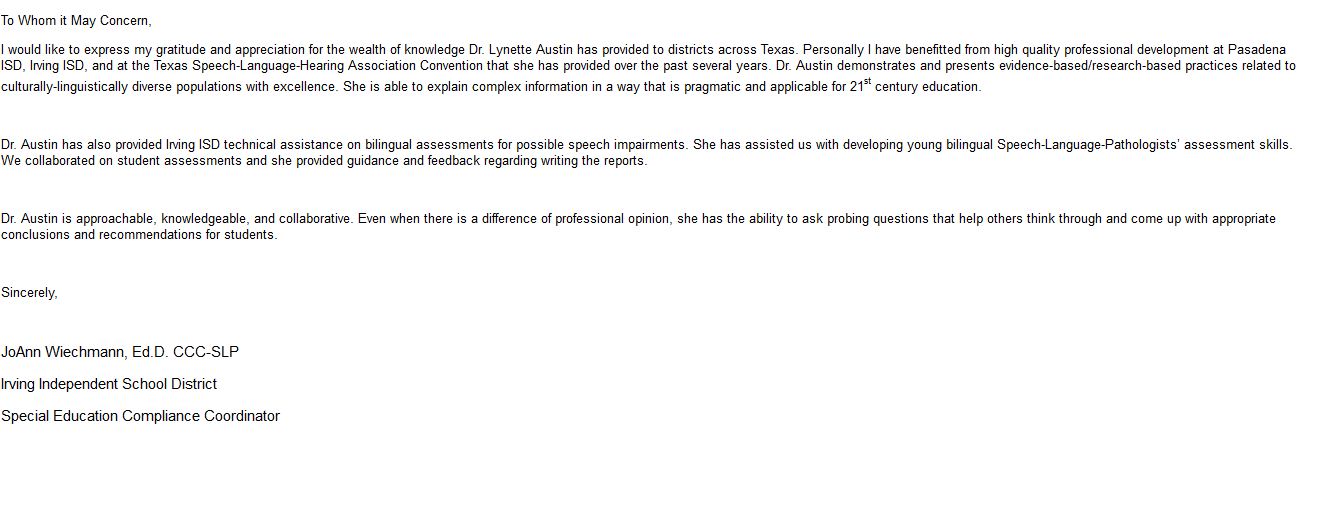
One school district (Irving ISD) has contracted with me to serve as an expert reviewer of assessments of English language learners, and mentor for new bilingual SLPs. This year will be my second to provide those services, as discussed below.
These opportunities for expanding my ever-broadening network of professional contacts have been fun and enriching. In some instances, however, it has been discouraging as I see regions where little attention is paid to best practices for serving CLD populations. There’s still much work to be done!
Finally, since accepting the faculty position at ACU I have continued to work on an “as needed” basis as a speech-language pathologist, providing assessments for Spanish-speaking children/English language learners, as well as occasional supervision of assistants providing therapy services in area schools. I value the authenticity that these ongoing professional experiences lend to the instruction that I give my students—“keeping it real!”
Next. . .Service to the Community