
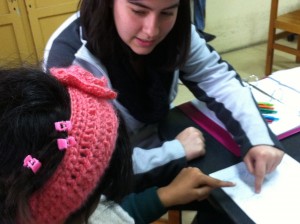
Undergraduate student engaged in a clinical learning experience under my supervision.
An earlier segment has included a discussion of my perspective on the importance of experiential learning. The purpose of this section is to develop that idea to include specific examples of clinical activities or experiences that I include in my coursework so that mastery of the course content both emerges from and leads to acquisition of clinical skills. At the undergraduate level, students in ComP 330 (Normal Language Development) are quickly involved in the identification of specific language skills in typically developing children. In previous semesters I had the students engage in “live” observation and assessment activities; currently I am using video clips so that I can see what they are seeing and give more in-depth feedback regarding the accuracy of their work. Similarly, in ComP 471 (Speech-Language Services in Schools), the students respond to case studies with specific strategies for intervention with children with different types of disabilities; for example, they may choose to work on a case study where they design a therapy program to help a child with autism comprehend the idea of “danger.”
In ComP 608 (Multicultural Issues in Assessment and Intervention) the students are required to interview a bilingual individual, trace the language history of that person, and make direct links within their papers to theories of bilingual language acquisition and multicultural influences on speech/language/communication. This is the culminating activity of the course. The students are generally excited to see that they now have the knowledge to make some informed conclusions about the person’s first and second language acquisition process and related questions; they are surprised by how much they know!
At the graduate level (in ComP 659/610), course-related clinical activities are direct and authentic. The students work with real children who have clear needs in the areas of speech and language. In a carefully guided process, they evaluate the children using evidence-based assessment strategies, and as appropriate plan and carry out a program of language intervention. This interaction is usually their introduction to actual service delivery as it occurs in the first semester of their graduate program.
In this aspect of clinical instruction our program differs in many regards from others. It is a relatively common practice to engage beginning CSD students in substantive clinical practice from the onset of their programs of graduate studies. However, I believe that it is unwise and potentially unethical to “send out” students to treat actual clients with only a limited base of information for providing that treatment. We have therefore worked to provide a gradual, scaffolded (supported) clinical experience as mentioned above. In this experience, we pair each clinician with a single child who demonstrates a language disorder (a disorder area which these first semester students begin immediately to study). The students all use the same, evidence-based therapy methodology with their clients (but of course the implementation of the methodology varies according to individual clients’ needs). We go as a group to provide these services over an 8 week period– students, professor, clinical director, and other supervisors. We debrief after each session and work as a group to build knowledge about a range of clinical practice issues, including how to structure therapy sessions, how to establish treatment objectives, clinical documentation, client engagement, and so on.
Student feedback regarding this process has been uniformly positive. At first students are overwhelmed with the responsibility of providing services to a real human being. I am pleased to note that it is a responsibility they take very seriously. After becoming comfortable with their clients, the students invest significant time and resources in creating and carrying out effective therapy plans. When they begin their first full clinical placement in the spring of year 1 of the graduate program, they report being able to generalize most of the clinical skills introduced through this initial process. (Student reflections on this experience were cited in the section “Philosophy of Teaching and Learning“, under the heading Experiential Learning.)
This year, providing this experience will mean working simultaneously with 24 graduate students and 24 children with language impairments! At times the logistics are intimidating; however, because of the value of this learning experience to the students I am willing to go to significant lengths to facilitate its occurrence. A tremendous blessing last year and now this has been the collaboration of the ACU clinic director/instructor, Diana Taylor, in this process. We now work together to design and implement this initial clinical program, and in April 2013 presented our model for integrating theory with practice at a national conference (click here to view the presentation on Scaffolding Early Clinical Experience).
Clearly, my teaching responsibilities involve clinical education, and in addition to the course-related activities noted above I have collaborated with Diana Taylor in providing instruction on specific clinical skills in ComP 693 (Clinical Forum). I have also served as a clinical supervisor in the Center for Speech and Language Disorders, primarily in the area of bilingual service delivery. Although these tasks result in additional time demands, they provide more opportunities to assist the students to integrate theory and practice, and I welcome them.
Next. . .Student Mentoring and Advising