
During preservice sessions in August of 2012, I was fortunate enough to attend a session on Cognitive Load Theory by Dr. Robert McKelvain. This session was an eye-opener for me as it directed my attention to aspects of teaching and learning that I had not previously considered. Funnily enough, the concepts comprising Cognitive Load Theory (CLT) were not entirely new to me; they have a place in the literature of rehabilitation science. But I had not applied them to pedagogy in higher education, nor specifically to the discipline of communication sciences and disorders. Dr. McKelvain’s common-sense application of the concepts of intrinsic load, extrinsic load, and germane load to college-level instruction helped me refine my pedagogy, and provided a theoretical foundation and a terminology to help me reflect on, describe, and modify practices I was employing intuitively.
Dr. McKelvain discussed the contrast between intrinsic load, or actual course content, and extrinsic load, or the peripheral “how-tos” for completing tasks, accessing materials, locating information, etc. If we accept that germane load is the actual content learned, or the schemas stored in long term memory, then a primary task of teaching becomes controlling or minimizing extrinsic load to allow more focus on intrinsic load. At times we must even manage or decrease intrinsic load if it is overwhelming the learner. In this manner germane load (learning) is maximized.
The elegance of this teaching/learning model fascinates me. I searched the literature in my own discipline and found no writings applying the theory to the teaching of communication sciences and disorders. I found articles in the disciplines of physical therapy and medicine, which provided a bridge from the theory to classroom practice. After reflecting on my own teaching practices and rejecting/refining/reframing these, I answered a call-for-papers to present this information at a national conference. Shortly after the conference, I had a manuscript on the topic accepted for publication. (The presentation and manuscript are discussed in the major section “Scholarship”.) In the points that follow I will outline my teaching practices that are theoretically coherent with CLT. Throughout this discussion I will refer to examples from my teaching, and these examples will primarily be taken from graduate coursework where I perceive that the course content has the greatest intrinsic load. I do apply these concepts to undergraduate courses as well. Note: specific teaching strategy terminology comes from the body of CLT literature.
1. Consider the learner: For novice learners, unstructured, problem-based learning experiences (experiential learning) do not facilitate optimal learning. The independent search for simple operational procedures, foundational information, problem-solving processes, and identification of desired outcomes creates an overwhelming extrinsic load. This is why on the teaching philosophy page I note that experiential learning without guidance does not result in a satisfactory learning experience. On the other hand, for the more advanced learner with some schemas constructed on a topic, experiential learning avoids redundancy (repeating of procedures and concepts) that can actually increase extrinsic load for the learner at that level. Therefore, the characteristics of the learner or the class are primary in determining teaching strategies. For a class of beginners in a discipline, the following techniques have been shown to be effective: low-stakes assignments (ungraded, inferential learning tasks), worked examples for students to analyze, completion tasks where students finish only a part of a larger project, and “just-in-time” instruction that avoids students having to search for procedures or information that is new to them. For more experienced learners, a “fading-guidance” strategy, where prompts and cues that are initially provided are then dropped, may provide them with the necessary support to get started on a task, which they then finish independently. This strategy enables knowledgeable learners to avoid having to split their attention between the task and redundant instruction that may interfere with learning.
2. Minimize extrinsic load: In the section “Teaching Philosophy” I have already described the value that I place on what I call experiential learning. However, I work to intentionally decrease extrinsic load to the maximum extent possible in learning activities and assignments by carefully structuring and explaining the procedures, task expectations, resources to be used, and outcomes to be achieved. I have rejected the “you problem-solve this and figure it out” style of experiential learning for new learners, which I had previously viewed as a valuable type of learning experience.
Relating this again to point number one, I use assignments such as having new graduate students at first analyze an evaluation report in groups and create a list of group questions, rather than asking them to generate a report from some data (inferential, low-risk assignment; analysis of a worked example). Shortly after that they are asked to complete part of a diagnostic evaluation and generate part of a report using a model (completion task). There are commonly accepted methods and styles for diagnostic report writing and it is unnecessary for beginning students to generate a report “from scratch”.
3. Work from simple-to-complex: To help students manage the intrinsic load of the course content, it is helpful to move from simple-to-complex concepts and materials. This means moving from topic introductions, where the interaction between elements and concepts is limited, and gradually increasing element interactivity . An example of this from my diagnostics class is the manner in which we introduce examination of the oral mechanism (OME): first, we review anatomy and physiology of the oral mechanism — terms, identification on a diagram, identification in the mouths of typical speakers (through experiences with different mouths in the class!) A completion grade (for checking off anatomical landmarks in several mouths) is obtained for this introductory experience. Then, the students are introduced to oral mechanism examination for a specific purpose, emphasizing the interactivity of the elements of anatomy and physiology in this particular disorder (reverse swallow, or tongue-thrust). The reason behind the tasks of the OME start to become clear as the students see how deviations in anatomy and function come together in the disorder. Next, the students complete a full OME of one of their peers, using a standard protocol and writeup template; with one catch — their “client” is given a deviation from normal which the examiner has to describe and explain its implications. The movement from simple to complex concepts and task expectations on this particular topic usually results in an acceptable OME report, and leaves the students reasonably prepared to conduct their first “real” examination three weeks later.
4. Move from low-to-high fidelity environments: performing tasks initially in low-fidelity environments decreases the extrinsic load of concern for the consequences of error. This is particularly true in disciplines where those consequences may be experienced by human subjects, such as in the discipline of CSD or other health disciplines. When students are able to work on skills in a hierarchy of contexts starting with imagined contexts (such as case studies), then moving to simulated contexts (such as computer simulations), and then finally in the context of actual client contact, they are able to achieve a positive practice effect without experiencing grave consequences for mistakes. This builds confidence and decreases fear. In the program we utilize simulated computer patients prior to introducing live patient contact for this very purpose. Following are some quotes from students regarding their experiences of learning within low(er) fidelity environments such as with the simulated patients of “SimuCase”:
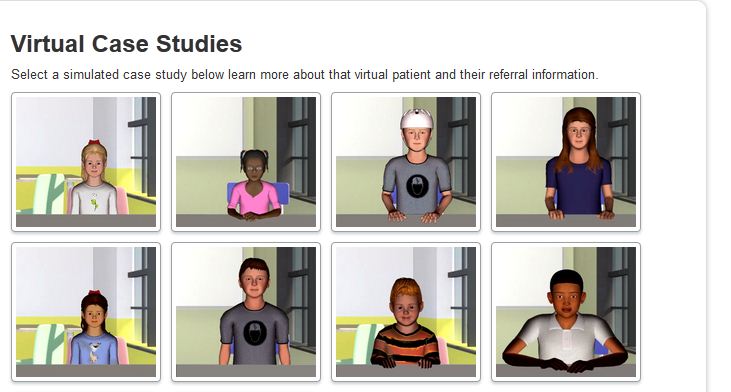
Simulated clients from the SimuCase program
I am thankful for simulated assessments that allow me to learn and make mistakes on a computer before I get thrown out into the real world!
The challenge scared me at first, but as I went through it, I realized that I am beginning to gain some tools that can help me work through the process. I feel I did better in some areas on this [second] case than I did on the prior case. For that reason, I feel [the program] is beneficial to my ability to apply what I am learning in class to real situations, with the added benefit of it being a simulated experience.
Overall I feel that this case led to significant improvement on my part. I moved up a category to developing competency, I was happy to see that. . . .Aside from [a] big mistake I have already acknowledged, which apparently affected my case history score, there is notable room for improvement in my assessment and recommendation areas. . . .. My most significant improvement was seen in both the collaboration and diagnostic areas.
5. Provide opportunities for self-explanation (reflection): I have come to the point in my career as educator where I believe that no learning occurs without reflection or self-explanation. If the learner cannot satisfactorily explain at least some part of what is learned from an experience, there is unlikely to be any schema formation with that content. Thus we have the short-term results attained from “cramming for a test”, where the information is memorized for a brief time and then lost soon after. I require frequent reflection in all courses, undergraduate and graduate. There are examination questions on each test requiring reflection on specific topics, and reflection components to assignments and group projects. In graduate classes, particularly during the clinical practice component of the Diagnostics and the Language Disorders class, we reflect together as a class on how therapy sessions went, what was challenging, what worked or didn’t work, and why. I’m trying to create a sense of professional unease within the students, so that if they cannot explain why something is true (even a partial explanation reflecting current understanding) they are not satisfied. Below are video clips (used with student permission) of some of these moments of guided reflection. (The clips are mp4 files and may take a moment to load).
Therapy documentation–trial and error
Language therapy: what is progress?
Next . . .Integration of Theory and Practice