
Observations
I have spent 18 years interpreting my course evaluations. The variation in responses is interesting and has presented a challenge in drawing objective performance conclusions.
However, my evaluations indicate that objective measures of what I do in class score higher than subjective measures which require students to make judgments about me vs what happens in class. For example, over the past five years, I received higher scores in the following categories in every class taught given the following measures:
Displayed personal interest in students – 3.74 to 4.25
Involved students in hands on projects – 3.9 to 4.5
Related course material to real life – 3.78 to 4.5
Gave projects, tests, assignments that required original or creative thinking – 3.64 to 4.75
Encouraged student/faculty interaction outside of class – 3.75 to 4.03
One measure where I consistently scored lower is the following:
Explained course material clearly/concisely – 2.17 to 3.75
I believe the lower scores in this last category are mainly due to my choice to use a lab-based environment to focus on student learning. As an engineering student, we did not attend lectures. We worked in teams to generate new outcomes based on investigation. This relates to having a “flipped” classroom experience, where readings are to be completed outside of class, and class time is “work” time. Overall, I believe the students appreciate this type learning environment, especially as it is used more and more in liberal arts setting.
This said, I have not been able to increase my overall scores to consistently range in the high 4 to 5 range. Unfortunately, research has confirmed that faculty with certain natural “traits” are rated lower on course evaluations by students. These traits – in no particular order, with supporting research linked – are being female, being a minority, and both of these traits combined when teaching science/technology/engineering/math courses. Because I identify with all three traits, I would anticipate lower evaluation scores in my performance from students. Because of this realization, teaching presents very interesting challenges each semester.
I receive the same range of scores, whether the course is a 3-week online course or a full term, 15 week face to face course. The only times I have received scores consistent with the COBA average was during the IT Global Leadership program in 2011, which had mainly an international enrollment.
Other factors also prevail. I have learned that undergraduate students are very impressionable. They are sociable and have a strong desire to “fit in.” It is therefore a major challenge for students to think independently when faced with the threat of isolation and retaliation if they choose to go against social and political norms that have become part of the social construct of an academic community.
Graduate students have quite different challenges, with the pressure of job, family, and, with some, attending a graduate program a number of years after receiving an undergraduate degree. These students have limited time to learn new concepts and new technologies, and can thus become stressed out in the learning process.
With this in mind, every semester I still seek opportunities to implement improvements in how each course is delivered. Although most of these improvements are sourced from articles and webinars provided to improve faculty interaction and student learning, I have used a number of sources to improve the student learning experience. The following is a sample list of improvements made in recent years:
- Implemented training for students as managers in a business environment where they evaluate direct reports to improve their contributions to organizational goals using key performance indicators (KPIs)/process measures as outcome metrics.
- Modified assignments to include both individual and team contributions to help students understand the purpose of teams to enhance business outcomes vs boost individual grades.
- Use business simulations to allow students to work within their discipline supporting various business scenarios – e.g., manufacturing, logistics, distributorships, and more.
- Allowed the use of any technology/device students have available where they learn to manage technology in a real-life setting.
- Incorporated the use of polling/random surveys to capture student feedback on specific activities vs evaluating people.
- Incorporated the ethics and truth of inaccurate assessments made concerning people based on opinions and what we see on the news.
Master Teacher Program
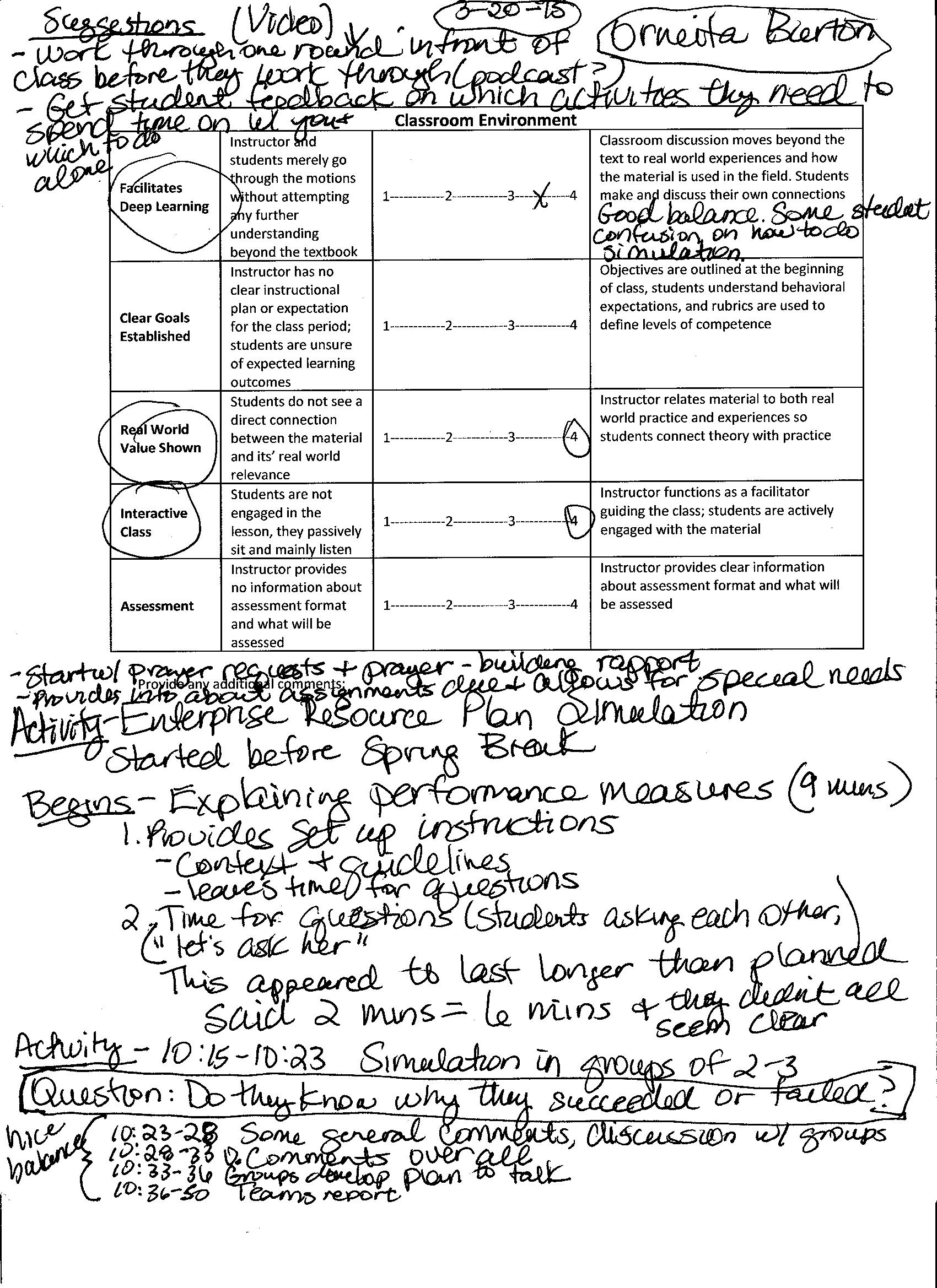
To receive external feedback, I volunteered for the pilot Master Teacher program to both evaluate and improve my pedagogical techniques. During this program, I was able to discuss instructional approaches and listen to both new and seasoned faculty share the “good, bad, and ugly” of teaching. I was also able to objectively evaluate my teaching style during the spring 2015 session by inviting an Adams Center instructional designer to sit in on a section of my Operations Management course. The evaluation was very positive (see here) and indicated no significant difference between other faculty. However, I was able to observe the actions of one student while the instructional designer visited the class. This particular student had missed a number of classes and was consistent in making no effort to prepare to participate when present. On this day, he visibly demonstrated that he did not understand the topic covered that day and made it a point to share this with the visitor. In spite of his effort, the visitor was able to see through his actions and positively report on the engagement and level of participation of other students.
Student Related Observations
I regularly have students who exhibit personal excellence in all they do, simply because it is right for them to do so. I have also had students do everything they can to avoid the effort of learning during the semester and then feel very comfortable engaging in deceptive practices to be given an “A” at the end of the semester. This summer, I had a student do nothing for the entire Summer IV session. In fact, I thought he had chosen to drop the course. However, at the end, he heard that Canvas had crashed on the last day of class. As a result, he assumed that I did not have a copy of the grades and tried to convince me that he had fully participated in the course. When I assured him of his error in both his performance and my competence, he discontinued his efforts and broke off communications.
I know that students can be immature and will test the waters in unusual ways. However, by analyzing my course evaluations, I believe there are efforts to make the ACU environment an undesirable place for some faculty and students as well. These desires do not necessarily originate within our students, but are actually operationalized through them by other adults with personal agendas. Comments are made in course evaluations that are unrelated to the instructional environment and are personally directed and derogatory, with the intent to defame character. In my situation, direct statements are made on course evaluations, saying I should not be a part of the ACU family and, as one student shared based on what she had heard, I am here only because of affirmative action. Her definition of affirmation action was: “When things that belong to us are taken away and given to someone else.”
I would like to share the following qualitative feedback from my most recent course evaluations:
What did you like about…
I really liked that she treated everyone respectfully and accepted all answers as part of a discussion
I appreciate that she is available at many times to be able to have a meeting with her.
I appreciate her willingness for her students to genuinely learn.
She had a very big passion with making sure we were ready for the work place and she tried to use videos.
She’s nice.
She is very nice and enthusiastic about the class.
Honestly, not very much. She is mean and disorganized. The only thing I appreciate is that she likes me.
The only thing I enjoyed about this class was how nice of a person Dr. Burton is and that she started each class off with a prayer. Other than that this was the worst class I have taken during my time here at ACU. If it was not a required course I would never recommend it to anyone.
Very kind
Patient
She is extremely smart. I like how this class pertains more to outside real world activity than just a classroom setting.
She is knowledgable and enthusiastic
You really knew best throughout your classes, don’t ever doubt your teaching abilities (: (See email exchange here – Email exchange Zach Higgins 2014)
Also see note of thanks from student employed by BNSF – Email from Bryan Rodriguez
Compare these statements to the following:
In what specific ways could the instructor/the course improve?
“Figure out how to teach! She has no idea how to communicate what she is trying to say. I will ask her a question in class about a test and she won’t give an answer, because she doesn’t know how to explain and probably doesn’t actually know what she is talking about.
Everyone knows she is a terrible teacher, and it is a horrible reflection upon ACU that she still has a job. She is the worst teacher I’ve ever had in college by far and should be gone.”
Overall, Burton is a very nice lady that I believe wants the best for all of her students. But this class she teaches could be summed up in 1 to 2 weeks
easily, she is being forced to drag it out over a semester and that is why i believe there are so many bad reviews in the past on this
class.
Not have it taught by Orneta Burton
The course absolutely needs to be taught by another teacher. There were so many misunderstandings about what was expected of us and what we needed to know. I do not think that I will be able to carry anything from this class onto later parts of my life because the material was not clearly taught and the entire class never knew what was going on.
I do not mean this rudely, but a change in professor. I feel like maybe her talents could be better utilized elsewhere.
In light of this, I do believe God works for the good of those who desire his presence. I am not concerned for me, because these comments are not new for someone who grew up in the 60s and 70s. However, students empowered to speak against authority become careless and do not assess the impact of their actions. For example, one spring, after sitting through behind-the-scene conversations in class, the only African American student in the class ran outside crying. She came to me later and said she shared other classes with the same students and they did not treat other faculty the same way. Another time, two students with learning challenges were troubled by statements made by other students. One began pounding on the desk when students near him were speaking in an extremely derogatory manner. Another student left the class and did not return.
It takes courage to stand for civility in a hostile environment. During some of the most challenging semesters, God has always brought a student who is willing to stand up for what they believe is right. For example, in the fall of 2014, one of the leaders of a social club noticed the intentional defamation that went on in class, in social media and in behind the scenes conversations. Instead of going along with other club members, he began praying in class. He treated me kindly, and paid special attention to inquire about my life. I also believe he took action to address behaviors outside of class, as this was a much improved semester. Perhaps this may explain the following comment from that semester’s course evaluation:
“She could avoid picking favorites, because her favorite students get way better grades on her very obscure objective tests.’
Life is interesting, particularly when seen through the eyes of those who are young and learning to think critically, live in community with all people, and to make hard decisions during trying times. Because such times are forever a part of life in a fallen world, I will forever appreciate those students and faculty who have had the courage to stand against injustice and thus make a much needed difference in the lives of others.
Further Encouragement
I met Dr. A. Overton Faubus in 2010 during the last summer of his life. He did not know me since I arrived at ACU just 3 years earlier, and, because he was ailing, would probably not recognize me if we had met in the past. The three things I knew about him was that he, like I, was a University of Arkansas grad (his PhD was in Accounting), that his portrait hung on a wall in COBA, and that his brother was the Governor Orval Faubus who stood against the desegregation of Central High School in Little Rock, AR in 1957 – the year I was born. During this visit, it seemed that everyone understood that this was a time of goodbyes. When they introduced me to him, he looked my way and said, “Don’t let anyone tell you that you can’t teach.” Prophecies have a way of being spoken at the right time. I remember Dr. Faubus’s words when reading my course evaluations to identify objective observations for improvement.
Representative semester evaluations from 2015 to 2018 can be found at the following links:
Spring 2015 – Qualitative S15 OM ERP, Quantitative S15 OM ERP
Summer 2015 – Qualitative SUM15 MICRO, Quantitative SUM 15 MICRO
Fall 2015 – Qualitative F15 OM EC, Quantitative F15 OM EC
Spring 2016 – Qualitative S16 OM, Quantitative S16 OM
Summer 2016 – Qualitative SUM16 MICRO, Quantitative SUM16 MICRO
Fall 2016 – Qualitative F16 OM STATS, Quantitative F16 OM STATS
Spring 2017 – Qualitative S17 OM ERP, Quantitative S17 OM ERP
Summer 2017 – Qualitative SUM 17 MICRO, Quantitative SUM17 MICRO
Fall 2017 – Qualitative F17 OM MICRO BC, Quantitative F17 OM MICRO BC
Spring 2018 – Qualitative S18 OM ERP, Quantitative S18 OM ERP
Summer 2018 – Macro Online, IS680.1 Data Mining, IS680.2 Data Mining