by M. C. Jennings | Dec 21, 2023 | Academics, COBA Faculty, Current Students, Student Spotlights, Uncategorized
written by special contributor, Lance Fleming
 The pandemic of 2020 wreaked havoc on the global economy, shut down businesses and schools, drove employees to home offices, separated friends and family, and took most people away from their routines.
But in ways no one considered before COVID, it brought families closer together, allowed everyone to slow down and take care of themselves and each other, and gave everyone time to reflect and think. It’s also when Natalie Lewis decided on a career path.
During those days spent sitting in her parents’ home in The Woodlands, she turned to YouTube videos to pass the time. She focused on fashion and lifestyle YouTubers, which led her to follow those influencers on Instagram. That’s when she put the pieces together.
“I noticed those individuals had made a career out of creating content for their audience and brands that they love,” said Lewis, a senior marketing major from The Woodlands. “I knew that would be something I would love to do, so I decided to give it a shot.”
Lewis began her own Instagram page (@natalieelewiss), which not only chronicles her life, but also allows her to pass along lifestyle and fashion advice. She engages with other influencers through YouTube and Instagram, which she says is her favorite platform. That’s why she started on Instagram but will expand to YouTube after she graduates in May.
Her parents, Colter (‘95) and Elizabeth (‘96), have supported her post-college career decision, especially after she’s seen so much success – almost 15,000 followers – early in the process. Her mother helps Lewis create content, and her father helps her think through all the logistics of payment and pitching herself to different brands.
“My parents have watched my gradual build-up from simply getting free products to getting paid campaigns, and they were able to understand it better,” Lewis said. “They saw the hard work I put in behind the scenes of growing my platform and gained more respect for what I wanted to do. When I told them I wanted to pursue this career, they already understood it and saw that influencing is a fast-growing industry.”
The influencer industry is relatively new, and she said the most important piece is finding a niche, a target audience, a social media platform that resonates with the audience, and constantly revamping the platforms for consistency. Lewis began slowly, posting outfit photos on Instagram because she wanted to step into the world of fashion content.
That made it easier to get brand collaborations from companies, who would look at her feed and see that her content aligned with their brand.
“Once I branded my Instagram, I started reaching out to small clothing brands and got rejected by some and accepted by others,” Lewis said. “Once companies had seen my work with other brands, they became more interested in working with me because of my credibility. And that has led me to work with bigger brands.”
 Lewis didn’t have a marketing plan when she started, just a passion for fashion and taking pictures. She began posting for fun because she was curious where the posts might lead. When Lewis found her passion, she researched how to grow her account and work with different brands. She didn’t write a marketing plan until her junior year at ACU.
Lewis said no follower count or income level is required to be considered an influencer. Consistency in posting and connecting with the community, Lewis said, are most important in building a career as an influencer.
“It’s a mindset,” Lewis said. “If you want to be an influencer, you have to post like one, which is awkward at first. But you get used to it. I got my first brand deal with 3,000 followers and have seen many other creators work with brands with only 1,000 followers. You can be an influencer with only 1,000 followers and earning no money, just as long as you’re actively pursuing influencing. In my first year of content creation, I only received free products and earned no money. Consistency, engagement rate, community, and trustworthiness are how I would measure whether someone is an influencer.”
Her education in COBA, she said, has helped her learn how to market herself, implement those plans, and measure the growth of her brand.
“I’ve had a tremendous opportunity to build relationships with so many professors who have helped me with this venture, specifically Dr. Jennifer Golden,” Lewis said. “She has helped me with my professional goals within the influencing industry. COBA has taught me how to market myself on social media. The biggest lessons I’ve learned are about personal branding, which is a crucial topic in the influencing industry because it sets one apart from millions of other influencers. The models and plans I’ve been taught in COBA have influenced my decision-making, steering me where I want to take my social media.”
After she graduates from ACU, Lewis said she looks forward to expanding her niche into more lifestyle-based content (bridal, newly married, interior design, daily routine, family, etc.). She also said she wants to focus more on growing and creating the content she truly loves while continuing to create fashion content.
“I’m going to get a job after graduation while pursuing influencing on the side,” Lewis said. “However, I’m going to work hard to grow my platforms so that one day I’ll be able to quit my job and focus on influencing full-time. Creating content for my audience and working with brands I love is my biggest passion, so the end goal is to go into influencing full-time one day.”
by M. C. Jennings | Dec 20, 2023 | Academics, Accounting, Alumni Spotlight, Financial Management, Uncategorized
written by special contributor, Lance Fleming

Linebacker Jack Gibbens #50 of the Tennessee Titans during the preseason game between the Tennessee Titans and the Chicago Bears at Soldier Field on August 12, 2023 in Chicago, IL. Photo By Emily Starkey/Tennessee Titans
As a double major in accounting and financial management, Jack Gibbens’ (‘20) learned a lot about discipline and tenacity during his time in the College of Business as a student-athlete. That steadfast determination was something he’d need on the road to the National Football League, which wasn’t as smooth as that of others he plays with as a member of the Tennessee Titans. But in the NFL – as Gibbens has heard over and over – it’s not about how you got to the league, it’s about what you do when you get there.
And despite being cut at the end of the Titans’ training camp in 2022, the former ACU Wildcat standout has finally earned his spot in the league as a starting linebacker for the Titans. He’s started all but one game this season for the Titans after playing in the team’s final five games in 2022.
Gibbens was a standout at ACU from 2017-20 and then spent his graduate season (2021) as a starting linebacker at the University of Minnesota, where he was an honorable mention All-Big Ten Conference selection and earned his master’s degree in accounting. He wasn’t drafted in 2022 but signed as a free agent with the Titans after the draft, and for most of training camp, it looked like he might make the final roster.
He quickly became a favorite of head coach Mike Vrabel, who dubbed him “Dr. Gibby” because of his intelligence. The former ACU Academic All-American had made an impression on the veteran head coach.
“He’s smart, answered all the questions, and then said, ‘Coach, I wasn’t in pre-med,’ “Vrabel said. “I told him I knew and that it was a joke.”
Gibbens has spent his career – both in college and now as a professional – using his athleticism and intelligence to reach the pinnacle in football: a starting spot in the NFL. A native of Bulverde, Texas, Gibbens quickly earned a starting spot for the Wildcats and played in 39 games over four years, earning all-conference honors and academic All-America accolades.
He went through the Titans’ training camp in 2022 but was one of the final cuts made before the regular season started. He was re-signed to the team’s practice squad on Sept. 12, 2022, and was promoted to the active roster on Dec. 10, 2022, making his NFL debut in their Dec. 11 game against Jacksonville. Just one year later, Gibbens is a mainstay in the middle of the Titans’ defense, having earned a starting spot over other veterans.
“Coach Vrabel continually preaches that it doesn’t matter how we got here; it’s what you do when you get an opportunity,” Gibbens said. “It’s been a journey to get to this place in my life. I was cut last year and then spent some time on the practice squad before I finally got an opportunity to play. Now, I’m playing a completely different role as a starter. I’m trying to keep the same process, which is to put my head down, keep working, and get better every day.”

Photo by Jeremy Enlow/Abilene Christian University
We recently had the chance to catch up with Gibbens, who spoke about his time at ACU (where he carried a 4.0 grade point average in accounting and financial management) as well as what he’s learned about managing his money in the NFL.
Q: You spent a lot of time in the Mabee Business Building while at ACU. Could you tell me about your experience in COBA and your gratitude for what you learned under those professors?
Gibbens: “When I think about my time in COBA, I am most appreciative of the amazing people I was surrounded by each day. The small class sizes allowed me to get to know my classmates and professors on a more personal basis. I am extremely grateful to my professors not only for teaching me about business but for their interest and investment in me as a person.”
Q: What are some of your biggest takeaways from your time in COBA?
Gibbens: “Probably learning how to combine business with my personal beliefs, interests, and values. Being in a Christ-centered environment was a huge blessing that allowed me to be myself and grow in knowledge and as a person.”
Q: When you think back on your time in COBA, who are the professors that stand out, and what life lessons did you take away from them?
Gibbens: “I had many professors who impacted my life, but two in particular stick out. Clint Buck had a huge impact in making it feel like home. He taught my first class at ACU and made me feel at home on campus by developing a personal relationship with me and praying for/ with me as I adjusted to college. And Andy Little. I appreciate the way he challenged my thinking and pushed me to form and defend opinions.”
Q: How difficult was it to balance getting ready to play a game on Saturday and studying to maintain a 4.0 GPA?
Gibbens: “Balancing those two was a challenge when trying to succeed at the highest level. Being a student-athlete taught me great lessons about time management and work ethic. I quickly learned the importance of being in the moment and fully investing myself in the task at hand.”
Q: When you played at the University of Minnesota, how much more difficult was the dual life of student and athlete?
Gibbens: “The adjustment from high school to college was much more difficult than my transition to Minnesota. Adjusting to life as a collegiate student-athlete is so different athletically, academically, and in everyday life from when you were in high school. Moving to Minnesota was much easier because I had already learned how to be successful in that lifestyle.”
Q: Now that you’ve moved into the NFL, with your background and major, how much are you watching your finances and where your money is going?
Gibbens: “Having a background in accounting and finance has caused me to have a huge interest in my finances. What I studied in college gave me a great foundation to make good financial decisions and understand the importance of budgeting, investing, and preparing for life after football.”
Q: A lot of guys in your position turn it over to a financial advisor and then don’t know anything about it. Did you determine early on you weren’t going to do that?
Gibbens: “The NFL is unlike any other profession because it creates specific challenges and opportunities from a financial perspective. To help me navigate this unique financial landscape I have hired a financial advisor who specifically works with athletes and understands my specific needs.”
Q: Going back to your ACU days: what did ACU and the experiences in COBA, football, and student life in general mean to you?
Gibbens: “Those times at ACU are some of the best years of my life. I made memories and friendships that I will carry with me for the rest of my life and, for that, I am extremely grateful for ACU.”
by M. C. Jennings | Dec 12, 2023 | Academics, Alumni Spotlight, COBA Events, COBA Faculty, Uncategorized
Written by special contributor Lance Fleming

Dr. Bill and Mrs. Donna Petty
If – as ACU President Dr. Phil Schubert (’91) said on Friday, Oct. 13 – the College of Business Administration has been an engine that has driven ACU’s extraordinary growth over the last 35-plus years, then the man who put the key in the ignition was Dr. Bill Petty (’64).
So, it was only natural that when the Mabee Business Building – which Petty and others planned, raised money for and saw through to its opening in 1986 – needed a facelift, Petty’s name would adorn one of the newly remodeled areas of the facility.
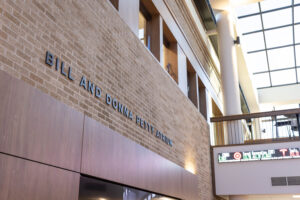
And that’s why Schubert, Petty and his wife Donna (Guinn ’64), ACU Dean of COBA Brad Crisp (’93), and numerous family and friends were on hand the Friday afternoon of Homecoming 2023 in the Mabee Business Building to celebrate the grand reopening of the Bill and Donna Petty Atrium.

Dr. Brad Crisp, Dr. Phil Schubert, Kelly Shewmaker, Bill and Donna Petty
The atrium renovation is part of a multi-million-dollar upgrade of the building that opened in 1986, allowing business classes to move out of the Hardin Administration Building and into a modern facility. The renovation project began out of the need to replace the heating, ventilation, and air conditioning system in 2020. Still, it grew to involve all major spaces inside the building – including classrooms, labs, offices, and the atrium, which reopened this semester after four summers of construction.
The Bill and Donna Petty Atrium features upgraded technology and appearance to better welcome students, faculty, staff, alumni, and business and technology leaders into the building and facilitate networking between these groups.
The atrium project was made possible thanks to a generous lead gift from an anonymous donor and substantial commitments from family and friends. It also received significant support during the ACU Gives event last April 25-26, when dozens of donors – many of whom the Pettys mentored – contributed an additional $100,000 toward the $1.4 million renovation.
 But the project got its push in 2020 when Crisp began meetings and conversations about the viability of raising the necessary money amid a global medical emergency.
“I vividly remember conversations with some of our key donors just as the pandemic hit in 2020, and I asked them if we should continue with the project,” Crisp said at the dedication ceremony. “And 18 families gave us the courage to fund the first phase and tell us it was time to move forward. Across the four phases, we had more than 280 donor families contribute more than $3.4 million toward the total cost of almost $9 million.”

The Petty Family
But when it comes to COBA and the Pettys, that should come as no surprise. COBA has been a catalyst for the remarkable growth of the university and its global reputation since the Mabee Business Building opened to students 37 years ago.
Petty was called back to ACU from Texas Tech in 1979 and became the founding dean of COBA in 1981. The newly formed college set up shop in the administration building, which hosted Bible classes and other programs at the time, putting available space at a minimum.
“We didn’t have room to grow, and it was limiting the number of students we could support,” Petty said in an article in the Spring-Summer 2023 issue of ACU Today.
That’s when Petty went to work, calling on friends and alums alike to raise the necessary money to build the Mabee Business Building. He has often given credit to Jozell Brister (’61), associate professor emerita of management sciences and former associate dean of COBA, and other dedicated faculty members.
But it was Petty who pushed, prodded, and cajoled to raise the money the university needed. The generosity of alumni and friends and a lead gift from the Mabee Foundation made the building a reality. And once the building opened, Petty, the faculty he hired, and the students he and other outstanding faculty taught helped propel the university to greater heights.
“Over the last 30 or 40 years, the College of Business Administration has been an engine for Abilene Christian University, fueling the trajectory of growth and escalation that we have enjoyed,” Schubert said. “That would not have been the case without the bold vision that Bill Petty brought to ACU, seeing all that could be in front of him with Donna by his side supporting him to bring that bold vision to reality.
 Another former student, Kelly (Stites ’91) Shewmaker, brought a calculator to the ceremony, the same one she used in Petty’s Financial Management class. The same calculator she thought would help her cruise through the course.
“I have this Hewlett-Packard 12C calculator that I used as a student,” she said at the ceremony. “I was convinced that it would be an easy A class after I found out you could calculate every answer to every question. But on the first day of class, Dr. Petty told us that for every test and every problem, we would be using the HP 12C. Then, we would have to calculate it by hand to show that we knew how to use the technology, calculate every problem by hand, and understand the calculations. I kept that HP 12C calculator as a trophy of sorts because I survived his class.”
In his brief remarks at the ceremony, Petty once again thanked Brister, his classmates, and friends Jack Griggs (’64) and Dr. John C. Stevens (’38) for persuading him to leave Texas Tech and return to ACU to be part of the business faculty. He also recalled the numerous times he and his wife hosted students in their home over the years, building the kind of relationships that would lead to two former students thanking him from the podium and many others attending the ceremony.
“I never felt more called by God than when I was called to return to ACU,” Petty said. “Those were 10 ½ of the best years of our lives. We raised our children in the shadow of ACU, and then they went to school here, so they have a deep love for ACU just like we do.”
And, it’s that deep love for ACU and sense of calling that Petty passed along to his students, including Schubert.
“I tell people all the time that I had the best experience anyone possibly could have had at ACU,” Schubert said. “I found people here at ACU, especially in the College of Business Administration, specifically people like Bill Petty, who saw things I didn’t see in myself. I found people who challenged me and encouraged me to be more like who God called me to be. My guess is that many others would tell the same story about the transformation that took place because they had people like Bill and Donna come alongside them and encourage them to be more like the people that God had called them to be. We’re all so incredibly grateful for them both. We’re grateful for their example of selfless service, amazing generosity, and bold vision to be more of who God calls us all to be.”
Note: Some information from this story appeared in the Spring-Summer 2023 issue of ACU Today.
