by Hanna Roberts | May 31, 2017 | Academics, Marketing, Student Spotlights
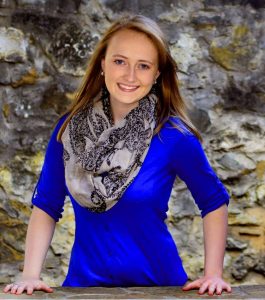
Our student spotlight this week is on Katherine Howell, a junior marketing major interning with a Financial Institution.
Katherine Howell is a junior marketing major from San Antonio, TX. This summer she has the opportunity to intern at a Financial Institution* and wanted to share about what she does and what she has learned so far.
Q: What have you done in your internship as of yet?
A: I am an IBM Marketing Operations intern for a Financial Institution. I have been learning the different marketing processes for each line of business (LOB; a general term describing the products or services offered by a business) at the Financial Institution. Soon, I will be helping IBM transition into new marketing roles for the Financial Institution
Q: What has been your favorite part?
A: My favorite part of working with the Financial Institution is learning the alliance LOB, which promotes the well-being of member households and provides support by leveraging relationships that provide value-added member solutions. I have also liked to see how the Financial Institution brands and markets with other companies.
Q: How do you see this experience aiding you in the future? What has grown you the most?
A: I have had to learn patience. It requires time to get used to how a company operates.
Q: What has been the most interesting aspect of your experience with this company?
A: It is interesting to me how the Financial Institution takes brand management very seriously. They have even outlined what the company would be like if it were a person!
*The name of the company at which Howell is interning has been removed due to client confidentiality agreements.
by M. C. Jennings | May 18, 2017 | Academics, COBA Faculty, Uncategorized
Each year, one ACU faculty member is honored as Teacher of the Year. This year’s honoree is COBA’s own Dr. Ryan Jessup, assistant professor of marketing. Jessup is a highly respected faculty member who inspired the following comments from his students:
- “He is a great teacher who cares so much about his students and wants them to succeed in all things.”
- “He’s the literal best #datamining.”
- “He truly wants to find ways to engage students in personal relationships and in class. It is not only about teaching content, but finding ways to apply the content in current ways to be able to understand and apply it in the future.”
Dr. Robert Rhodes, ACU Provost, said, “Ryan is one of the most dedicated faculty I have seen not only to his work but to his students as well. He’s very passionate about what he does and who he engages with.”
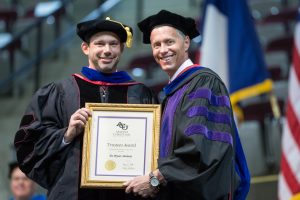
Dr. Ryan Jessup accepts the Teacher of the Year Award from Dr. Robert Rhodes, Provost
We asked Dr. Jessup a few questions about who and what inspires his teaching.
Who was your inspiration for teaching?
My mother was a wonderful, hardworking educator as a first grade teacher at a public school that served low income students. I think that I learned from her how hard it is teach and how hard it is to care about students. She did both and she did both extremely well. One thing I learned from observing and conversing with her was that when someone is poor and struggling to eke out an existence, education often takes a backseat to survival. I know that my mother labored long hours and she did it, not to receive recognition, but because it was the right thing to do. I thank God for my mom who set such a wonderful example in all facets of life, including her efforts to be an effective teacher even when it would be so much easier to take a shortcut.
What do you love most about teaching?
Undergraduates are special. They are bursting with potential, sort of like those little toy cars that you pull back to wind up – when you let go you never know where they’ll end up. Just like those toy cars, undergrads need to be carefully “aimed” so that they fulfill their potential while still maintaining integrity. It is our job to help aim the students, a responsibility I do not take lightly. It can be challenging and humbling because I make my share of mistakes, often causing me to ask “who am I to ‘aim’ these students when I am so filled with error?”
What is your teaching philosophy and what do you hope students learn from your classes?
It pleases me when an individual begins to understand and grasp concepts, and I dedicate myself to producing such attainment in my teaching. Similarly, I desire that attentive and hardworking students complete my courses with well-founded confidence in their course-related abilities as they apply them to the real world.
Substance not hype
I recently had a conversation with a faculty member in my department in which we were discussing a corporation, and I stated “they are all hype, and I don’t like it.” The faculty member replied “well, it is a good thing you do not teach marketing classes, then”, using sarcasm to humorously imply that marketing is mostly hype. Initially befuddled by his comment, I replied “But I do not teach marketing from that perspective – I want students to learn to sell and market their products with substance and honesty, not hype.” Since coming to ACU to teach marketing this has been one of my touchstone principles: marketing can be based on substance and is not merely an academic synonym for hype. So, I have striven to teach students that they should not rely on hype as their preferred tool of persuasion.
Natural consequences of behavior meets meta-learning
I love sports. However, my first semester as an undergraduate at ACU, I (and my teammates) forfeited every intramural sport in which we competed: flag football, soccer, and ping pong. I never did it again, but why did I do it the first semester? In retrospect, I suspect that it was because my parents always insured that I was at games, thus I had not yet learned personal responsibility for showing up on time. However, the natural consequences of my behavior – not planning sufficiently well and thereby forfeiting each competition – soon taught me to adapt. Similarly for today’s college students in the classroom: many of them need to learn how to learn, whether by learning to not be distracted by devices or learning to show up to class. This meta-learning is essential for growing up. I want them to learn to learn. If someone always correctly decides for them during college then they will be forced to learn to decide correctly in the real-world where the safety net is far less secure. So, I often allow students to experience the natural consequences of their decisions in order to encourage this meta-learning. I tell them on the first day of class that (1) college is an opportunity to learn that they must seize and (2) it is a safe place to fail — but they should always try! If they fail or do poorly in my class, I don’t “fire” them; I’ll even give them another chance to learn, even though it may take two or more semesters!
Emphasize connections with what they already know
Learning can be intimidating. When a student encounters a challenging course, led by a teacher with high expectations, it can even feel overwhelming. One component of my philosophy of teaching is to first remind students what they already know in order to induce connections with the new things they are learning. The reasoning underlying this is the associative network model of memory (Wickelgren, 1981). According to this theory, our memories are stored using a distributed network of neurons and when one element is activated (e.g., McDonald’s), closely connected nodes are activated as well (Big Mac, Hamburglar, fries, kids, fast food, etc.). I try to first connect into their existing associative network and then build onto it the new information and ways of thinking which I am trying to convey.
Allow research experience to enhance my teaching
Lastly, I have striven to allow my research experience to improve my teaching. I think that conducting research is a true asset to teaching because it provides real experiences in interpreting and critiquing information that are hard to obtain if one has never been out on the research frontier. For example, I try to convey a healthy skepticism of data and research findings in every class I teach. I often encourage students to contemplate the potential flaws in the studies we examine. I try to rarely teach things as fact, but, rather that these are research findings or this is a theory about human behavior. I think I am benefited in that I teach research classes, yet even the field of education (i.e., teaching) strives to train teachers to use research-based strategies, indicating a shared recognition of the value that research lends to teaching.
Congratulations to Dr. Ryan Jessup on being named ACU’s 2017 Teacher of the Year!
by M. C. Jennings | May 8, 2017 | Academics, COBA Faculty, Current Students, Faith Infusion, School of Information Technology and Computing, Uncategorized
What is your educational background?
- BBA in Business Computer Information Systems, UNT cum laude
- MS in Information Technology, UNT

Karen St. John
What is your work background?
- Worked as an Academic Advisor – ten years both graduate and undergraduate
- Computer Audit Specialist training for IRS/ Treasury department for seven years
- Started teaching at the University level in 2009
What do you teach at ACU?
Information Technology courses: Scripting, Networking, Database Administration
What committees/other duties do you have at ACU aside from teaching?
- Board member for family business – Pinecrest Cemetery in East Texas
- Wife, married 17 years (18 this May)
- Mom to six kids

The St. John Family
What drew you to teaching? Why did you want to work with students?
I have always loved to learn as much as possible. Working with students is enjoyable and rewarding.
What’s the best part of working with students?
Taking an intimidating concept, breaking it down and explaining it, and watching students have the “lightbulb” moment when it clicks.
Have you ever given up any big opportunities to keep working with students?
Turned down opportunity to work at a major bank doing anti-money laundering.
Outside of teaching, what passions and hobbies do you have?
I love to cook. We live in the country and have chickens, sheep, goats, and cattle.
Tell me about a project or accomplishment that you consider to be the most significant in your career.
I was recognized by the Treasury department for my contribution and efforts in working with the Regulatory Audit division, which was nice. However, I am most proud that I have balanced having a big family with my career. Most of the women I went to school with had to choose one or the other.
Who is your role model, and why?
I think my Dad is my biggest role model. He has a strong work ethic, is smart, unselfish and one of the best examples of what a good Christian looks like. His professional career was that of a programmer and database administrator. He has been a song leader at church for as long as I can remember. He has been happily married to my mom for over fifty years.
Who was your most inspirational professor and why?
I was incredibly fortunate to earn my degree at UNT. I had several professors that taught me important lessons that I try to pass on to my students. Dr. Steve Guynes taught me that the way to look good is to make everyone around you look good.
What is something that students might be surprised to find out about you?
I learned handwriting analysis for a project in a government class once. And I am colorblind.
What would you really want students and alums to know about you?
I feel incredibly blessed to be working at ACU. I love to come to work every day! The students are fantastic. The faculty and staff are wonderful to work with.
by M. C. Jennings | May 3, 2017 | Academics, Accounting, COBA Events, COBA Faculty, Current Students, Faith Infusion, MAcc, Uncategorized
COBA honored the MAcc (Master of Accountancy) class of 2017 at a luncheon on Tuesday, May 2nd that was sponsored by PricewaterhouseCoopers (PwC).

Amanda Stephens receives MAcc award from Dr. Curtis Clements
Amanda Stephens was named the Outstanding MAcc Graduate of the Year. As an undergraduate student, Amanda majored in Accounting with minors in Spanish, Sociology, and Public Service. Amanda will start full-time in January with Whitley Penn in its Forensic, Litigation, and Valuation Services Department.
-

Chris Baker
Chris Baker, partner with PwC and ACU alum, addressed the graduates and encouraged them to live a life of authenticity and integrity in all that they do. He also impressed upon them the need to give back to the world around them.

Dr. David Perkins
Dr. David Perkins gave a blessing over the graduates, reading Deuteronomy 8, and exhorting them to never forget the Lord, live humbly and remember that everything has been given to them by God – including their abilities.

MAcc Class of 2017
Graduates, your adventure begins now. Congratulations to the Master of Accountancy graduating class of 2017!
To download and/or order prints of pictures from the luncheon, click here.
by M. C. Jennings | May 2, 2017 | Academics, COBA Events, COBA Faculty, Faith Infusion, School of Information Technology and Computing, Uncategorized
On March 27th, COBA hosted Visiting Committee and Dean’s Council members on campus. The Visiting Committee provided feedback on each academic program to help evaluate and improve the learning experience for each major. Thirty-three alumni with careers in various disciplines traveled across Texas and represented accounting firms, Fortune 500 companies, fast-growing startups, and nonprofit organizations.
Because of the diversity of industries and career experience among our alumni, COBA was able to obtain a wide range of insight. Tim Johnston, Assistant Dean, stated that “The visiting committee was pleased to hear that ACU has sustained our long-standing advantage of personal attention and instruction by professors who excel in their discipline and are committed Christians.”
The visiting committee reviewed business and technology degree plans, met with students, talked to faculty members, and offered their recommendations for improvement in all areas of the student experience. This helps keep COBA in-tune with the expectations that employers and companies have for our graduates, and helps us clarify our priorities and goals. The members are deeply committed to the mission of ACU, Business and Technology education and their advice will strengthens our strategic plan.
The visiting committee talked to students directly about their experiences in COBA. The most outstanding aspect of COBA, according to the students, was the personal attention received from prepared professors who care about their scholarship and students as individuals. Leah Montgomery, junior marketing major, had the opportunity to talk with committee members. Montgomery values “being included in the conversations about our classes and majors” and appreciates COBA’s measures to include and place weight upon student input.
The visiting committee also met with students to network at a root beer float mixer held in the COBA atrium. Students were able to meet with professionals in their field, ask questions about careers and opportunities, and solicit advice from our experienced alumni. Bethani Culpepper, sophomore management major, said that she “received valuable advice from accomplished and professional individuals who have been in her shoes” and that the networking event was her favorite part of the day.
COBA would like to thank the Dean’s Council and Visiting Committee for giving of their time and talents to help us continue to improve and provide distinctive offerings to current and future students.
by M. C. Jennings | Apr 27, 2017 | Academics, Current Students, Faith Infusion, Uncategorized
Chris Kirklin, senior financial management major from Richardson, TX, has been very active on campus during his time at ACU. Among some of his accomplishments, he has served as the 2016-17 president of men’s social club, Trojans, has been part of A Cappella, and has worked in the COBA Dean’s Suite. Chris is not only an exceptional student – he is an exceptional human being. He was matched through a drive on the ACU campus to add new bone marrow donors to the national bone marrow registry. We hope when you read his story below, you’ll consider registering or giving to this organization to help save a life.
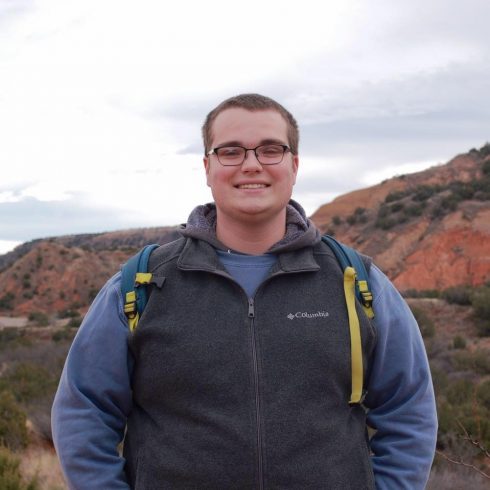
Chris Kirklin
Let’s start from the beginning – how did you find out about Delete Blood Cancer and what motivated you to sign up? How did you sign up?
I have known Earl Young for several years, since he goes to my church in Dallas. Earl came to ACU to speak in Chapel about registering to be a donor in April of 2015. I remember sitting in that chapel and not paying much attention because 1) I already knew everything about his organization and 2) I was very burned out as the semester came to an end. I left chapel in a hurry and cut through the campus center to make it to class. One of my nursing friends was running the table to swab and sign up to be a donor. Selfishly, I tried to walk as fast as I could so I would not have to stop and register. But she screamed my name across the campus center and summoned me over to register. Looking back on this experience, I have realized how close minded I was. I was almost too selfish to take literally 2 minutes out of my day to register to save someone’s life. This totally changed my perspective on how I focus on “giving” to others.
How long after signing up were you contacted by Delete Blood Cancer asking you donate?
I swabbed in April of 2015, and was called in January of 2017 by the organization DKMS, which runs the Delete Blood Cancer campaign.
What was the donation procedure like? Did anything about it surprise you?
When DKMS calls you for the first time, you are listed as a preliminary match. After a lot of paper work and more detailed blood tests, about a month later I was notified that I was a perfect match for the patient. I did some more paperwork, and made a trip to the donation center to get a physical exam done, before my donation. The week of my donation, I received an injection called filgrastim, which serves to boost stem cell production so there is plenty to extract at the day of the donation. About two and a half months after I had first been contacted, I donated my stem cells. It took about 5 and a half hours to extract all that they needed for the donation.
Can you describe the pain or sensation for the couple of days after the injections and donating itself?
Leading up to the donation, I was in a lot of pain. I had the worst headaches I had ever had in my life, which prevented me from doing daily activities. I felt fatigued and achy (all from the injections). I began to get frustrated with how I was feeling, and remember having the feeling of “I just want this all to be over”. But that was not the point. None of this was about me. This was about God making it possible for someone to give life to someone suffering. None of the pain I was going through that week was near as great as my match.
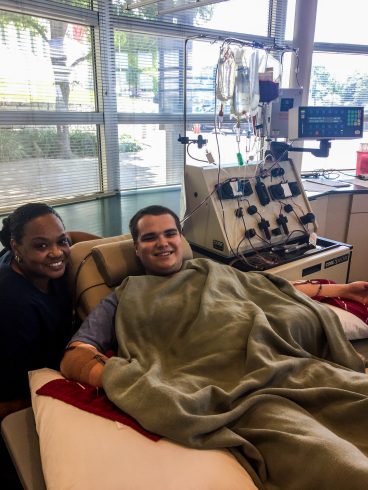
Chris and his nurse pose for a pic during the donation process
How much inconvenience did the whole process cause you?
As I touched on in the previous question, there were definitely some days where I was having a bad attitude about the whole process. But in the grand scheme of things, this was such a simple and easy process. I was able to keep on track with my schoolwork and job, all while going through the process.
How were you treated by DKMS?
DKMS does an exceptional job of treating the donors well. Every time I spoke with them on the phone or had some sort of communication with them, they were extremely helpful and thankful for my time. They provided lodging and meals for my travel expenses, and made me feel extremely prepared for the donation.
Have you met the person who received your stem cells? Would you like to meet them?
I have not met my match yet. I will not be able to for several years, and I definitely want to meet them! I hope they will want to meet me as well. I also will not be able to know if the donation was successful until about halfway through the summer.
How did your friends and family react when you were asked to donate?
They were amazed and very supportive of me. I also had a few other friends that were matched as donors who reached out to me.
Was there anything about this experience that surprised you? Anything it made you realize or look at in a different light?
The most important thing I learned throughout this process is that we are called to be the hands and feet of Jesus to everyone. I still am almost “haunted” that at a time I almost didn’t register to be a donor, because none of this would have happened. This donation process made me realize that I can be extremely selfish at times, and that is not how Jesus was to others. I need to give, in any way that I can, to help further the Kingdom and glorify God. This process has changed my life in such an amazing way. I feel like I see God working in so many more ways now than I did before.
What would you say to anyone considering registering for the Bone Marrow Registry?
There is no reason that we can’t at least try to help someone in need. Less than 1% of registered donors ever get contacted, but just the fact that you are willing to be there for someone in need is so powerful. I can’t think of any easier way to save someone’s life than being a part of the Bone Marrow Registry. There are so many sick people out there who have very little hope at life, and they would cherish forever the opportunity for someone to give them a second chance at life.
Anything else that you would like to add about your experience?
I hope others read this story and are able to see that I am a normal person, who had reservations about registering, and am in no way perfect. I never would have thought that I, out of the millions in the registry, would be the ONLY match for someone with blood cancer. There is nothing to lose by registering, and you never know how God could be calling you to give, even in an unexpected way.
