So you just checked out one of the Learning Studio’s Canon DSLR cameras, and you go to shoot your first short film. But the process is a little trickier than you expected.
DSLRs were originally built for still photography, but today many of them also shoot video, and they’ve been prized by filmmakers for the quality of the images they produce. Yet shooting video on a Canon 60D isn’t quite as intuitive as shooting photos.
In our first installment of the Gear Up series, the Learning Studio’s Nathan Driskell gives you a three-minute checklist to get you up and running with video production using the Canon 60D.
For more advice on shooting with your DSLR, stop by the Learning Studio and ask a Media Assistant for help on your next project.
.
DSLR Filmmaking on Lynda.com
Once you’re comfortable with how to set-up the camera, check out a course on Lynda.com to continue to develop your skills.
This year student filmmakers involved in FilmFest had the opportunity to work with DSLR cameras with HD video provided by Canon. The Learning Studio managed checkouts for a wide variety of camera bodies and lenses, including Canon’s popular 5D we discussed in a recent post.
Friday night at a premiere event at the historic Paramount theater winners were announced.
“Hazel & Jack,” directed by Lawson Soward and produced by Caitlin Bardford, took home awards for Best Picture, Best Director and Best Producer.
“Smile,” directed by Ben Weaver and produced by Nathan Vail, earned the People’s Choice Award and Best Original Composition.
“The Reunion,” directed by David McMichael and produced by Trevor Cochlin, won Best Independent Film.
The screening also included Best Picture for last semester’s 24-hour FilmFest, “Pages,” directed by Jordan Havens and produced by Ben Weaver.
Then on Saturday a panel of guest judges met with students to provide feedback on each film as well as share their experience in the entertainment industry. Thanks to the judges for taking time to join us and to Tom Craig and his student production team for putting on a remarkable event.
And thanks to Canon for providing equipment that challenged our students to produce a higher caliber of work this year.
For those looking for help on shooting and editing their first video, Vimeo has put together a series of shorts introducing basic concepts, including selecting gear, shooting, editing, sound, and software.
The last year has seen an explosion of indie filmmaking on new hybrid cameras that bring HD (1080p) video to the digital SLR still camera. DSLRs have significantly larger image sensors than most pro-sumer video cameras and already work with a wide-range of lenses that bring the cinematic quality of shallow depth of field and low-light shooting to a growing number of HDSLR professional and aspiring filmmakers.
Vincent Laforet is photographer and commercial director out of LA who has produced some exciting work on Canon’s 7D and 5DmkII. Nocturne and Reverie were two early films that set off much of this early excitement.
A clear example of how much this community has grown in the last year is The Story Beyond the Still contest, hosted by Canon and Vimeo. Laforet was commissioned to shoot the first short film (2-4 minutes) entirely on HDSLR cameras telling the first chapter in a story that would then be continued over several months by other filmmakers. The Cabbie was Laforet’s prologue. The contest page below links to the winners and finalists of each of the following weeks.

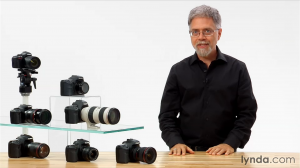 Once you’re comfortable with how to set-up the camera, check out a course on Lynda.com to continue to develop your skills.