by Hanna Roberts | Oct 12, 2018 | COBA Events, Distinguished Speakers Series, Faith Infusion, Special Speakers, Uncategorized
Last week, COBA partnered with the Lytle Center for Faith and Leadership to host our annual Distinguished Speaker Series. We were honored to have Horst Schulze as our guest this year. Schulze was born in a small German village and knew he wanted to work in hotels at age 11. He left home at 14 to be a busboy and the rest, as they say, is history. Schulze spent nine years with Hyatt Hotels Corporation before becoming a founding member and president of The Ritz-Carlton Hotel Company. After resigning from The Ritz-Carlton, Schulze is now the chairman and CEO of Capella Hotel Group, an ultra-luxury hotel chain. 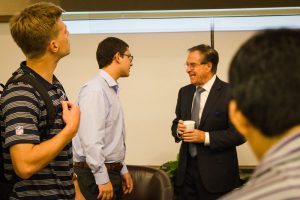
Schulze spent his time in Abilene connecting with students, faculty and staff, and community and university leaders conversing about exceptional customer service and what it means to be a leader striving for excellence. He shared stories from his years in the hotel industry and the absolute importance of having a vision and a purpose. Schulze advised that the steps to success are vision, commitment, and initiation. You must have a dream, a vision, to guide what you do and define what you are working toward. The dream becomes more than just a dream when you commit to it and decide to carry it out. Carrying it out entails taking the first step, initiating, and persevering to make the dream and vision a reality. Especially as a leader, the vision is very important and gives meaning and information to everything you do. According to Schulze, being a leader implies that you have something in your mind that you are bringing people to. People respond not to rules and orders, but to objectives and motives. Schulze shared that he thought it was immoral to hire people to fulfill functions; you hire people to join the vision and become a part of the dream.
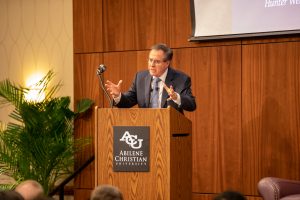 Schulze also spoke about a seeming contradiction: what it means to be the best in the world but to live a life as Christian where we are called to not be of the world. In scripture, we are consistently reminded that our citizenship is in heaven, how we should not conform to the world, and how it is likely that the world will hate us because we are not of it. This leaves many questioning how can we be in the world, but not of the world. Schulze shared how he struggled with working in the luxury hotel business and wanting to create the very best hotel in the world, but not being sure how that connected with his calling as a Christian. He then realized that this was an opportunity to be an example and show the kingdom to the world. It all connects back to Schulze’s personal vision for his life: to be excellent in every role he fills. Excellence in how he treats and grows his employees, excellence in serving customers and shareholders, excellence in every aspect of his hotels points back to Christ. Creating the best hotel in the world sets his hotels apart and creates an example for others. Schulze believes that if we are not living with a mission to be excellent and not using our God-given gifts and abilities, then we are not fully living in every way we can for Christ. Being an example of excellence while living for Christ allows others to see Him through you and points people back to Him. Scripture also reminds us that being holy implies being different and unique. By being excellent, you are set apart like we are called to be.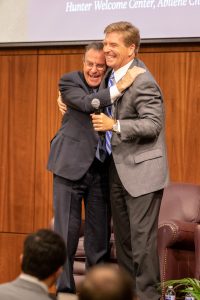
Schulze’s messages were eloquent, inspiring, and convicting. Below are some of the testimonies that students shared after listening to him:
“This was the best part of my entire semester. I heard him in the morning and at the luncheon and wish I could have had him in all of my classes. I have a renewed commitment to living out my calling with Christ.”
“Horst made me grateful to be at ACU. I never realized how special this place was until I heard this accomplished man come to us and tell us that we bring him hope by what we do and how we aren’t ashamed of Christ.”
“The way he stayed consistent with his vision over his entire career is so impactful – I just want to live better after hearing him.”
“How often do you hear about someone who worked their way up from washing dishes and busing tables to running the #1 hotel brand in the world? This means we have to start being our best right now, where we are.”
It was our pleasure to have hosted Horst Schulze this year. To view pictures from the DSS luncheon, click
here.
by M. C. Jennings | Sep 14, 2018 | Academics, COBA Faculty, Current Students, Faith Infusion, Social Entrepreneurship, Student Spotlights, Uncategorized
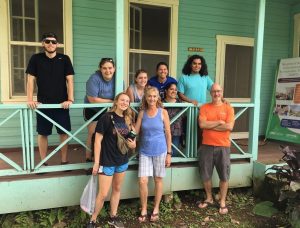
COBA professors and students were world travelers this summer, as we have covered in parts 1 and 2 of our blog series on our study abroad trips. This July, professors Laura and Mark Phillips took students to Central America where they received course credit in MGMT 419 (Global Entrepreneurship) and MGMT 340 (Fundamentals of Life Design). We asked Dr. Laura Phillips to tell us about their experience. We hope you enjoy the third installment of our four part blog series on the 2018 travels of the COBA Study Abroad program.
What made Central America a unique place to study?
Central America is a unique place to study Global Entrepreneurship because while the culture, laws, and economic environment are different from the United States, Central America is a place with lots of start-up businesses. Also, the people are very hospitable which makes visiting start-ups easier. In addition, Central America is small geographically but the different countries are unique. Some of the challenges of starting a business in Costa Rica are different from the challenges of starting a business in Honduras. Finally, we were able to see first hand how the government can drastically alter the business environment; the recent unrest in Nicaragua is an unfortunate example of the instability inherent in emerging economies.
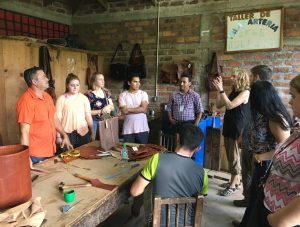
What businesses were you able to visit?
I’m not even sure where to start here. I guess I’ll just make a list.
San Jose, Costa Rica
- Yuxta Energy–solar energy
- e.e.d.–legal services for social ventures
- VivaIdea–a think tank for increasing the impact of entrepreneurship in Latin America
Guanacaste region
- Vida Adventura–adventure camp
- Hotel Las Tortugas–small private hotel in Playa Grande
- Taco Star–taco shop on the beach
Sarapiqui region
- Chilamate Rainforest Eco Retreat
Turrialba region
- CATIE University and the Sustainability House
- butterfly farm
- dairy/cheese making business
- beneficial plants business (medicinal, herbs, etc.)
- pueblo tourism business
Honduras
- Mission Lazarus–here we also
- made organic fertilizer
- conducted a half day training session for the students and teachers at the vocational schools on basic business topics
- hardware store
- bootmaker
- trash collector/recycler
- restaurant owner
- coffee farm/barber shop/tienda owner
For the most part we visited with the entrepreneur (or an employee for the larger organizations) to learn about what they do, what the biggest challenges are, how/if they plan to grow, etc.
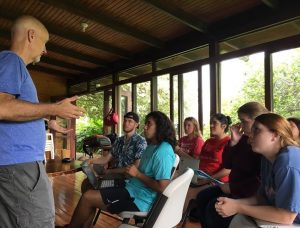
Did you take the students on any sight seeing tours?
- Walking tour of San Jose
- Ziplining at Vida Adventura
- Horseback riding at Vida Adventura
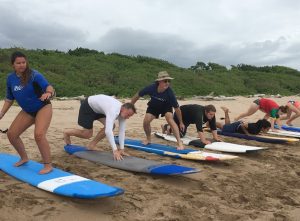
- Surfing lessons at Playa Grande or
- Canoeing on the estuary at Playa Grande
- Birdfinding nature walk
- Hike to waterfall and swimming
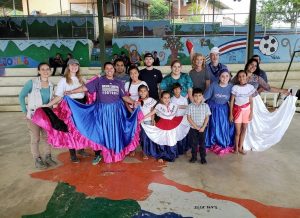
- Cultural scavenger hunt (milking cows, Latin dancing, making tortillas, etc.
- Archaeological tour
The students enjoyed the sightseeing activities. They were a lot of fun.
What is it like to be able to spend so much time with students in another country? How does it differ than being in a classroom setting in Abilene?
This particular study abroad is different from going to Oxford or Leipzig because we really are all together most of the time. There were even a couple of places where we stayed in one big house. It’s very different because in Abilene you are with your students in class and then they do their own thing the rest of the time. On this study abroad we usually eat together, we travel together, we spend much of our free time together, plus we have class together. You really get to know each other and, as the students said, you become more like family.
What were your favorite moments/experiences of the trip?
Well, I love the fact that we are outside so much and that even when you are “inside” you are usually outside. In many ways life is harder but in many ways it’s simpler. The pace of life is slower and the people put more emphasis on relationships than on to-do lists. Most of our students found the Latin pace therapeutic. There were many great experiences but one of my favorites was going in the butterfly house. The house was full of flowers and the butterflies seemed like flying flowers. It was beautiful.
I also loved watching our students conduct the business training for the people at Mission Lazarus. That activity was a real challenge and stretch for our students, especially since we were having to work through a translator. They students rose to the challenge and did a fantastic job!
If students could only learn one thing, what do you hope they learned?
I would want our students to learn that people are people everywhere; we are more similar than we are different. I would want them to learn that there are business opportunities everywhere but that to be successful you MUST know the culture and context of the place in which you are operating. I would want them to know that the fast-paced, individualistic, climb to the top American business style is not the only way to live. I would want them to know that being happy and being successful are not directly tied to a salary amount or prestige. (So…that’s four things, but they are kind of related.)
by M. C. Jennings | Aug 20, 2018 | Academics, COBA Faculty, Current Students, Faith Infusion, Uncategorized
This July, the COBA classroom moved around the world to Leipzig, Germany with professors Don Pope and Dennis Marquardt leading the way. Students received course credit in Cross Cultural Organizational Behavior and Global Operations Management. We asked Dr. Pope to tell us an overview of their trip. We hope you enjoy the second installment of our four part blog series on the 2018 travels of the COBA Study Abroad program.
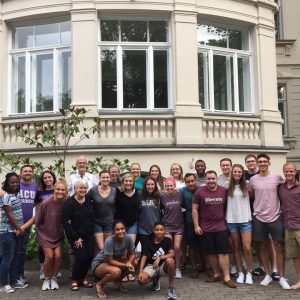
The group poses in front of their home away from home in Leipzig
What made Leipzig a unique place to study?
Leipzig is a mid-sized German city with a long and proud history. It is not a tourist destination. You would have to search for a souvenir shop. It is historically important because it was the home of Bach, among other well known German musicians and writers. Martin Luther lived in the nearby town of Wittenberg. Leipzig was the center of the ‘quiet revolution’ uprising that brought down the iron curtain in 1989. The German language adds a dimension to a study abroad experience that an English-speaking location cannot provide. But, enough English is spoken to allow one to get around without great difficulty.
Were you able to visit any companies or work on projects with companies in other countries?
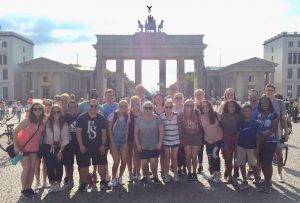
At the Brandenburg Gate in Berlin
We toured the BMW assembly plant in Leipzig which is very modern, is automated, and operated with great German efficiency and attention to sustainability.
Did you take the students on any sight seeing tours?
We took the students to visit Wittenberg where Martin Luther nailed his statement of protest to the church door 501 years ago, at great personal risk to his life. We also did a group tour of Berlin and many of the sites there, including the Berlin wall and memorial museum for Jews who lost their lives in the Holocaust. We traveled to Weimar and the nearby site of the World War II Nazi concentration camp, Buchenwald. We saw a place of great horrors and felt the weight of the suffering that occurred there. We saw the 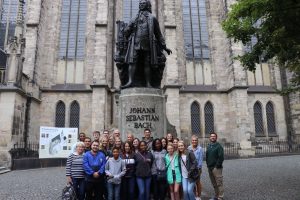 ovens that burned the bodies of those killed, the hooks on the walls where people were hung, the shoes of the victims, many of them children. We saw the memorial to the living – those who survived. The memorial plaque is simple in design, and heated to a living temperature of 98.6 all through the cold winters.
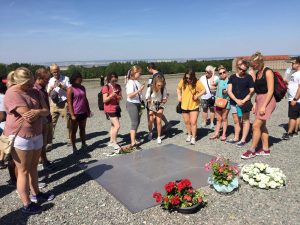
Visiting the Buchenwald Concentration Camp Memorial
What is it like to be able to spend so much time with students in another country? How does it differ than being in a classroom setting in Abilene?
Spending time in other countries helps to open your mind, eyes and heart to the world and appreciate the lesson that God tried to each Jonah long ago – that He loves and cares for all people everywhere.
What were your favorite moments/experiences of the trip? 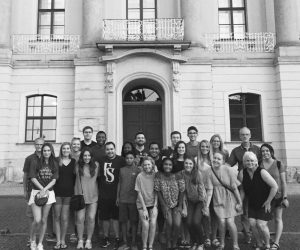
The trips mentioned above, and getting to hang out with the students and get to know them better.
If students could only learn one thing, what do you hope they learned?
That the world is a much bigger place than the little bubble that most of us live in, and that we need to learn to live and function in a global community.
by Hanna Roberts | Jul 23, 2018 | Current Students, Faith Infusion, Student Spotlights, Student Spotlights
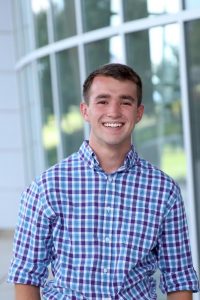
Zach Fetter (’19)
Zach Fetter is a senior with majors in finance and youth ministry from Charlotte, North Carolina. This summer, Zach is an operations intern at Hill Country Bible Church in Austin. As the fiscal year starts on September 1st, leaders across the church have been building budgets for their respective ministries. Zach has met with more than fifty leaders to work through and approve their budgets in preparation for the new fiscal year. He is helping build a projection for the church’s giving numbers for the next year and will present those to the executive pastors and elders. Zach is also in charge of implementing new goal software for the staff that will lead to the improved alignment of the church’s goals from top to bottom.
Through these projects, Zach has been able to learn a lot about how the church operates and its responsibility to be faithful stewards of the money that congregants give for ministry. He has also made strong connections with those around him. Zach’s favorite part of his internship so far has been meeting with the leaders for budget reviews. “Sitting down and talking one-on-one with each leader has given me so much experience in learning how the church stewards money,” says Zach “I hope that this knowledge will help me to confidently and strategically lead a church towards fiscal responsibility one day.”
Zach has also had the opportunity to receive feedback in a job that has helped guide how he approaches his day-to-day. Every week, Zach has a one-on-one with his boss, one of the church’s executive pastors. These one-on-one meetings have grown him the most this summer, both spiritually and professionally. In those meetings, Zach is commended for what he has done well but is also guided through areas in which he can improve. Zach has taken the advice very seriously and applies it to his job and life, as he knows this feedback will help him become a better leader of a church someday.
One thing that has struck Zach in his time at Hill Country Bible Church is the wholehearted submission to God that is evident in every staff member and in the church overall. “The one thing that has been crucial to everything I have done in my internship has been a reliance on God,” says Zach. “The way that the leadership of the church relies on faith and prayer is evident.” Zach has learned that the church could not conduct their business as effectively as they do if they did not consistently give up control and wait to see what God will do through their organization. This is a principle that he believes goes beyond Hill Country Bible Church and his internship and is something that he will remember and apply when he returns to Abilene and for the rest of his life.
by M. C. Jennings | Jun 28, 2018 | Academics, Current Students, Faith Infusion, Social Entrepreneurship, Uncategorized
Students often take advantage of summer courses to receive credit in a compressed amount of time and effectively use block tuition. Those summer courses can sometimes be a little more creative in the way they are taught – even in deciding the location for the class. MGMT 320: Social Entrepreneurship is no exception to that rule. Social Entrepreneurship is taught at City Square in downtown Dallas by Dr. Laura Phillips over the course of five days. Business students are not the only students who take the class. Phillips says, “The social entrepreneurship course is appropriate for business majors and non-business majors alike. We’ve had students in the class who are studying art, English, architecture and political science – just to name a few. It’s also relevant for students at different points in their academic career. I’ve had students who just finished their first year of college in the class as well as students who are taking it as their very last class. It may seem overwhelming to squeeze an entire class into a week, but it’s an engaging and inspiring week!” We asked a couple of the students who completed the course to tell us a little about why they chose to take the class and what they took away from the week.

Ashleigh Price (’18) management major from Sunnyvale, Texas said, “I had one more class I needed to take to complete my degree and was really looking for classes in that last semester that focused on the field I wanted to go in to – poverty and development. It was convenient since I lived in Dallas and I had heard so many great things about it, so I jumped on it!” Jordan Eason, senior accounting major from Keller, Texas said, “I had always wanted to take this class, because I had heard from others that it was a great class. I am also very interested in social entrepreneurship from my time volunteering with various non-profit organizations.”
Tell us a little bit about the format of the class. What was a typical day like?
Jordan: “In the class, we had a lot of guest speakers come to us but we also went on field trips to businesses, too. A typical day included hearing from guests and then engaging in a lot of discussion to process what we were learning.”
Ashleigh: “There is no such thing as a typical day! Every day is special in its own way. The first and last days included a few speakers but we were also taking care of administrative tasks and assignments including group work. On Tuesday through Thursday, however, we had a networking lunch (Tuesday) and breakfasts (Wednesday and Thursday). We were able to sit down with the guest speakers and talk about our passions. We were also able to hear the coolest testimonies of business owners and people who are in prominent positions in large companies like Southwest Airlines and HKS. Every day, we had additional speakers along with the networking. In those sessions, we heard about real life situations and learned applicable skills to apply to our potential business models.”
Cafe Momentum
Tell us about some of the speakers and/or experiences that stood out to you?
Jordan: “We visited a restaurant in Dallas called Café Momentum and heard from the entrepreneur that started it, Chad Houser. At his café, he employs and trains teens that have been in juvenile detention. His hope is for them to be placed in a job and leave the café once they finish the program. We actually were able to eat at the restaurant, which was named one of the top restaurants in Dallas. It was great to hear him talk about his mission and the passion he had for what he was doing.”
Ashleigh: “One of my favorite speakers was Todd Spinks who works for Southwest and possessed a love for people, wanting to unite them to work for good. Another was Chad Houser who runs Cafe Momentum which helps to rehabs kids, get them jobs, and gets them off the streets. There were others that I loved (and honestly all of them were really great) but these two people had a lot of impact on me.”
What was your favorite thing about the class?
Jordan: “My favorite thing about the class was getting to have conversations with the guest speakers. On two of the days of class, we were able to have breakfast with them. There was one guest to a table of 3-4 students, so we were able to have great conversations and ask them questions. The guests were all so kind to take that time out of their day to talk with us.”
Ashleigh: “The connections made and the subjects talked about – any and all things having to do with social enterprise.”
What surprised you the most about the class or any of your experiences in the class?
Jordan: “I learned a lot in this class, specifically of ways to help people without hurting them. It was surprising that different ways of poverty alleviation were useful in certain areas but not in others. We really learned how there is not a one size fits all solution and that was echoed by speakers through the week.”
Ashleigh: “I was expecting it to be a lot of work but it wasn’t like that at all. It was constructive and thought provoking. It reminded me a lot of Leadership Summit. It was basically a mini LS but it focused on doing good rather than leadership.”
Ashleigh went on to say that the class has, “Changed how I view poverty and what people in those situations need versus what I think they need. They know what they need better than I ever could. It showed me how much more diverse I need to make my friend circle. The class also confirms my love of this career path and it has given me tools to use in the future at either my own business or in a position with a company or organization.”
Social Entrepreneurship at CitySquare is pushing students to think outside the box and time again, they state how much they love the class. How about the professor? We asked Dr. Phillips a few questions about the course as well.
What is your favorite thing about teaching the class?
Dr. Phillips: “Almost every day one of the students makes a comment to me about how a particular speaker or a field trip has ‘blown their mind’. I think that’s my favorite thing about teaching the class. Some students are blown away by the inequalities that exist around them that they’ve never noticed before. For some students what blows their mind is the variety of creative ways people are using their business to achieve social impact in their community. For other students the most eye-opening aspect of class is the wide variety of backgrounds our speakers come from – the fact that there’s not a prescribed path to social entrepreneurship. I love being able to sit back and watch their eyes open up to a whole new world of possibilities.”
I know you have many speakers that come in to talk to the students. Who are some that have made a big impact on the students?
Dr. Phillips: “This question is hard to answer because the students have different favorite speakers. That’s one of the nice things about bringing in a wide variety. While they may appreciate and learn from all of the speakers, students typically really connect with a handful of our guests and who that is varies from student to student. A couple of speakers who are perennial favorites are John Siburt, President and COO of CitySquare, and Chad Houser, CEO and Executive Chef at Cafe Momentum. Both are charismatic, innovative, and inspiring and they motivate the students to have big dreams.”
What do you hope students will take away from the class?
Dr. Phillips: “I hope that students will leave class with the understanding that they can choose to do good through their business regardless of what that business is. I also hope they leave class with a set of tools and contacts that make them feel empowered and capable of launching a social enterprise – maybe soon, maybe not for 20 years.”
The College of Business seeks to inspire, equip, and connect students to honor God and bless others. We can’t wait to see what these students do to change the world. Any student wanting to learn more about the next offering for MGMT 320: Social Entrepreneurship can contact their academic advisor or Dr. Laura Phillips.
by M. C. Jennings | May 29, 2018 | Academics, Alumni Spotlight, College Decisions, Faith Infusion
Phil Garcia graduated from ACU in 1999 with a degree in marketing. We asked Phil to reflect on his time in the College of Business and asked how that shaped his life post-graduation. Phil said, “The most fundamental thing I took away from ACU is my Christian faith. I did not arrive at ACU with a relationship with Jesus Christ, but I was very quickly influenced by the Christian friends and professors who took time to get to know me. Being a Christ follower is core to everything that I do. My faith has allowed me the success I have because I am genuine and ethical with all of my business practices. Both clients and co-workers know that I am real and I care about them outside of our work relationship. I believe many of my professors showed me what humility and authenticity look like by the way they worked with me and lived their lives both on and off campus.”

Phil Garcia
In his work as a Senior Vice President in investments, he provides professional asset management and consulting for client’s investment portfolios. His clients are business owners, corporate executives, foundations/endowments and retirees and Phil finds great joy in helping clients reach their goals and funding a lifestyle that they’ve grown accustomed to. Phil believes that being a Christian creates positive occasions for him to live out his faith with his work. He says, “It encourages me to be humble, allows me to give grace and mercy to those around me, and creates authentic relationships. Being real and vulnerable with people has opened many doors and created great business opportunities. My authentic relationships have created clients and friendships that have become like family, and much of my business growth can be attributed to referrals from these clients.”
Phil says that students need to know that business is about relationships. “Students should make all the friends and connections they can. Meet board members, trustees, guest speakers on campus, etc. I made the mistake of limiting my interactions with my social club for most of my time at ACU, and that kept me from making many connections that could have helped me in my career. People whom you have a relationship with are more likely to make introductions for you in the business world, and this is what leads to success.”
When reflecting on his favorite memories while at ACU, Phil said that Welcome Week was an incredibly positive experience for him as he was the first in his family to attend college and had some trepidation after moving 8 hours away from home. He said, “I met people that became lifelong friends and eventually led me to finding the Lord my junior year. Pledging Knights introduced me to a great group of men, and some fun experiences like Sing Song and intramurals. We still meet once a year for an annual fishing trip and they provide me with a solid foundation for moral support. They are the true meaning of ‘iron sharpening iron’.”
Phil also says that one of the most significant memories he has was having a private Bible study with Dr. Rick Lytle. He goes on to explain, “His simple invite and desire to take an interest in me has impacted my life forever. We still have an ongoing relationship, and he still plays a significant role in my life. I attribute a large part of my success to that faithful servant of God.”
Phil says that the absolute BEST memory he has from his time at ACU is meeting his wife, Brittney Binder (’00). He says, “She is the backbone of our family, and without her I wouldn’t be who I am today. She wanted to travel the world with her International Business degree, but selflessly gave that up to raise our family, encourage me daily and be there for others.”
Phil advises incoming freshmen to “Make friends with everyone! Do all the activities that you can possibly do….even if they might not sound cool. Be authentic, volunteer, tryout, put your phones down and do life!”
Phil says he didn’t plan on attending ACU. He explains, “ I just want to share about my beginnings…I did not come from a privileged home. No one in my family had ever gone to college, and I had no help or expectations on what I should do. By the grace of God (and some great family friends) I landed at ACU. I had never heard of ACU until the summer after my senior year. On a whim, I applied and was accepted and a month later, I was dropped off at my dorm. I was scared and felt alone. I had no way to pay for school, and I ended up taking out loans for all the years I was there. I feel that in order to understand my success, others need to know my background. Looking back I can see God’s hand in all of this, and I know He had a plan for my life. I am forever grateful for my time at ACU and the path it paved for my life!”
