Marshall Keeble’s Fellow Workers: Luke Miller

In conjunction with our current exhibit, “The book will be preaching after you and I have gone home”: Marshall Keeble’s Print Legacy our student workers will provide expanded content on the “Fellow Workers” pictured in Biography and Sermons of Marshall Keeble, Evangelist. Today’s post on Luke Miller was researched and written by Sarah Dillinger, a Senior Social Studies major from Pittsburgh, Pennsylvania. She has been a student worker in Special Collections for three years. Sarah enjoys the research and connections she makes while working in Special Collections and hopes to pursue a career in teaching history when she graduates.
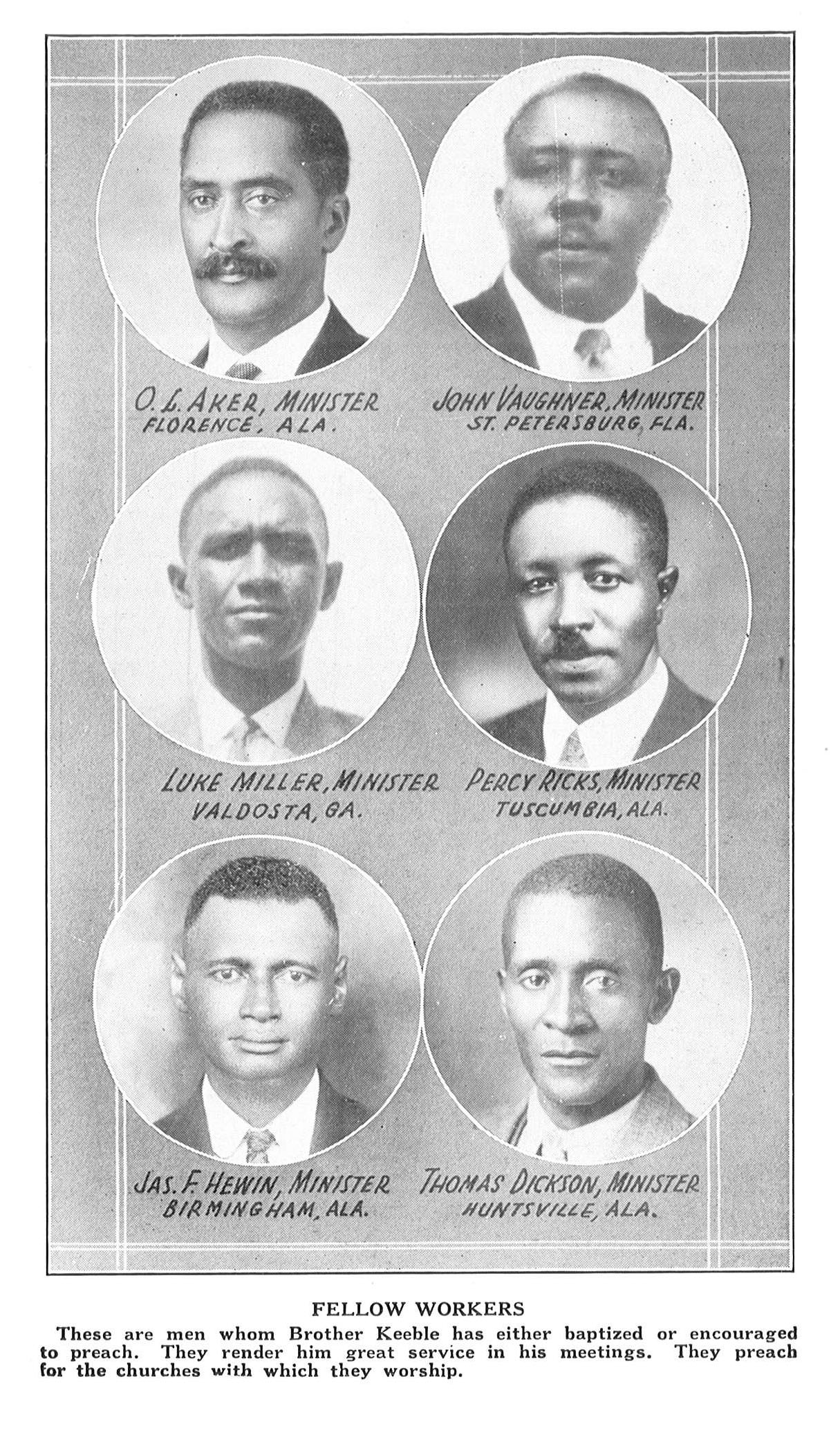
1931 photographs of men Marshall Keeble either baptized or encouraged to preach. B. C. Goodpasture, ed., “Biography and Sermons of Marshall Keeble, Evangelist” (Nashville: Gospel Advocate Company, 1931), 24-25.

Luke Miller was born March 16, 1904 in Limestone County near Belle Mina, Alabama. In 1923 he married Mattie Lee Ballentine who was a great encouragement to him during his ministry. Another influence in Miller’s life was Marshall Keeble, who baptized him in Decatur, Alabama.  Keeble became a father-like figure in Miller’s life. A few years later, after extensive preparation, Miller was ready to give his first sermon. The sermon, which Miller estimated would be 30 minutes, was given at a meeting conducted by Mr. Keeble. However, the excitement of the audience in Florence, Alabama led Miller to preaching his first sermon in three minutes. Miller spent a large amount of time in revival meetings with Mr. Keeble.
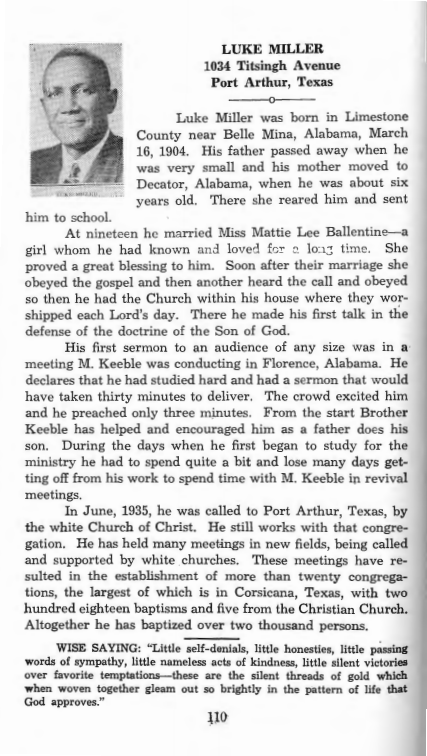
Tuggle, Annie C., “Our Ministers and Song Leaders of the Church of Christ” (1945). Stone-Campbell Books. 238.


The white Church of Christ in Port Arthur, Texas asked Miller to serve in their church in June of 1935 to preach a series of meetings to the African-American community of Port Arthur. Over his years of service in the Churches of Christ Miller baptized approximately 10,000 people. After one gospel meeting in Corsicana, Texas he baptized 216 people. In 1940 he published a collection of his sermons titled Miller’s Sermons which explores topics from dancing to baptism by immersion.
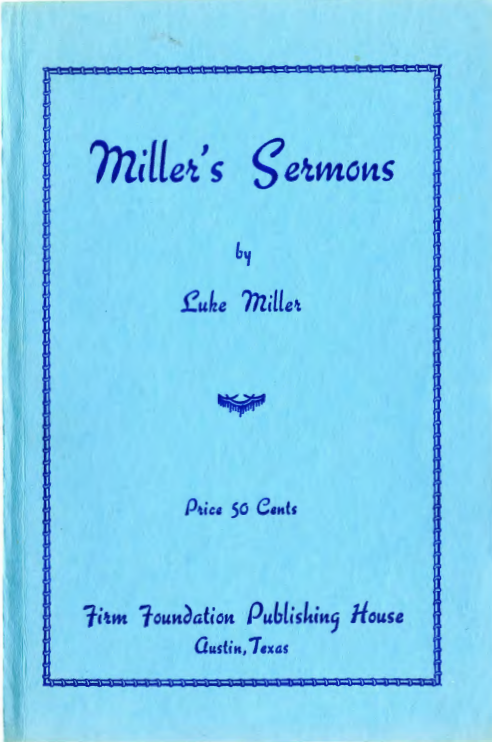
Miller, Luke, “Miller’s Sermons” (1940). Stone-Campbell Books. 126.

Miller served churches in Valdosta, Georgia, Paris, Texas, St. Petersburg, Florida, and Port Arthur, Texas. Luke Miller died in his home on February 1, 1962 at age of 57 of a heart attack.

Works cited:

Find A Grave, database and images (https://www.findagrave.com : accessed 18 April 2018), memorial page for Luke Miller (16 Mar 1904–1 Feb 1962), Find A Grave Memorial no. 72982977, ; Maintained by Tom Childers (contributor 46515204) Unknown.

Miller, Luke, “Miller’s Sermons” (1940). Stone-Campbell Books. Book 126.

Tuggle, Annie C., “Our Ministers and Song Leaders of the Church of Christ” (1945). Stone-Campbell Books, page 110.

This Just In: The William Douglass and Charline F. Gunselman Papers Now Open for Research

Brady Cox is a graduate student who is completing an MA in church history. He has worked in Special Collections since January 2016. He joins us today to talk about a collection he recently processed.

We have recently organized and completed a finding aid for the William Douglass & Charline F. Gunselman Papers. This collection represents the activities of the Gunselman family while they served as missionaries in Manila, Philippines (1964-1972). This collection includes Gunselman’s correspondence with American churches and financial supporters, Filipino church leaders, and other missionaries in the Philippines and Southeast Asia (1962-1972). There are meeting minutes, financial information, and student records from the Philippine Bible College in Quezon City (1965-1972). The collection additionally includes surveys, research, and edited drafts of materials for Gunselman’s Ed.D. dissertation, “Status of the Ten Evangelical Bible Colleges in the Philippines with a Proposed Program for their Improvement,” which he received from Manuel L. Quezon University (1971).

Before becoming a missionary, William Douglass Gunselman taught in Florida and Pennsylvania and worked with churches in Arkansas, Florida, Maryland, New Mexico, North Carolina, and Pennsylvania. While in the Philippines, Gunselman was instrumental in leading the educational efforts of the Churches of Christ in Manila. He started the Philippine Bible College of Quezon City and served as its director from 1965-1971. The school sought to train Filipino preachers and church leaders. The Gunselman’s efforts to train Filipino preachers occurred during the peak of postwar missionary activity among Churches of Christ. While their efforts with the school were not particularly unique among other Churches of Christ missionary endeavors, this collection provides archival evidence of a phenomenon (i.e., the creation and use of schools to train ministers) that occurred among Churches of Christ missionary efforts which has been noted, but has not been thoroughly researched.

Student leading singing while Gunselman (right) observes. William Douglass & Charline F. Gunselman Papers, 1942-2009, MS #389, Box 6, Folder 21, Center for Restoration Studies, Abilene Christian University.

There are also materials related to the Churches of Christ in Florida from when the Gunselmans lived in Florida before moving to the Philippines. Gunselman was involved with the Central Florida Bible Camp and he worked at the Christian Home and Bible School (Mount Dora, Florida). He compiled information for and produced a directory of the Churches of Christ in Florida in 1962. The directory includes a list of churches and a list of preachers, and this master copy includes Gunselman’s notes. The Gunselmans received much of their financial support from churches in Florida (including Concord Street Church of Christ and Sanford Church of Christ), and Gunselman often corresponded with friends and church leaders in Florida. Therefore, there is a significant amount of correspondence with church leaders in Florida.

This collection provides unique insight into Churches of Christ mission work in the Philippines following World War II, offers Filipino perspectives and voices through letters sent to Gunselman by church leaders and students, and includes research concerning Protestant Bible colleges in the Philippines. The Florida materials are intriguing as well, and provide a look into the context of the Florida churches during the 1960s and early 1970s.

For more information, please contact Special Collections Librarian and Archivist, Mac Ice, at mac.ice@acu.edu.


Picture This: Edwards Hall

Jackson Hager is a senior history major from Austin, Texas who hopes to go on to graduate school for public history or archival studies. Jackson has been a student worker in Special Collections for several years and joins us as a guest blogger today as we continue our series on dormitories throughout the years at ACU.

For many young men following in the footsteps of their fathers by attending ACU, spending their first two years on campus in the same dorms where their fathers lived has become somewhat of a tradition on campus. I followed in that tradition with my father, uncles, and cousins. Ever since its founding in 1955, Edwards Hall has remained a place of memories and stories for the generations of young men who have dwelled within its walls.

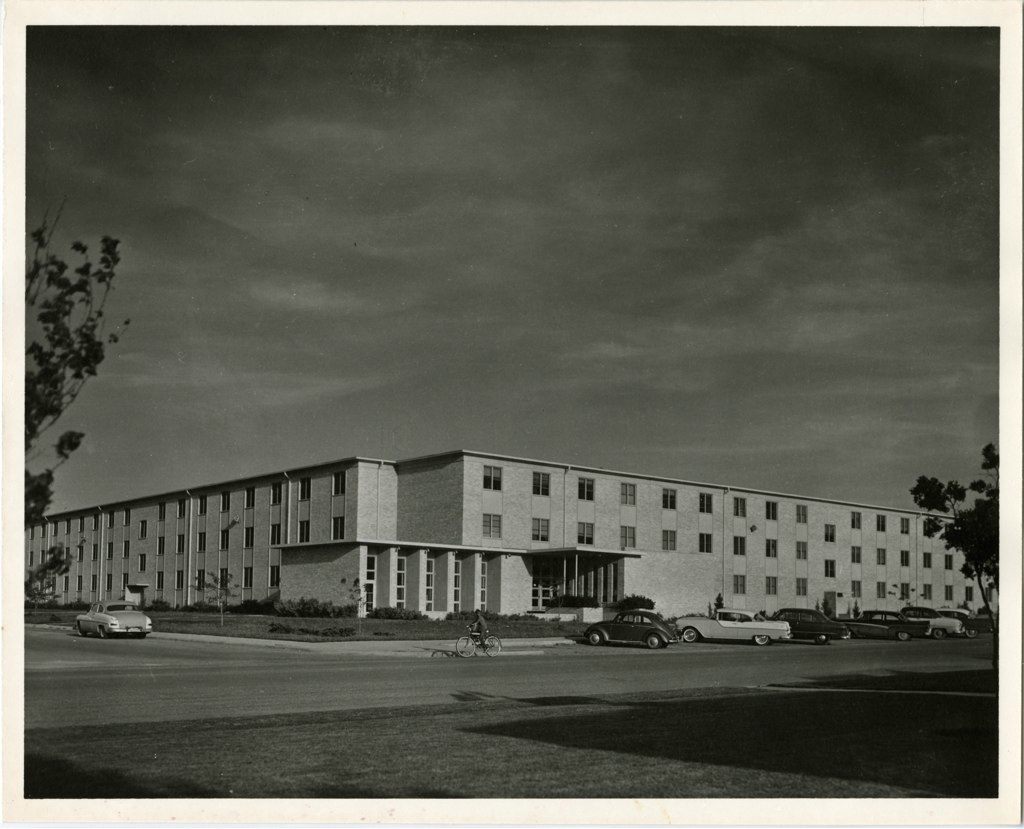
Photograph of Edwards Hall from the front and right side. From the Sewell Photograph Collection.

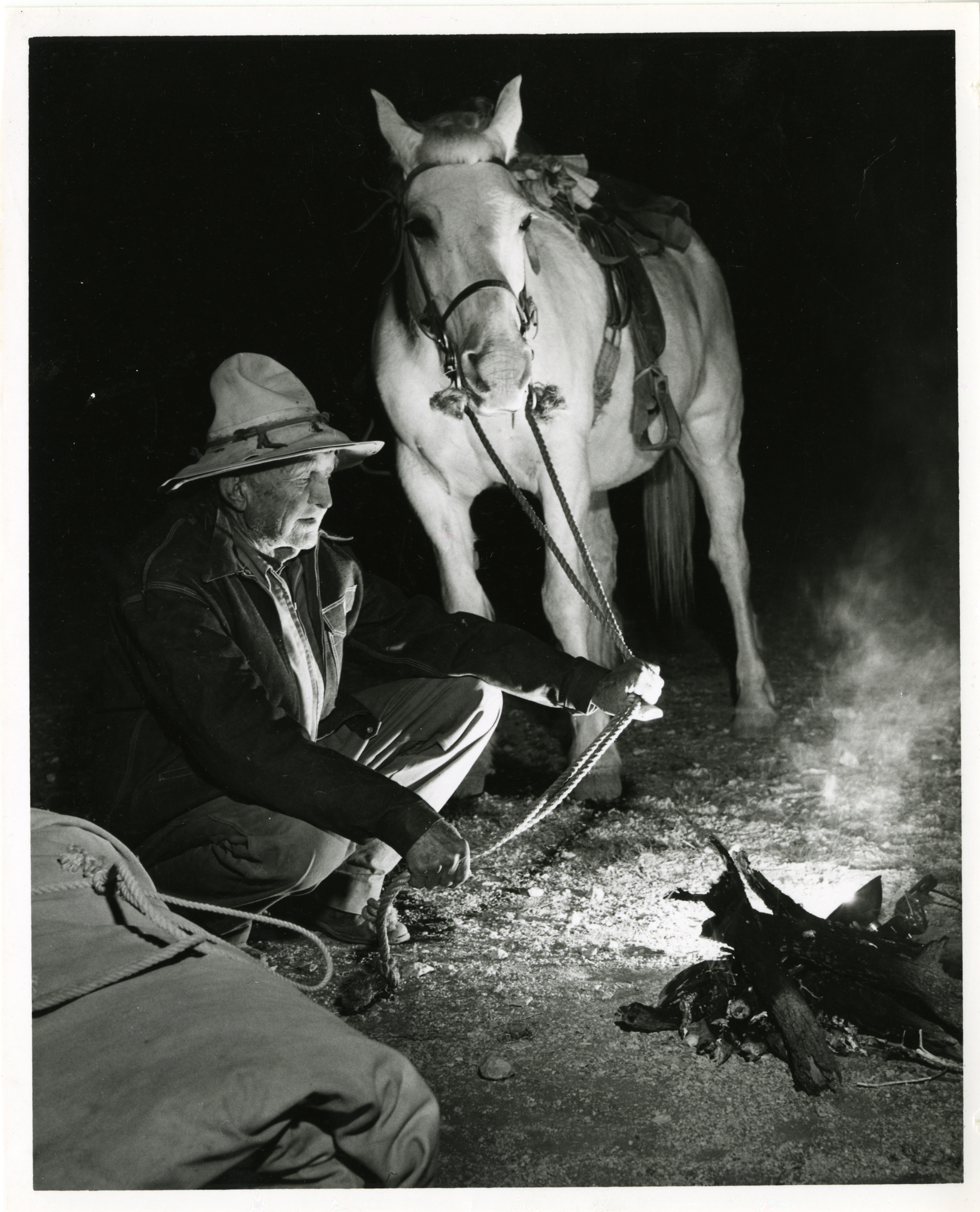
Before 1955, young male students had few options for places to live on campus. Before the university’s move to today’s location in 1927, men could find local houses or apartments to live in while students. In the 1930’s McDonald Hall was built to house the growing number of young men. In the later years, married men were able to take up residence in the Hutments, north of McKinzie Hall. In 1952 Mabee Hall was constructed. And finally, in 1955, Edwards Hall was constructed, thanks in part to the donations of land and money from famed Texas rancher William Edwards.

William Edwards and a horse by a campfire on Edwards’ ranch. From the Sewell Photograph Collection.

The construction of Edwards Hall was a part of a larger burst of expansion on Abilene Christian College’s campus, which included Catching Cafeteria, Nelson Hall for women, and the much beloved Bible Building. The quality of the facilities were well-known with spacious rooms, beautiful outdoor areas to grill, and according to 1979-1980 ACU Catalog, air-conditioning. All these features lead to cost of living in Edwards Hall for the 1979-1980 school year to be $209. Mabee, on the other hand, only cost $189 due to the lack of air conditioning. Despite all the changes that have come to the campus of Abilene Christian University, life in Edwards Hall remains relatively the same. Young men study, laugh, pull pranks, grow together spiritually, and continue to contribute to the wonderful culture that exists here on campus. Edwards Hall may seem like only a building, but it is so much more that. It has a place where ACU history is made, and where friendships are formed for a lifetime.

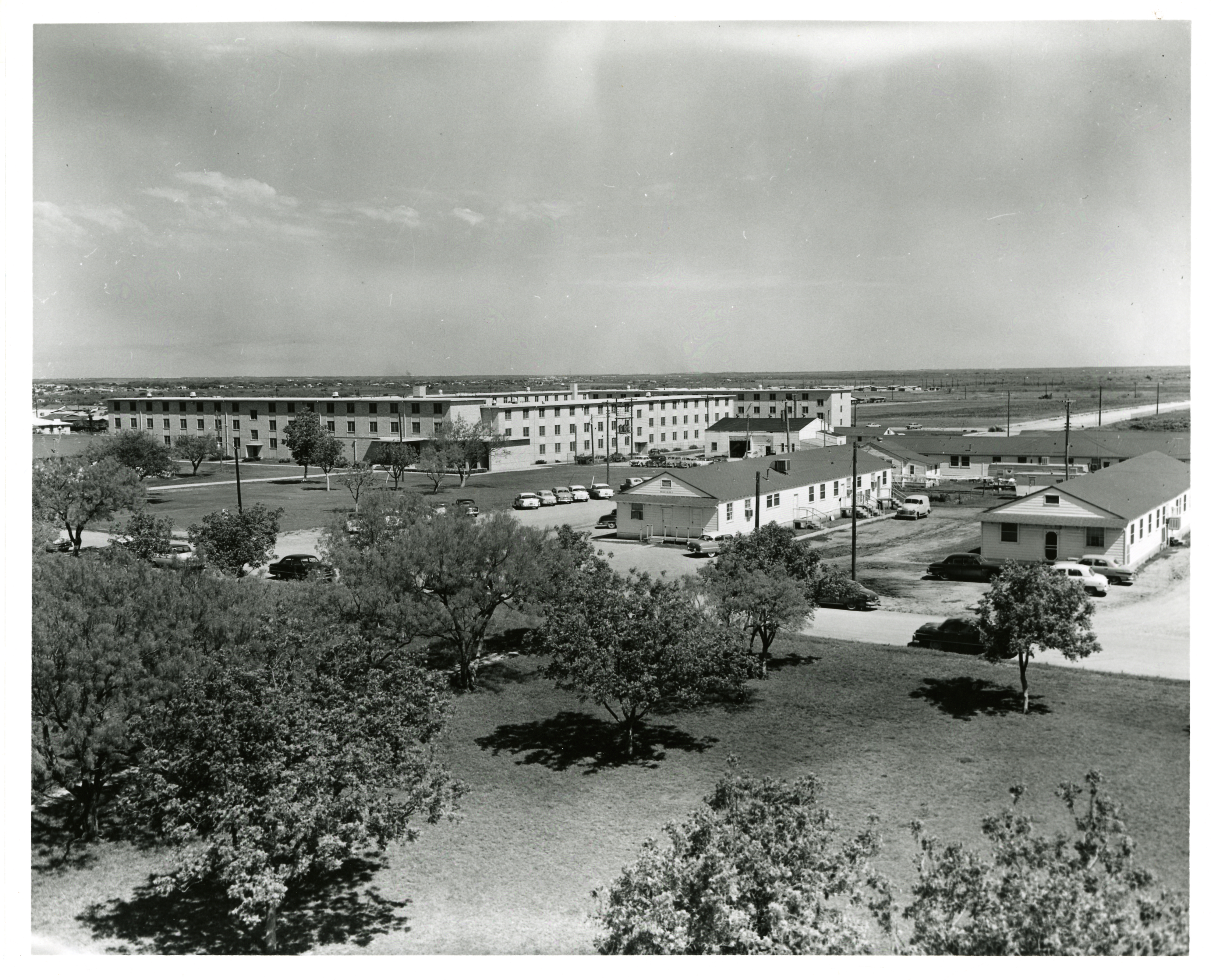
View of the Abilene Christian College campus from the roof of McKinzie dormitory. The “L” shape of Edwards Hall is visible in the upper left of the photograph. From the Sewell Photograph Collection.