Tradition and Transformation: Worship Evolution at Abilene Christian University

In Spring 2026, Dr. Laura Carroll’s ENGL 325: Advanced Composition students were challenged to engage Special Collections broadly, and, more specifically, with the hymnal collection. Each student wrote a research paper on a topic inspired by the hymnal collection. Their research included databases, interviews, library print resources, and data collection. Today we welcome ACU student Ashlyn Anderson to the blog. Read on to learn more about her research. 


My research project explored the evolution of worship practices at Abilene Christian University and asked the question: how did a university so deeply rooted in a cappella tradition begin incorporating instrumental and blended worship services? I was interested in understanding whether this change represented a rejection of traditional Church of Christ beliefs or a response to changing student expectations over time. Through my research, I found that the shift was gradual and heavily influenced by media exposure, contemporary Christian culture, and the increasing diversity of students coming to campus from different religious backgrounds.

To answer this question, I used a combination of theological texts, historical studies, university lectures, and archival student newspaper articles. One of my main sources was The Instrumental Music Issue by Everett Ferguson, which explained the biblical reasoning behind a cappella worship traditions in Churches of Christ. I also examined historical studies about the interpretation of Ephesians 5:19 and speeches by Jeff Nelson and George Bailey discussing worship changes at ACU. One of the most interesting parts of my research was reading archived issues of The Optimist, where students publicly debated instrumental worship over several decades.

What surprised me most was how emotional and divisive the debate became among students. Earlier articles from the 1980s showed strong resistance to instrumental worship, with many students arguing that instruments lacked biblical authority. Other students defended instrumental worship by pointing to scripture and arguing that worship practices could evolve. By the late 2000s and early 2010s, however, student perspectives had shifted noticeably. Many students viewed blended worship as more inclusive and welcoming to people from different church backgrounds, and some believed it helped ACU remain relevant to modern students.

Ultimately, my research showed that ACU’s worship evolution reflects a balance between preserving tradition and adapting to cultural change. Rather than abandoning its heritage, the university expanded its worship practices to create a more inclusive spiritual environment while still honoring its historical identity.


Thank you, Ashlyn, for sharing your research with us. We’ll be back soon to highlight more student research inspired by our hymnal holdings. 
Restoration Day 2025

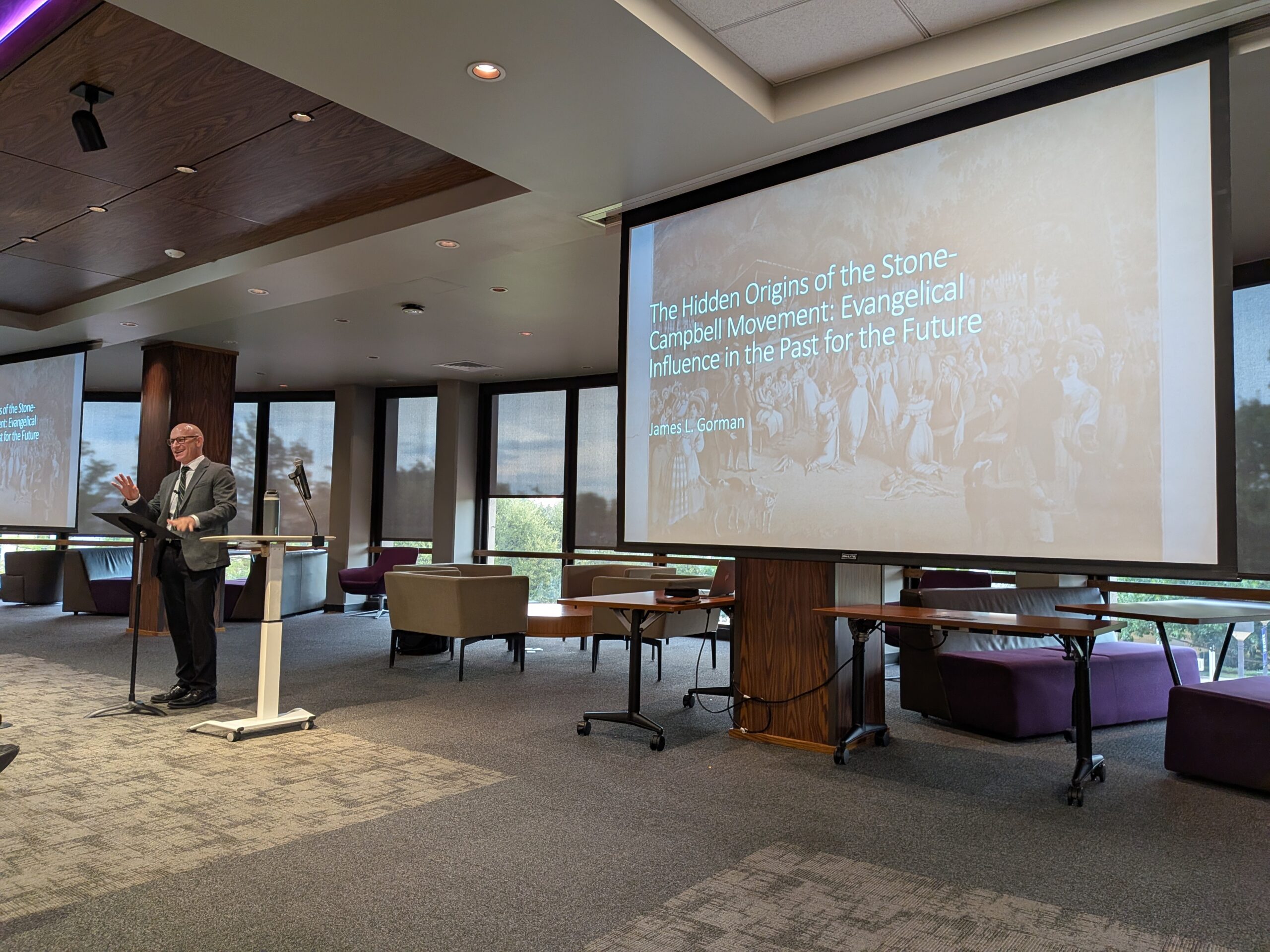
This year’s Restoration Day was held at the ACU Library on September 29th in the Packer Forum.

Hosted by the Center for Restoration Studies (CRS), the featured speaker for 2025 was Dr. James Gorman, who was recently appointed as the new CRS Director following Dr. Wes Crawford. Dr. Gorman’s areas of research include the history of Christianity, Stone-Campbell Movement history, race and Christianity in American history, and the history of Bible interpretation. He has published three books including a third edition of Reviving the Ancient Faith.

Dr. Gorman gave two lectures titled, “The Hidden Origins of the Stone-Campbell Movement: Evangelical Influence in the Past for the Future” and “What Has Alexander Campbell to Do with Christian Nationalism?”

You can watch the lectures below or go to our Restoration Day Lectures collection to see videos from current and previous years.


Finding Aid Round Up

Today’s blogpost is by Sidney Irwin. Sidney is a Master’s of Library Science student at the University of North Texas who is getting a general studies degree and a graduate certificate in archival management. Sidney is an Abilene, TX native who earned a Bachelor of Arts in English from Abilene Christian University.

We’ve been busy writing finding aids for recent acquisitions and revising finding aids for sets of papers already in our holdings. You can browse all of our collections on DigitalCommons. See something below that piques your interest or could be useful for your research? Get in touch and let us know what you’re thinking about; we’d love to help!


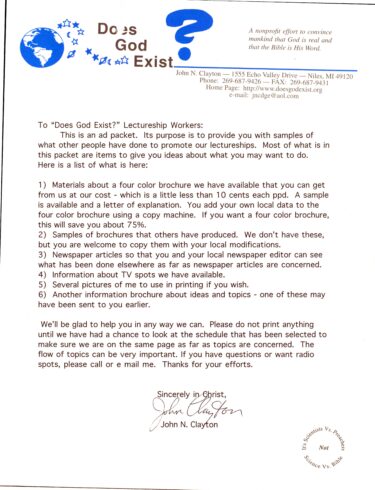
John Clayton Papers, 1977-1990, MS#208 [Revised Finding Aid]

John Clayton was originally an atheist, part of the atheist group that made Madeline Murray O’Hair famous. In his work writing a book called All the Stupidity of the Bible he became convinced of Christianity. He is a retired teacher and geologist with multiple accolades in the field of teaching. He now travels the U.S. doing lectures on “Does God Exist?” This collection consists of materials from the “Does God Exist” ministry, including correspondence, written material, DVDs, and tapes. 

“Does God Exist?” ad packet letter, John N. Clayton Papers, 1977-1990. Center for Restoration Studies MS #208. Abilene Christian University Special Collections and Archives, Brown Library. Abilene Christian University, Abilene, TX.

Tom Tune Papers, 1960s-2006, MS#542 [Revised Finding Aid]

Tom Tune was a long-term missionary in Asia and the South Pacific, before which he did work in South America and the Mediterranean. He also served as The Christian Chronicle’s business manager for two years following when he and several church members acquired the publication and moved it to Tennessee. This collection consists of one reel-to-reel tape and one folder from the life and work of Tom Tune relating to Elizabeth Barnard, a Chinese missionary whom he wrote a book about. 

Michael Ervin Sadler Papers, 1970-2021, MS#580 [New Finding Aid]

Physicist Michael Ervin Sadler taught at Abilene Christian University for 40 years and was a pioneering faculty in the field. He received the American Physical Society’s Prize for Research in an Undergraduate Institution (1995), as well as two Fulbright Scholarships to conduct research in Russia (2002-03) and Bosnia (2010-11). He was fluent in Russian, which helped him to form research collaborations and connections abroad and host Russian scientists at ACU for guest research. He was a mentor for undergraduate work and also participated in community outreach organizations in a volunteer leadership capacity. This collection consists of one box of materials documenting Michael Sadler’s work as a physicist. 

George Willis Bailey Papers, 1937-2005, MS#592 [New Finding Aid]

George Willis Bailey was an influential preacher serving churches in Oklahoma, New York, New Mexico, and Texas. He also did traveling ministry work across the U.S and abroad. He was also a regular speaker on Herald of Truth radio and television for three years as well as a staff writer for three Christian publications and an author. The Bailey papers contain sermon notes and materials reflective of the breadth of his preaching career. It also contains materials collected by or presented to Bailey. Most of the materials are paper-based, but there are a number of cassette tapes and other media types. 

Kenneth Rufus Badgett Papers, 1954-1981, MS#599 [New Finding Aid]

Kenneth Rufus Badgett preached among Churches of Christ in DeQuincy, Louisiana, and Port Arthur, Texas. He was married to Lula Mae Starnes, sister of Trine Starnes. This collection contains one box of papers from Kenneth Rufus Badgett, consisting of sermon notes and notes about subjects preached or not preached.


Stay tuned for more installments of Finding Aid Round Ups!