Picture This: Daisy Hall

This post is part of our ongoing series featuring photographs from our collection. Explore more of our digitized photos (and other items) over on Digital Commons @ ACU

As students arrive on campus this fall, we’re taking a look back at dorm life through the years at Abilene Christian University, starting off with Daisy Hall. Don’t recognize that name from a recent walk around campus? That’s because Daisy Hall was located at the Childers Classical Institute (and then in 1917 the newly renamed Abilene Christian College) campus on North 1st street near the center of Abilene.
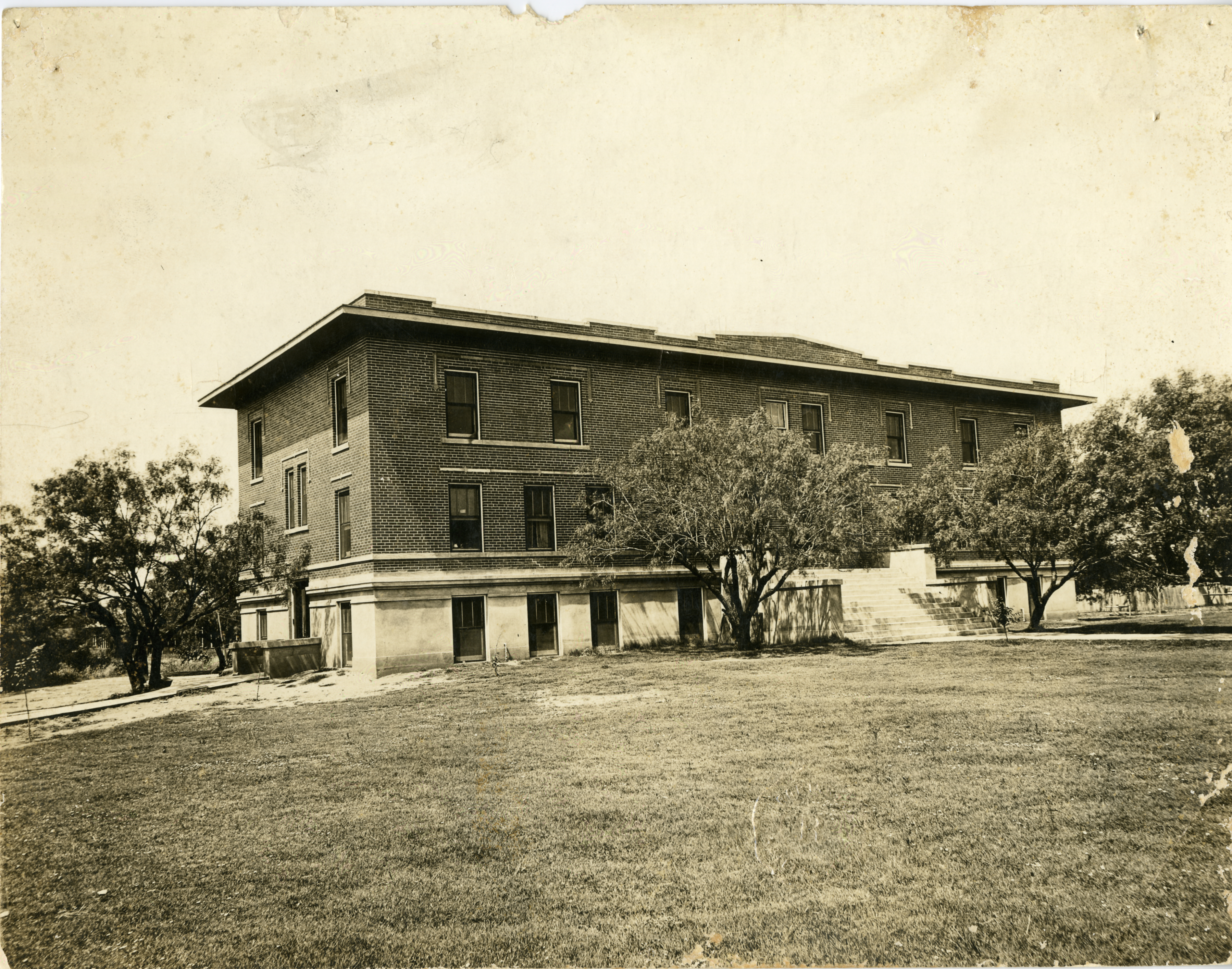
Daisy Hall on the Abilene Christian College campus, circa 1914-1915. The new sidewalk pictured was built by the Zellner Literary Society as a memorial at the end of the 1914-1915 school year. From the Sewell Photograph Collection.

Named in honor of President Jesse P. Sewell’s wife Daisy Sewell, Daisy Hall served many purposes on the growing campus. The 1915-1916 Catalog of Abilene Christian College described Daisy Hall:

This is a three story brick structure, modern and first class in every respect. It is heated with steam and lighted with electricity. There are baths, with hot and cold water on each floor. Each floor has completely equipped toilet rooms. Each room has individual clothes closets and a lavatory with running water. Most of the rooms are furnished with single beds, and all of them with nice dressers, tables, chairs, etc. The reception parlor, library and dining room are decorated with Sister Sewell’s beautiful oil, pastel and water color pictures, and hand painted china. The library contains Brother Sewell’s excellent collection of more than six hundred books. 

Brother and Sister Sewell live in the building, with other members of the faculty, and give their very best thoughts and efforts to making it a pleasant and wholesome home for all girls who are trusted to their care.
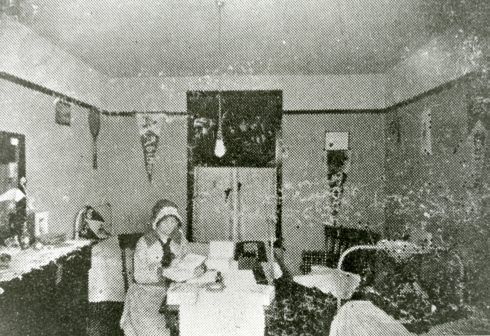
Photograph of a student reading in a Daisy Hall bedroom, circa 1915-1916. From the Sewell Photograph Collection.
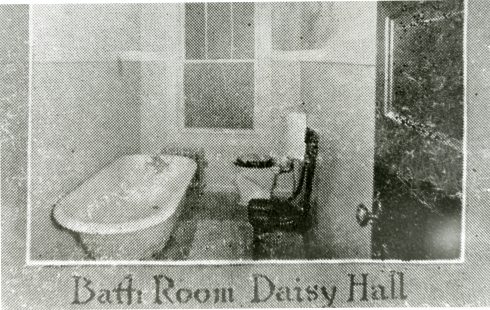
Daisy Hall bathroom, circa 1915-1916. From the Sewell Photograph Collection.
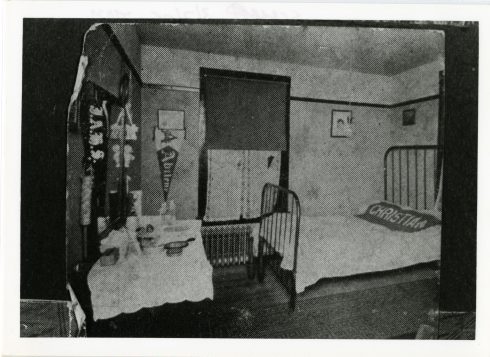
Daisy Hall bedroom, circa 1915-1916. From the Sewell Photograph Collection.

According to the 1919-1920 Catalog of Abilene Christian College, board in Daisy Hall ranged from $59-$75 per semester, depending on the term and if you preferred a north room or a south room. For comparison, tuition for the same academic year ranged from $22.50 for the winter term all the way up to $27.50 for the fall term.
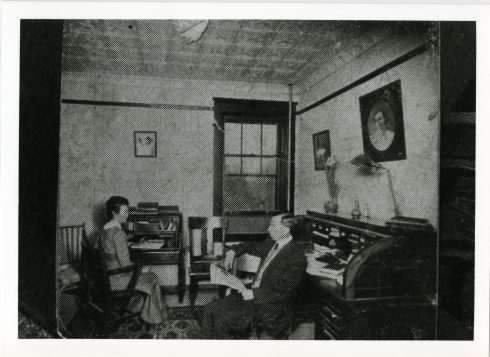
The administration office in Daisy Hall, circa 1915-1916. From the Sewell Photograph Collection.
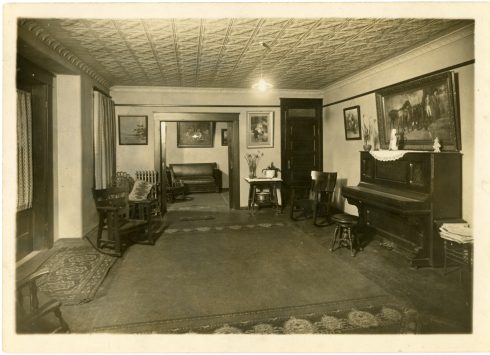
Parlor of Daisy Hall, circa 1919. The photograph was taken from Carrie Acuff Brasher’s scrapbook and is part of the Sewell Photograph Collection.
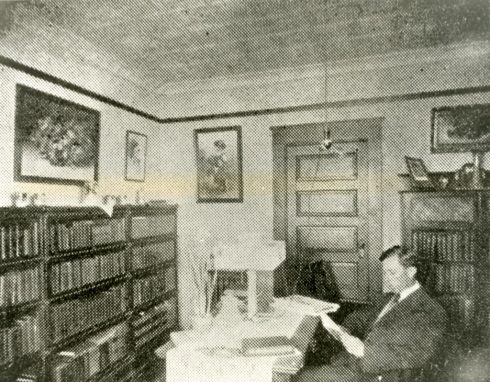
The Library in Daisy Hall, circa 1915-1916. President Jesse Sewell is pictured reading a book. From the Sewell Photograph Collection.

The same 1919-1920 catalog provides a glimpse into the daily schedule of the residents of Daisy Hall:

6:30-7:00__ Arise and arrange rooms.

7:00-8:00__Breakfast.

8:00-10:00__Study and recitations.

10:00-10:30__Chapel.

10:30-12:30__Study and recitations.

12:30-1:30__Lunch.

1:30-3:30__Study and recitations.

3:30-6:00__Exercise.

6:00-7:00__Dinner.

7:00-10:30__Study.

Daisy Hall was used until the ACC campus moved to its current location in 1929.

Are you interested in the history of a particular ACC or ACU dormitory? If so, find us on Twitter (@DISCAatACU) and let us know! 

Picture This: Ibaraki Christian College Ping Pong Champs

August 4, 2017 Abilene Christian University Special Collections staff participated in the US National Archive’s Twitter Hashtag Party. The featured hashtag for the party was #ArchivesSquadGoals. We brought to the party this 1953 photograph of the “Ping pong champs” at Ibaraki Christian College and queried if anyone was up for a match:

The US National Archives quickly put the ball back in our court with this tweet:

Be sure to check out Twitter on September 1 to see what the National Archives has going on for the next Archives Hashtag Party! To see more photographs from Ibaraki Christian College, search the ACU Digital Commons page here.

Digital collection of Stone-Campbell books now features over 300 items

The Stone-Campbell and associated movements from their beginning harnessed the power of the printing press to advocate for religious freedom and theological reform. James O’Kelly in Virginia and North Carolina, Abner Jones and Elias Smith in New England and the Mid-Atlantic states, Barton W. Stone in Kentucky and Tennessee, and Thomas and Alexander Campbell with Walter Scott across the Ohio Valley and the Western Reserve employed a steady stream of published tracts, periodicals and books to advance their causes.  Center for Restoration Studies holds thousands of such items.

Total Depravity, a Review of S. A. Paine’s Book, by W. T. Kidwill. Published by Firm Foundation in Austin, Texas, 1909. Worldcat shows only one other known copy.

A few weeks ago we passed a small milestone for our growing online digital collection of Stone-Campbell Movement books, tracts and pamphlets.  Housed at digitalcommons.acu.edu, the collection now holds 329 published items by, from or about these movements, their leaders, shapers, adherents, principles, and values. Each item is available in full-text PDF download and the site is searchable in a number of ways.

The quantity, though, is relatively a minor milestone.  When celebrating a milestone, we gravitate towards numbers like 100, 500 or 1000…not 300.  But reaching this point gives me an opportunity to stress the qualities of this collection rather than celebrate a quantity (be it 300 or 30,000) for its own sake.

We launched this series realizing many Stone-Campbell books are already available on the web, particularly through archive.org, hathitrust.org and Google books.  So we knew right off the bat it was unwise to steward our resources by scanning items that already exist digitally elsewhere.  Instead, I set these goals to guide selection of items for digitization: we want to curate items that 1) are relevant for historical inquiry into the thought and activity of the movement worldwide; 2) unavailable elsewhere online; 3) are held in hard copy by only a few institutions (at least so far as can be known through Worldcat.org); and 4) reflect a wide representation of the movement.

Our goal is to serve scholarship (whether conducted in the academy or for the sake of the church) by preserving and providing excellent sources.  Hosting these materials online, for free, for any and all users, is one way to fulfill this mission.

Here are the most recent additions:

“Directory of Churches of Christ in the Northeast” (1969) 

C. A. Norred, The Bible Teacher: A Training Course For Bible Teachers” 

W.T. Kidwill, Total Depravity by W.T. Kidwill: A Review of S.A. Paine’s Book” 

H. T. Morrison,Twelve Reasons Why I Stand Identified With The People Known As Disciples Of Christ” 

Charles H. Roberson,Spiritual Depression”  

J. Harvey Dykes,The Kingdoms of the World”  

Guy N. Woods,The Menace of the Movies” 

Elbridge B. Linn, The Gods of “Christianity

Elbridge B. Linn,The Obedience of Faith” 

Elbridge B. Linn,The One Faith and The Creeds of Christendom” 

H. Leo Boles, The Second Coming of Christ and “The Millennium

Norman Davidson, A Christian Business Man Writes His Brethren”